
Dagstuhl Seminar 25201
Computational Geometry
( May 11 – May 16, 2025 )
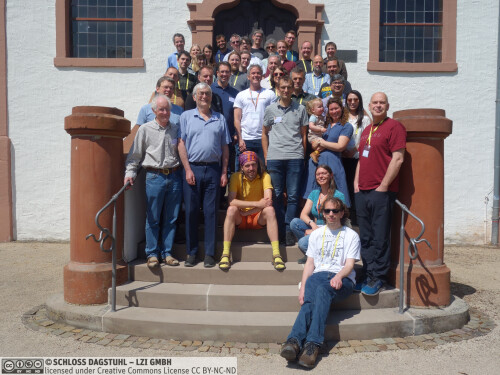
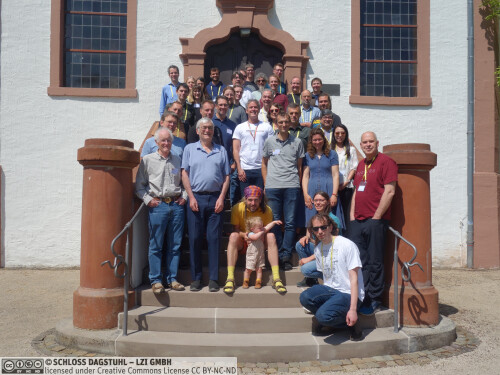
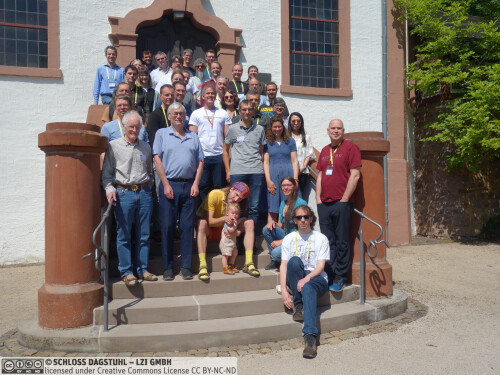
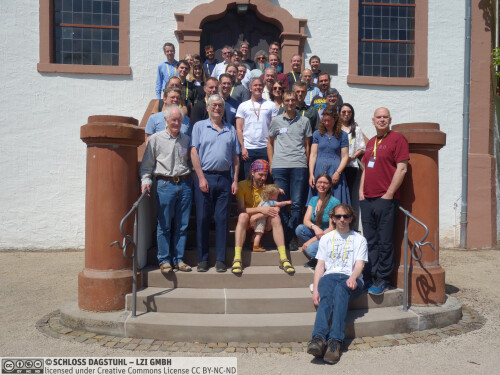
(Click in the middle of the image to enlarge)
Permalink
Please use the following short url to reference this page:
https://www.dagstuhl.de/25201
Organizers
- Maarten Löffler (Utrecht University, NL)
- Eunjin Oh (POSTECH - Pohang, KR)
- Jeff M. Phillips (University of Utah - Salt Lake City, US)
Contact
- Michael Gerke (for scientific matters)
- Simone Schilke (for administrative matters)
Schedule
This Dagstuhl Seminar constituted a biennial gathering of computational geometers and topologists at the Dagstuhl venue to share recent results, and further research on some of the most important problems of the time in this field. This year the seminar focused on two central challenges within computational geometry and topology: (1) the emergence of parameterized algorithms, and (2) the interaction between implementation and theory in geometry. Within the parameterized algorithms theme, two enlightening overview talks were given. The first was on parameterized techniques in computational geometry, focusing on clustering, covering, and geometric intersection graphs. The second was on parameterized complexity and its role in geometric topology, focusing on triangulated topological manifolds. The second theme on the interplay between implementation and theory covered a broader set of topics from motion planning to persistence homology to geometric software engineering to geometric topology software to non-metric high-dimensional geometries to using Haskell for low-dimensional geometry. A highlight was a panel discussion on the state of the challenges of promoting implementation-driven research in a field dominated by primarily theoretical results. Finally, an open problem session promoted a variety of intriguing unsolved issues in the field; many are stated within the full Dagstuhl Report. These problems occupied many of the participants throughout the week as they were interrogated in small working groups. Some research resolution during the week, and we expect others to lead to publications soon after.
Changes to the Lottery
The Computational Geometry Dagstuhl Seminar series is the longest-running series of Dagstuhl seminars, starting in 1990 with Dagstuhl Seminar 9041 (see Dagstuhl Seminar 9041) and the current seminar 25201 being its 19th iteration.
In 2013, the organizers of Dagstuhl Seminar 13101 introduced a lottery to select participants. The reason for this was that a steadily growing number of established names in the community being invited each time limited access for more junior researchers to this series. While this is not necessarily a bad thing and is indeed a sign of a healthy and expanding community, the organizers felt this conflicted with Dagstuhl's unique opportunity for junior and senior researchers to interact. They reported in 2013:
We believe that the lottery created space to invite younger researchers, rejuvenating the seminar, while keeping a large group of senior and well-known scholars involved. The seminar was much “younger” than in the past, and certainly more “family-friendly.” Five young children roaming the premises created an even cosier atmosphere than we are used in Dagstuhl. Without decreasing the quality of the seminar, we had a more balanced attendance than in the past. Feedback from both seminar participants and from researchers who were not selected was uniformly positive.
Since 2013, the lottery has been used each time to select most of the participants. Over time, though, the task of maintaining an accurate list of "the community" has proven challenging, and through its lack of transparency the series also acquired some mystery, specifically surrounding the questions how one enters the lottery.
This year, we have for the first time not used the hand-curated list, and instead automatically generated a list of names as input to the lottery. Here we report on how the lottery was run this year.
A large Dagstuhl Seminar has space for about about 45 participants. The organizers reserved 10 seats for hand-selected invitees based on the chosen themes for the seminar. The remaining 35 seats were selected through the lottery.
The organizers have used DBLP's SparQL interface DBLP’s SparQL interface to generate a list of names to enter the lottery. The query used this year was:
“all people who have at least 3 publications in SoCG, of which at least 1 appeared in the last 5 years”.
From this list, a weighted random selection was made, taking into account Dagstuhl's requirements on geographical and gender diversity, the themes of the seminar, and invitations to previous Dagstuhl Seminars.
 Creative Commons BY 4.0
 Maarten Löffler, Eunjin Oh, and Jeff M. Phillips
Computational geometry is concerned with the design, analysis, and implementation of algorithms for geometric and topological problems, which arise naturally in a wide range of areas, including computer graphics, CAD, robotics, computer vision, image processing, spatial databases, GIS, molecular biology, sensor networks, machine learning, data mining, scientific computing, theoretical computer science, and pure mathematics. Computational geometry is a vibrant and mature field of research, with several dedicated international conferences and journals and strong intellectual connections with other computing and mathematics disciplines.
The emphasis of the Dagstuhl Seminar is on presenting recent developments in computational geometry, as well as identifying new challenges, opportunities, and connections to other fields of computing. In addition to the usual broad coverage of new results in the field, the seminar will include broad survey talks with a special focus on two areas. The first is on parametrized algorithms in geometry and topology, and the second is on theoretical questions arising in Implementing Geometric Algorithms.
Parametrized Algorithms in Geometry and Topology
Certain algorithmic problems arising in geometric and topological settings seemed to be computational intractable, i.e., requiring exponential time in the worst case. However, yet in many cases they were often seemingly solvable more efficiently in practice. In the past several years, the community has started to develop a clear theory for how and when this can happen. Parametrized algorithms consider some parameter in the size of the solution (e.g., number of outliers, or topological features) and isolate the large (e.g., exponential) complexity in terms of only this component. This perspective has revitalized many core problems for which it had seemed no useful analysis was possible. By considering this recent progress on challenges in geometry and topology, we hope to reveal many more places where this perspective can be applied.
Theoretical Questions Arising in Implementing Geometric Algorithms
The interplay between theoretical algorithmic analysis, and the implementation of those algorithms has been a recurring pattern in computational geometry and topology. By actually implementing algorithms, it has revealed brushed over issues such as degeneracies or hidden constants or poor cache coherence. The identification of these implementation challenges has in turn driven the algorithmic modeling and design side of the community to refocus their efforts on managing these issues. And this has in turn led to impactful new theoretical results. This interaction is needed now more than ever as geometric algorithms are designed for applications in data analysis, robotics, physical modeling, and geographic information systems; yet there are sometimes hidden barriers keeping these designed algorithms from being widely adopted. This topic will aim to help identify ways that computational geometers and topologists can tune theoretical frameworks to adhere better to practical implementation demands.
Participants
Dagstuhl Seminars on computational geometry have been organized in a two year rhythm since a start in 1990. They have been extremely successful both in disseminating the knowledge and identifying new research thrusts. Many major results in computational geometry were first presented in Dagstuhl Seminars, and interactions among the participants at these seminars have led to numerous new results in the field. These seminars have also played an important role in bringing researchers together, fostering collaboration, and exposing young talent to the seniors of the field. They have arguably been the most influential meetings in the field of computational geometry. The organizers hold a lottery to create space to invite less senior researchers, while keeping a large group of senior and well-known scholars involved.
Maarten Löffler, Eunjin Oh, and Jeff M. Phillips
- Oswin Aichholzer (TU Graz, AT) [dblp]
- Sayan Bandyapadhyay (Portland State University, US) [dblp]
- Benjamin Burton (The University of Queensland - Brisbane, AU) [dblp]
- Otfried Cheong (Universität Bayreuth, DE) [dblp]
- Mark de Berg (TU Eindhoven, NL) [dblp]
- Jeff Erickson (University of Illinois - Urbana-Champaign, US) [dblp]
- Fedor V. Fomin (University of Bergen, NO) [dblp]
- Robert Ganian (TU Wien, AT) [dblp]
- Marc Glisse (Inria - Orsay, FR) [dblp]
- Joachim Gudmundsson (The University of Sydney, AU) [dblp]
- Dan Halperin (Tel Aviv University, IL) [dblp]
- Michael Hoffmann (ETH Zürich, CH) [dblp]
- Kristóf Huszár (TU Graz, AT) [dblp]
- Phillip Keldenich (TU Braunschweig, DE) [dblp]
- David G. Kirkpatrick (University of British Columbia - Vancouver, CA) [dblp]
- Francis Lazarus (CNRS - Grenoble, FR) [dblp]
- Jim Little (University of British Columbia - Vancouver, CA) [dblp]
- Maarten Löffler (Utrecht University, NL) [dblp]
- Gert Meijer (NHL Stenden Hogeschool - Leeuwarden, NL)
- Fabrizio Montecchiani (University of Perugia, IT) [dblp]
- Ian Munro (University of Waterloo, CA) [dblp]
- André Nusser (INRIA - Sophia Antipolis, FR) [dblp]
- Eunjin Oh (POSTECH - Pohang, KR) [dblp]
- Yoshio Okamoto (The University of Electro-Communications - Tokyo, JP) [dblp]
- Jeff M. Phillips (University of Utah - Salt Lake City, US) [dblp]
- Valentin Polishchuk (Linköping University, SE) [dblp]
- Raimund Seidel (Universität des Saarlandes - Saarbrücken, DE) [dblp]
- Jonathan Shewchuk (University of California - Berkeley, US) [dblp]
- Diane Souvaine (Tufts University - Medford, US) [dblp]
- Jonathan Spreer (University of Sydney, AU) [dblp]
- Frank Staals (Utrecht University, NL) [dblp]
- Birgit Vogtenhuber (TU Graz, AT) [dblp]
- Hubert Wagner (University of Florida - Gainesville, US) [dblp]
- Alexandra Weinberger (FernUniversität in Hagen, DE)
- Carola Wenk (Tulane University - New Orleans, US) [dblp]
- Mathijs Wintraecken (INRIA - Sophia Antipolis, FR) [dblp]
- Alexander Wolff (Universität Würzburg, DE) [dblp]
- Yelena Yuditsky (ULB - Brussels, BE) [dblp]
- Ling Zhou (Duke University - Durham, US) [dblp]
Related Seminars
- Dagstuhl Seminar 9041: Algorithmic Geometry (1990-10-08 - 1990-10-12) (Details)
- Dagstuhl Seminar 9141: Computational Geometry (1991-10-07 - 1991-10-11) (Details)
- Dagstuhl Seminar 9312: Computational Geometry (1993-03-22 - 1993-03-26) (Details)
- Dagstuhl Seminar 9511: Computational Geometry (1995-03-13 - 1995-03-17) (Details)
- Dagstuhl Seminar 9707: Computational Geometry (1997-02-10 - 1997-02-14) (Details)
- Dagstuhl Seminar 99102: Computational Geometry (1999-03-07 - 1999-03-12) (Details)
- Dagstuhl Seminar 01121: Computational Geometry (2001-03-18 - 2001-03-23) (Details)
- Dagstuhl Seminar 03121: Computational Geometry (2003-03-16 - 2003-03-21) (Details)
- Dagstuhl Seminar 05111: Computational Geometry (2005-03-13 - 2005-03-18) (Details)
- Dagstuhl Seminar 07111: Computational Geometry (2007-03-11 - 2007-03-16) (Details)
- Dagstuhl Seminar 09111: Computational Geometry (2009-03-08 - 2009-03-13) (Details)
- Dagstuhl Seminar 11111: Computational Geometry (2011-03-13 - 2011-03-18) (Details)
- Dagstuhl Seminar 13101: Computational Geometry (2013-03-03 - 2013-03-08) (Details)
- Dagstuhl Seminar 15111: Computational Geometry (2015-03-08 - 2015-03-13) (Details)
- Dagstuhl Seminar 17171: Computational Geometry (2017-04-23 - 2017-04-28) (Details)
- Dagstuhl Seminar 19181: Computational Geometry (2019-04-28 - 2019-05-03) (Details)
- Dagstuhl Seminar 21181: Computational Geometry (2021-05-02 - 2021-05-07) (Details)
- Dagstuhl Seminar 23221: Computational Geometry (2023-05-29 - 2023-06-02) (Details)
- Dagstuhl Seminar 28161: Computational Geometry (2028-04-17 - 2028-04-21) (Details)
Classification
- Computational Geometry
- Data Structures and Algorithms
- Discrete Mathematics
Keywords
- Combinatorics
- Complexity
- Algorithms
- Geometric Computing
- Implementation