
Dagstuhl Seminar 25152
Multi-Faceted Visual Process Mining and Analytics
( Apr 06 – Apr 11, 2025 )
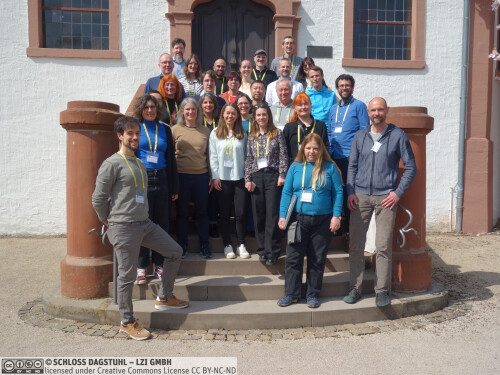
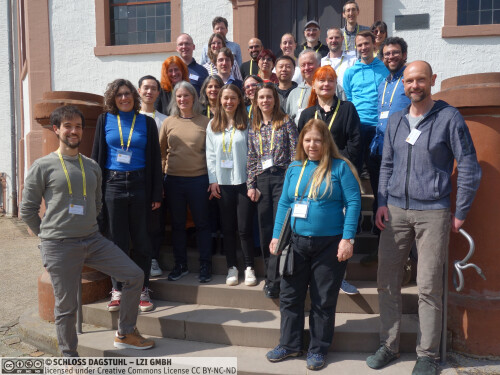
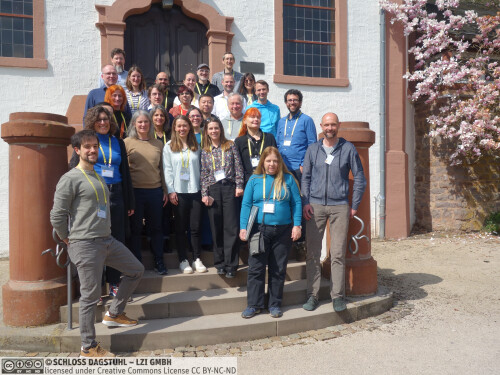
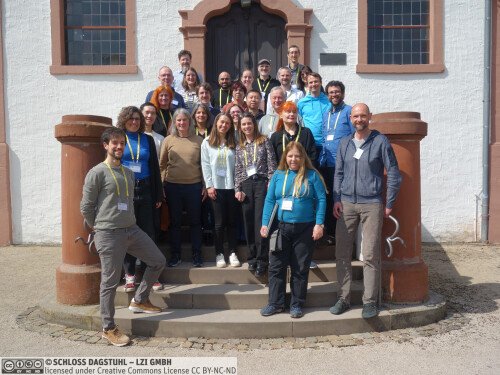
(Click in the middle of the image to enlarge)
Permalink
Please use the following short url to reference this page:
https://www.dagstuhl.de/25152
Organizers
- Claudio Di Ciccio (Utrecht University, NL)
- Pnina Soffer (University of Haifa, IL)
- Christian Tominski (Universität Rostock, DE)
- Katerina Vrotsou (Linköping University, SE)
Contact
- Andreas Dolzmann (for scientific matters)
- Simone Schilke (for administrative matters)
Impacts
- Interactive Discovery and Visualization of Process Trees : article in 2025 IEEE Visualization and Visual Analytics (VIS) - Heijden, Wouter van der; Elzen, Stef van den - Los Alamitos : IEEE, 2026. - 5 pp..
- Towards Multi-Faceted Visual Process Analytics - Elzen, Stef van den; Martin, Niels; Pieters, Femke; Villa-Uriol, Maria-Cruz; Zelst, Sebastiaan J. van; Tominski, Christian; Jans, Mieke - Amsterdam : Elsevier, 2025. - 16 pp. - (Information Systems ; 133. 2025 : article).
- Towards Integrating Visual Analytics in Multi-Perspective Conformance Checking : A Call to Action - Linden, Sanne van de; Filipov, Velitchko; Pufahl, Luise; Miksch, Silvia; Elzen, Stef van den - Aire-la-Ville : Eurographics Association, 2025. - 6 pp..
- VESPA : Visual Event-Stream Progressive Analytics : article in Business Process Management Workshops (BPM 2025) - Burratin, Andrea; Miksch, Silvia; Schulz, Hans-Jörg; Vrotsou, Katerina - Berlin : Springer, 2025. - 8 pp..
- Towards informed process exploration : better previews, reviews, and views beyond - Tominski, Christian; Hadar, Irit; Koytek, Philipp; Villa-Uriol, Maria-Cruz; Zerbato, Francesca - Berlin : Springer, 2026. - 24 pp. - (Process Science ; 3. 2026, article 20).
Schedule
Work done at this Dagstuhl Seminar has contributed to the following events:
- The series of Workshops on Visual Process Analytics.
This Dagstuhl Seminar “Multi-Faceted Visual Process Mining and Analytics” (25152) brought together 27 experts from the Process Mining (PM) and Visual Analytics (VA) communities to Schloss Dagstuhl to work on the challenges arising from the multi-faceted nature of processes and corresponding event log data. The seminar was held from April 6 to 11, 2025 as a follow-up seminar to Dagstuhl Seminar 23271, “Humans in the (Process) Mines” (https://www.dagstuhl.de/23271).
PM is a rapidly growing discipline blending machine learning and data mining concepts with ideas taken from the field of business process management. PM studies event log data to support business process execution for a variety of tasks, from the automated discovery of graphical process models to operational support. VA is a multidisciplinary approach that combines interactive, visual, and analytical methods to make complex data comprehensible, facilitate new insights, and enable knowledge discovery. VA research happens at the intersection of data mining and knowledge discovery, information visualization, human-computer interaction, and cognitive science.
The focus of this seminar was on discussing and investigating the challenges of multi-faceted visual process mining and analytics. The relevant facets include time (when do processes happen?), space (where do processes happen?), topology (how are processes connected?), object centricity (how are processes characterized?), uncertainty (what are we unsure about?), analytic provenance (how did we obtain our knowledge?), and more. The seminar discussed approaches to deal with and gain insight into these different data facets, individually and in combination, and outlined novel ideas and promising directions for future research to further strengthen the synergies of PM and VA.
The seminar started with a general introduction by the seminar organizers. In addition to presenting the general goals of the seminar, the organizers also reflected on the impressive outcomes of the previous seminar, which initiated the collaboration between PM and VA. The general introduction was followed by the introduction of the seminar participants, who briefly stated their background, expertise, and expectations in the seminar.
The first day of the seminar featured a series of expert presentations, mainly introducing the participants to key concepts and methods related to the different data facets. Gennady Andrienko gave an overview of VA for spatio-temporal data, highlighting the need for dedicated visual representations and the aspect of spatial and temporal scale. Hans-Jörg Schulz focused on the topology facet by introducing VA methods for visually analyzing graph structures (or networks). He introduced fundamental network visualization principles and also showcased examples of how the data facets of space and time can be combined with network visualization. The important issues of data quality and uncertainty were presented in the talk by Silvia Miksch. She emphasized different types of uncertainty and data quality problems for temporal, spatial, and network data. She also introduced basic strategies for visually representing uncertainty and discussed insights from user experiments. Claudio Di Ciccio turned the participants’ attention towards an object-centric perspective of processes, where processes are defined through multi-valued entities and relations among them. He introduced the object-centric event data (OCED) meta model as a means to describe processes in an object-centric manner. Finally, Francesca Zerbato gave a detailed introduction to the actual process of PM, which involves various iterative steps, each generating different results and artifacts. She also highlighted the importance of integrating provenance and corresponding analytical tools into the PM process for informed decision-making.
The theoretical aspects conveyed by the talks were supplemented with practical hands-on challenges based on two multi-faceted data sets. The organizers presented a data set from the VAST challenge series addressing a fictitious scenario related to involving people in urban planning and shaping social communities. A second data set was concerned with processes from truck shipment logistics. Both data sets illustrated the richness of multi-faceted processes and the event logs that they create, and indicated the challenges involved in exploring, analyzing, and understanding such processes.
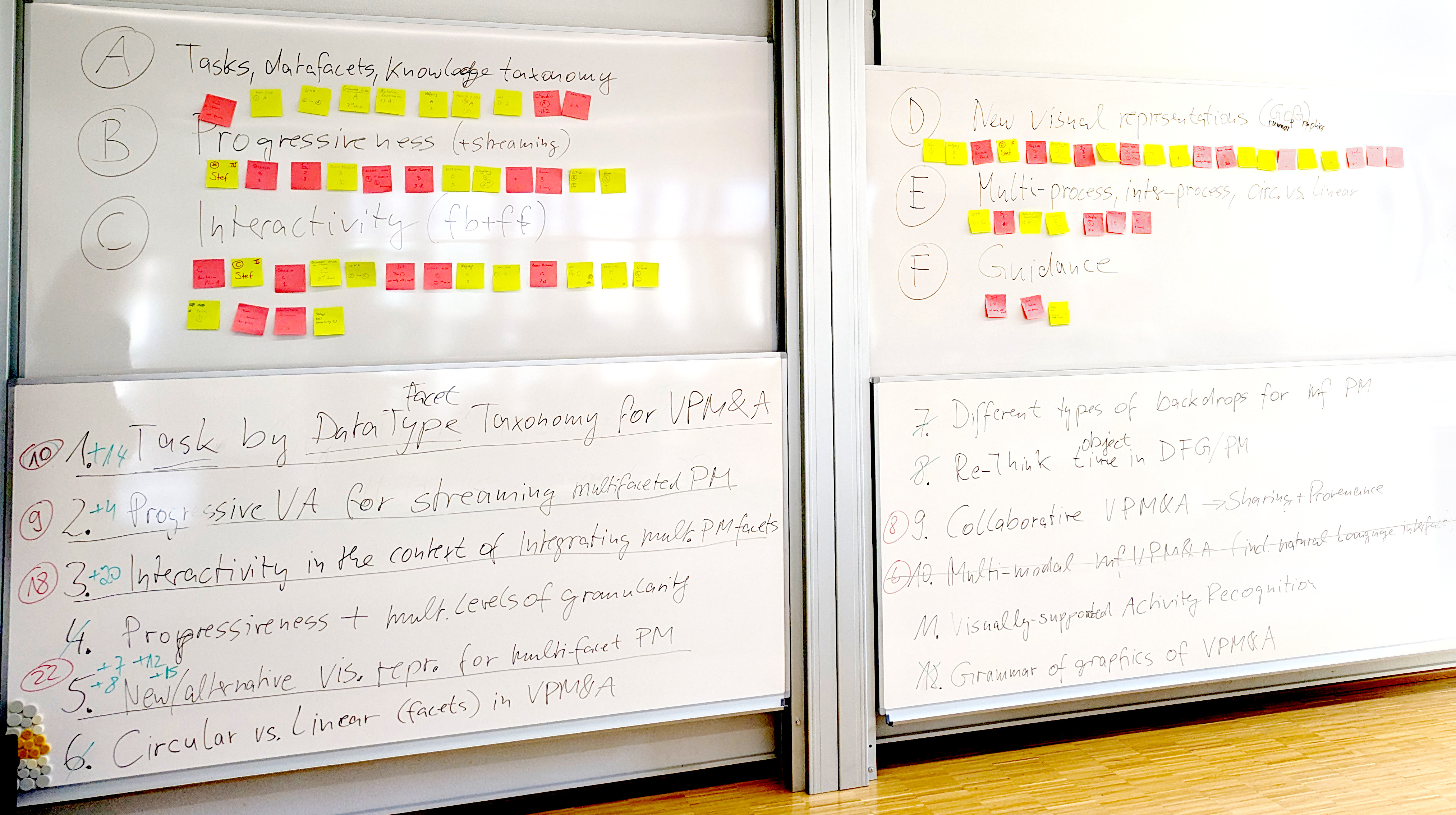
Figure 1 Whiteboards with investigation topics and preferences following the brainstorm session.
Talks and hands-on challenges were followed by discussions and ideation toward working group formation. The seminar participants brainstormed potential ideas and collected them on the whiteboard (see [fig:whiteboard]). From a list of about twenty ideas for working groups, five promising topics were merged and crystallized based on relevance, potential impact, and participant preferences. Eventually, the five groups worked on the following topics.
- Group A:
-
Towards Improving Processes Using Multi-Faceted Visual Analysis
- Group B:
-
Progressive Visual Analytics for Streaming Process Mining – VESPA
- Group C:
-
Interactivity: Visual Feedback and Feedforward for Process Exploration
- Group D:
-
Coordinated Projections: A New Approach to Multi-Faceted Process Exploration
- Group E:
-
Towards Visual Process Analytics for Process Ecosystems
Overall, the working groups had about six sessions to work on their topics. During intermediate group reports, all participants had the opportunity to provide feedback and contribute their expertise to all working groups. Moreover, lightning talks were given on specific aspects that arose during the seminar. Natalia Andrienko provided an overview of storyline visualizations for the analysis of event logs, highlighting their use to track the unfolding of processes based on the business objects evolution over time. Philipp Koytek held a demonstration of the object-centric process mining functionalities in the Celonis suite, with a special focus on visualization and user-guided exploration. Iris Beerepoot presented a novel dataset for the seminar attendees to explore pertaining to personal information management, with three years worth of data records tracking and categorizing knowledge workers’ tasks at their workstation.
The final day of the seminar included the presentation of the results of the working groups and set the stage for the official closing of the seminar. The results of the working groups can be read on the following pages of the full report. Although the seminar was held in a smaller format with fewer participants (compared to the previous seminars in the series), the reports from the working groups present an impressive amount of creative new ideas for combining PM and VA approaches. Given the success of the collaboration of PM and VA experts, also beyond Dagstuhl, the participants suggested and agreed to submit a proposal for continuing the series of Dagstuhl seminars on combining PM and VA. The planned follow-up seminar shall reflect the fruitful collaboration by merging PM and VA to a new unified research area of Visual Process Analytics (VPA).
 Creative Commons BY 4.0
 Claudio Di Ciccio, Pnina Soffer, Christian Tominski, and Katerina Vrotsou
Process mining and visual analytics are separate disciplines with the common goal of helping humans gain insight into and extract knowledge about relevant phenomena from complex data. Process mining (PM) is a rapidly growing discipline blending machine learning and data mining concepts with ideas taken from the field of business process management (BPM). It utilizes event data recorded by IT systems that support business process execution for a variety of tasks, from the automated discovery of graphical process models to operational support. Visual Analytics (VA) is a multidisciplinary approach that combines interactive, visual, and analytical methods to make complex phenomena more comprehensible, facilitate new insights, and enable knowledge discovery. VA research happens at the intersection of data mining and knowledge discovery, information visualization, human-computer interaction, and cognitive science.
Clearly, PM and VA are complementary research areas that would greatly and mutually benefit from joining forces. The combination of VA solutions with PM algorithms has the potential to render complex information structures more comprehensible and facilitate new insights. It also raises challenges and opportunities for analyzing process data in open-ended and under-specified exploratory analysis settings. Where PM aims to extract information and knowledge from event logs that often exhibit unexpected behavior and complex relationships, VA can provide mixed-initiative approaches in which humans and computers work together to extract valuable information from large and complex data, ultimately yielding crystallized, relevant insights.
So far, however, there have been very few interactions between the PM and VA communities. A first Dagstuhl seminar (23271, “Human in the (Process) Mines”) established a basis for scientific exchange and future collaboration. To further strengthen the identified synergies and identify novel promising directions, we propose a continuation seminar titled “Multi-faceted visual process mining and analytics” focusing on the challenges arising from the multi-faceted nature of processes, reflected in the multi-faceted data to be investigated. The relevant facets include time (when do processes happen), space (where do processes happen), topology (how are processes connected), object centricity (how are processes characterized), uncertainty (what are we unsure about), analytic provenance (how did we obtain our knowledge), and more.
This Dagstuhl Seminar will deal with challenges related to these different data facets, individually and in combination. As a general principle, we advocate that VA methods be an integral part of all phases of the PM process to facilitate a comprehensive multi-faceted data exploration, hypothesis generation, and presentation of results. The discussion will revolve around several aspects, including but not limited to: the data facets under analysis; the human factors at play; the catalog of aided tasks; visual, interactive, and computational methods; integration, scalability and evaluation fundamentals; mixed-initiative guidance; and general applicability of the devised solutions. These general seminar topics involve a variety of specific research questions. To name only a few: What kinds of multi-faceted VA methods can effectively support process sense-making? How can multi-faceting enhance human understandability of processes? How can we intertwine VA with PM to tackle quality, uncertainty, and provenance over time and space? How can VA help inject domain knowledge to reduce the process discovery search space?
Finally, this seminar aims to cross-fertilize and advance the fields of PM and VA, enrich future approaches to be developed, and serve as an incubator for sustained collaborations leading to joint scientific efforts and initiatives to attract research funding.
Claudio Di Ciccio, Pnina Soffer, Christian Tominski, and Katerina Vrotsou
- Wolfgang Aigner (FH - St. Pölten, AT) [dblp]
- Gennady Andrienko (Fraunhofer IAIS - Sankt Augustin, DE) [dblp]
- Natalia V. Andrienko (Fraunhofer IAIS - Sankt Augustin, DE) [dblp]
- Iris Beerepoot (Utrecht University, NL) [dblp]
- Andrea Burattin (Technical University of Denmark - Lyngby, DK) [dblp]
- Lena Cibulski (Universität Rostock, DE)
- Claudio Di Ciccio (Utrecht University, NL) [dblp]
- Irit Hadar (University of Haifa, IL) [dblp]
- Marie-Christin Häge (Universität Mannheim, DE)
- Andreas Kerren (Linköping University, SE) [dblp]
- Philipp Koytek (Celonis Labs GmbH - München, DE) [dblp]
- Zhicheng Liu (University of Maryland - College Park, US) [dblp]
- Giovanni Meroni (Technical University of Denmark - Lyngby, DK) [dblp]
- Silvia Miksch (TU Wien, AT) [dblp]
- Manuel Resinas (University of Sevilla, ES) [dblp]
- Shazia Sadiq (University of Queensland - Brisbane, AU) [dblp]
- Hans-Jörg Schulz (Aarhus University, DK) [dblp]
- Pnina Soffer (University of Haifa, IL) [dblp]
- Christian Tominski (Universität Rostock, DE) [dblp]
- Cagatay Turkay (University of Warwick - Coventry, GB) [dblp]
- Stef Van den Elzen (TU Eindhoven, NL) [dblp]
- Maria-Cruz Villa-Uriol (University of Sheffield, GB) [dblp]
- Tatiana von Landesberger (Universität Köln, DE) [dblp]
- Katerina Vrotsou (Linköping University, SE) [dblp]
- Barbara Weber (Universität St. Gallen, CH) [dblp]
- Peilin Yu (Linköping University, SE)
- Francesca Zerbato (TU Eindhoven, NL) [dblp]
Related Seminars
Classification
- Artificial Intelligence
- Human-Computer Interaction
- Other Computer Science
Keywords
- Process mining
- Visual analytics
- Human in the loop