
Dagstuhl Seminar 26302
AI Governance: Supporting Compliance Across Phases and Roles
( Jul 19 – Jul 22, 2026 )


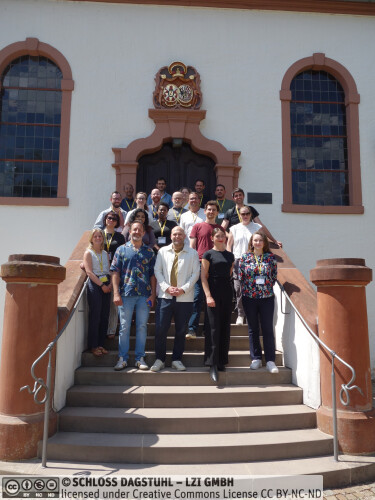

(Click in the middle of the image to enlarge)
Permalink
Please use the following short url to reference this page:
https://www.dagstuhl.de/26302
Organizers
- Edyta Bogucka (Nokia Bell Labs - Cambridge, GB)
- Orestis Papakyriakopoulos (TU München, DE)
- Daniele Quercia (Polytechnic University of Turin, IT)
- Marie-Therese Sekwenz (TU Delft, NL)
Contact
- Michael Gerke (for scientific matters)
- Simone Schilke (for administrative matters)
Dagstuhl Reports
As part of the mandatory documentation, participants are asked to submit their talk abstracts, working group results, etc. for publication in our series Dagstuhl Reports via the Dagstuhl Reports Submission System.
- Upload (Use personal credentials as created in DOOR to log in)
Shared Documents
- Dagstuhl Materials Page (Use personal credentials as created in DOOR to log in)
The rapid spread of AI regulation creates an urgent challenge: ensuring that compliance requirements are not only legally sound but also practically usable across the different phases of AI development and by diverse stakeholder roles. Many governance tools (such as model cards, risk assessments, or audit templates) only partly reflect regulatory obligations, while legal texts often lack the clarity and structure needed to guide day-to-day practice for developers, auditors, and end users.
This Dagstuhl Seminar takes up this challenge by bringing together researchers and practitioners from computer science, human-computer interaction, law, and policy. The work will focus on practical strategies for supporting compliance, guided by a small set of internationally recognized regulations and guidelines such as the EU AI Act, the U.S. NIST AI Risk Management Framework, and ISO 42005. This set provides common reference points while still allowing participants to bring in comparative insights from their own jurisdictions.
The seminar will combine five short design sprints with structured discussions. Participants will rotate across interdisciplinary groups to map obligations across phases of AI development, link them to the roles responsible for compliance, and examine how well existing tools provide support. The sprints are designed to encourage collaboration and quick idea generation, helping participants establish common ground across disciplines.
This Dagstuhl Seminar will produce three concrete outcomes. First, participants will create mappings that connect regulatory obligations from selected standards to phases of AI development and to the roles responsible for compliance. Second, they will evaluate how well existing governance tools support these obligations and document the gaps that emerge. Third, the seminar will consolidate these insights into a joint research agenda that identifies priorities for future work.
 Creative Commons BY 4.0
 Daniele Quercia, Edyta Bogucka, Marie-Therese Sekwenz, and Orestis Papakyriakopoulos
This seminar qualifies for Dagstuhl's LZI Junior Researchers program. Schloss Dagstuhl wishes to enable the participation of junior scientists with a specialisation fitting for this Dagstuhl Seminar, even if they are not on the radar of the organizers. Applications by outstanding junior scientists are possible until Friday, June 12, 2026.
Please log in to DOOR to see more details.
- Isobel Acquah (Ceta Foundation - Kigali, RW)
- Edyta Bogucka (Nokia Bell Labs - Cambridge, GB) [dblp]
- Katharina Bossoni Frey (ETH Zürich, CH)
- Tania Cerquitelli (Polytechnic University of Turin, IT) [dblp]
- Marios Constantinides (CYENS Centre of Excellence - Nicosia, CY) [dblp]
- Elizabeth M. Daly (IBM Research - Dublin, IE) [dblp]
- Dirk Hovy (Bocconi University - Milan, IT) [dblp]
- Zoe Kahn (Universität Duisburg-Essen - Duisburg, DE) [dblp]
- Laura Koesten (MBZUAI - Abu Dhabi, AE) [dblp]
- Filip Konopczynski (NASK - Warsaw, PL)
- Niklas Kühl (Universität Bayreuth, DE) [dblp]
- Michael Madaio (Google - New York, US) [dblp]
- Orestis Papakyriakopoulos (TU München, DE) [dblp]
- Pooja Prajod (CWI - Amsterdam, NL) [dblp]
- Daniele Quercia (Polytechnic University of Turin, IT) [dblp]
- Rainer Rehak (Weizenbaum-Institut - Berlin, DE) [dblp]
- Timothée Schmude (Universität Wien, AT) [dblp]
- Marie-Therese Sekwenz (TU Delft, NL) [dblp]
- Peter Slattery (MIT - Cambridge, US) [dblp]
- Bernd Carsten Stahl (University of Nottingham, GB) [dblp]
- Himanshu Verma (TU Delft, NL) [dblp]
Classification
- Artificial Intelligence
- Computers and Society
- Human-Computer Interaction
Keywords
- Legal Design
- AI Governance
- Responsible AI
- Human-Centered AI