
Dagstuhl Seminar 25381
Open Scholarly Information Systems: Status Quo, Challenges, Opportunities
( Sep 14 – Sep 19, 2025 )
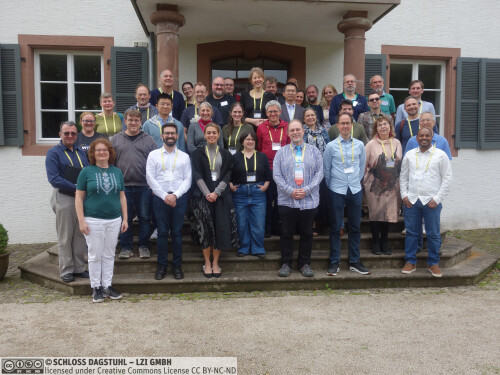
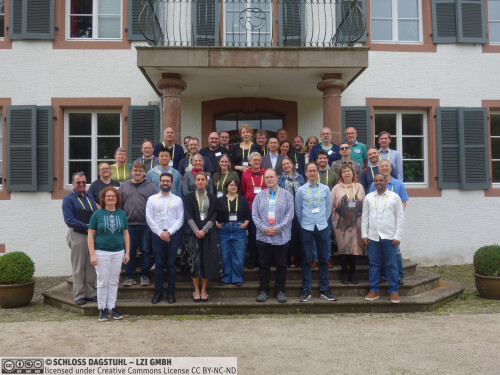
(Click in the middle of the image to enlarge)
Permalink
Please use the following short url to reference this page:
https://www.dagstuhl.de/25381
Organizers
- Hannah Bast (Universität Freiburg, DE)
- Guillaume Cabanac (University of Toulouse, FR)
- Paolo Manghi (CNR - Pisa, IT)
- Jian Wu (Old Dominion University - Norfolk, US)
Coordinator
- Marcel R. Ackermann (Schloss Dagstuhl - Trier, DE)
Contact
- Michael Gerke (for scientific matters)
- Susanne Bach-Bernhard (for administrative matters)
- KMi at Dagstuhl: Open Scholarly Information Systems blog entry at Knowledge Media Institute News, September 25, 20025.
- Dagstuhl Seminar: Open Scholarly Information Systems by Angelo Salatino in his blog on September 20, 2025.
This report presents the outcomes and strategic next steps derived from Dagstuhl Seminar “Open Scholarly Information Systems: Status Quo, Challenges, Opportunities” (25381), held in September 2025. The seminar brought together an international group of experts to address the critical challenges facing Open Scholarly Infrastructure (OSI), the evolution of Scholarly Knowledge Graphs (SKGs), and the transformative impact of Agentic AI on the research lifecycle.
Purpose and Context
The primary objective of the seminar was to foster collaboration among diverse infrastructure "owners" and stakeholders to ensure the long-term sustainability and interoperability of the systems that support global research. Participants engaged in high-level plenary discussions and focused working groups to tackle technical, ethical, and economic hurdles within the scholarly ecosystem.
Key Themes and Discussion Pillars
The results detailed in this report are organised around several core pillars:
- Sustainability and Digital Sovereignty: A central theme was the urgent need for nations to retain control over research outputs to avoid dependency on commercial monopolies. The group explored the Barcelona Declaration as a framework for promoting open research information and discussed strategies to convince institutions to dedicate a portion of their budgets to open infrastructure.
- Metadata Excellence and Interoperability: Discussions focused on harmonising metadata across platforms like DBLP, Wikidata, and OpenReview. The "COMET" approach was proposed to align decentralised metadata enrichment efforts, reducing redundancy and enhancing data quality.
- The Rise of Agentic AI: The seminar examined how autonomous AI agents might reshape discovery, writing, and peer review. A critical concern was maintaining human agency and accountability to safeguard scientific integrity, even as AI accelerates baseline tasks like replication.
- Reforming Research Assessment: Participants challenged the current "perverse system" of publication metrics and rankings. The consensus emphasized that research quality cannot be measured by numbers alone and that data providers should focus on providing comprehensive data rather than automated rankings.
Strategic Objectives
The outcomes represent a collective effort to move from “building” to “using” and “sustaining” open systems. Key outputs include a draft manifesto on the economic and social value of OSI, technical roadmaps for migrating services like Scholia to QLever, and position papers on the future of human-AI collaboration in science. The full report serves as a record of these discussions and a roadmap for the community to ensure that scholarly information remains a transparent, trustworthy, and shared global resource.
 Creative Commons BY 4.0
 Hannah Bast, Guillaume Cabanac, Paolo Manghi, and Jian Wu
Over the past 30 years, a rich ecosystem of scholarly information systems that openly provide their services to the scientific community has developed. Examples of such systems are aggregators of metadata, such as DBLP, OpenCitations, OpenAIRE Graph, OpenAlex, ORKG, aggregators of full texts such as Semantic Scholar, CiteSeerX, CORE, data repositories, such as arXiv.org, Figshare, Zenodo, Dataverse, and ID authorities, such as ORCID, ROR, Crossref, DataCite.
In this interdisciplinary Dagstuhl Seminar, we want to bring together practitioners from this ecosystem as well as researchers who investigate related research questions or who rely on these systems in their research. This Dagstuhl Seminar is the first of its kind. It will provide a unique opportunity for dialogue, sharing insights, building new networks, and fostering collaboration. In particular, we aim to achieve the following outcomes:
Education about the status quo: Few participants will be familiar with the full ecosystem, which has developed fast in recent years. Just knowing which systems and services exist in the meantime and having heard about them from the creators or key people will be very valuable for all participants.
Bridging the gap between researchers and system providers: We are confident that both researchers on key topics and key people from the various systems will be present at the seminar. We expect that the system’s people will learn about new research relevant to their systems. Vice versa, researchers will learn which problems are relevant in practice, and get inspiration for new practical problems to work on.
Identifying common tasks: We expect that several of the tasks will lead to the identification of common tasks and potentials for synergies between projects. As a minimum, new network connections will form. We also expect that new collaborations or joint initiatives will form, for tackling challenges of common interest.
Hannah Bast, Guillaume Cabanac, Paolo Manghi, and Jian Wu
- Marcel R. Ackermann (Schloss Dagstuhl - Trier, DE) [dblp]
- Phoebe Ayers (MIT Libraries - Cambridge, US) [dblp]
- Wolf-Tilo Balke (TU Braunschweig, DE) [dblp]
- Hannah Bast (Universität Freiburg, DE) [dblp]
- Guillaume Cabanac (University of Toulouse, FR) [dblp]
- A. Seza Dogruöz (Ghent University, BE) [dblp]
- Martin Fenner (Front Matter - Münster, DE) [dblp]
- Ingo Frommholz (MODUL Universität Wien, AT) [dblp]
- Carole Goble (University of Manchester, GB) [dblp]
- Iryna Gurevych (TU Darmstadt, DE) [dblp]
- Lynda Hardman (CWI - Amsterdam, NL) [dblp]
- Holger Hermanns (Universität des Saarlandes - Saarbrücken, DE) [dblp]
- Min-Yen Kan (National University of Singapore, SG) [dblp]
- Petr Knoth (The Open University - Milton Keynes, GB) [dblp]
- Bianca Kramer (Sesame Open Science - Utrecht, NL) [dblp]
- Christin Kreutz (THM - Gießen, DE) [dblp]
- Cyril Labbé (University of Grenoble, FR) [dblp]
- Michael Ley (Schloss Dagstuhl - Trier, DE) [dblp]
- Paolo Manghi (CNR - Pisa, IT) [dblp]
- Philipp Mayr (GESIS - Köln, DE) [dblp]
- Daniel Mietchen (FIZ Karlsruhe - Berlin, DE) [dblp]
- Carlos Daniel Mondragón Chapa (OpenReview - Cambridge, US)
- Patrick Neises (Schloss Dagstuhl - Trier, DE) [dblp]
- Natasha Noy (Google - Mountain View, US) [dblp]
- Mario Petrella (University of Bologna, IT)
- Lydia Pintscher (Wikimedia - Germany, DE) [dblp]
- Ruzica Piskac (Yale University - New Haven, US) [dblp]
- Rüdiger Reischuk (Universität zu Lübeck, DE) [dblp]
- Angelo Salatino (The Open University - Milton Keynes, GB) [dblp]
- Ralf Schenkel (Universität Trier, DE) [dblp]
- Ansgar Scherp (Universität Ulm, DE) [dblp]
- Raimund Seidel (Universität des Saarlandes - Saarbrücken, DE) [dblp]
- Tilahun Abedissa Taffa (Leuphana Universität Lüneburg, DE)
- Sahar Vahdati (TIB - Hannover, DE)
- Nees Jan van Eck (Leiden University, NL) [dblp]
- Ruijie Wang (Universität Zürich, CH) [dblp]
- Kathryn Weber-Boer (Digital Science - London, GB)
- Jian Wu (Old Dominion University - Norfolk, US) [dblp]
- Ramin Zabih (Cornell Tech - New York, US) [dblp]
Classification
- Digital Libraries
- Information Retrieval
- Machine Learning
Keywords
- scholarly information systems
- scholarly big data
- knowledge graphs
- semantic search
- artificial intelligence