
Dagstuhl Seminar 25372
Precision in Geometric Algorithms
( Sep 07 – Sep 12, 2025 )
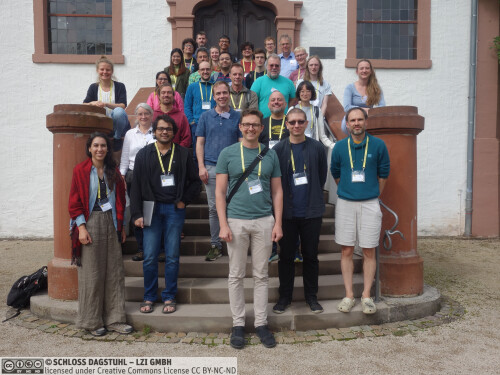
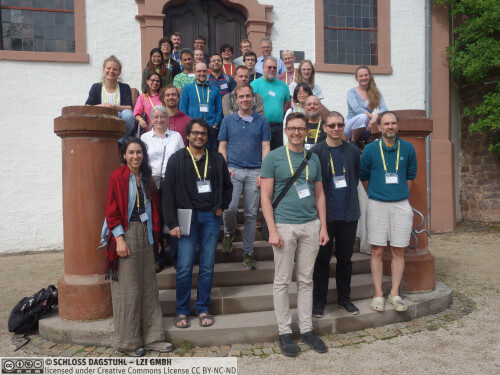
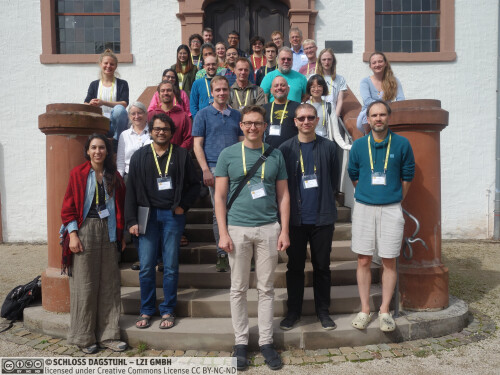
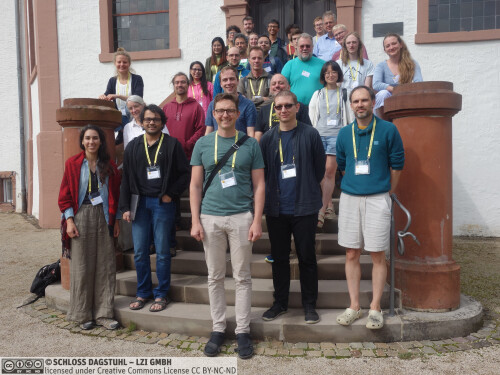
(Click in the middle of the image to enlarge)
Permalink
Please use the following short url to reference this page:
https://www.dagstuhl.de/25372
Organizers
- Mikkel Abrahamsen (University of Copenhagen, DK)
- Sándor Kisfaludi-Bak (Aalto University, FI)
- Linda Kleist (Universität Hamburg, DE)
- Till Miltzow (Utrecht University, NL)
Contact
- Andreas Dolzmann (for scientific matters)
- Christina Schwarz (for administrative matters)
Schedule
The Dagstuhl Seminar “Precision in Geometric Algorithms” (25372) brought together researchers working on computational geometry, real-complexity theory, and geometric computation models that require high-precision reasoning. The seminar aimed to understand how geometric problems behave when precision, real-number computation, and continuous models become central, and to explore the algorithmic, structural, and complexity-theoretic consequences.
The invited talks covered a broad spectrum: geometric graph theory in hyperbolic spaces; optimal convex-hull reconstruction from imprecise data; ER-complete recognition problems for geometric intersection graphs; oracle separations in the real polynomial hierarchy; new approximation schemes for geometric multimatching; the complexity of the boundary–boundary art gallery problem; and dynamic Steiner spanners in curved spaces. Together, these contributions showcased how precision constraints shape both the geometry and the complexity of algorithmic problems.
Several working groups produced substantial progress. One group extended Fréchet-distance techniques to more than two curves and proved meaningful lower bounds via reductions from 3OV. Another initiated the study of “Devil’s Games,” a class of infinite-move combinatorial games linked to the first-order theory of the reals. Others explored realization spaces of geometric graph representations, online packing of convex objects, sparse geometric emulators, and the flip distance needed to eliminate crossings in geometric matchings.
The open-problem session highlighted future challenges: recognizing strongly hyperbolic disk graphs, understanding polygonal knot realization spaces and their potential universality, establishing ∃R-completeness of continuous distance problems, efficiently computing weak circle representations of planar graphs, and bounding fixed points of compositions of monotone polynomials.
 Creative Commons BY 4.0
 Till Miltzow
Geometric algorithms deal with simple objects and shapes (points, lines, disks) or abstract geometric data. Unfortunately, even for classic problems on relatively simple objects, one often needs very high precision arithmetic. High-precision or symbolic computation in turn leads to significant challenges in geometric algorithm design that differ from the challenges posed by combinatorial complexity. Classic computational geometry often deals with such issues by working on an idealized machine (the so-called Real RAM model). This approach however hides most of the precision issues. In computational complexity theory there are some well-established tools as well as some recent developments that address the issue of precision head on: smoothed analysis, conditional lower bounds for approximation schemes, and ∃ℝ-completeness. Intuitively, these tools express important aspects of precision, such as robustness under tiny probabilistic perturbations, time-precision tradeoffs and whether the problem requires arbitrary algebraic numbers to be representable.
In this Dagstuhl Seminar Precision in Geometric Algorithms, we will study the precision issues that arise during the design of geometric algorithms. Three possible topics to be discussed are:
- Curved Spaces: When we consider problems in curved spaces, such as in spherical or hyperbolic geometry, then precision issues can arise easily and are largely unexplored. What is the most natural way to represent points such that distances and geometric shapes can be efficiently computed, and conversions between different models is robust?
- Geometric Graphs: Many real-world problems involve graphs that allow for geometric representations, e.g., as intersection graphs of disks, intervals, squares, etc. The associated recognition problems are often ∃ℝ -complete. In the context of precision (as well as robustness and readability/visual clarity), it is interesting to study so-called ε-robust representations where the intersection graphs remain the same even if each object may be moved to a new position of distance at most ε. In the seminar, we want to explore how ε-robustness affects algorithmic problems on geometric graphs.
- Packing: Geometric packing constitutes a vast domain within computational geometry, operations research, and pure mathematics. Recent research has shown that packing problems involving irregular objects such as convex polygons are often ∃ℝ-hard. In the seminar, we will investigate how well such problems can be approximated.
The seminar brings together researchers from the fields
- computational geometry and topology,
- approximation algorithms,
- computational complexity,
- graph algorithms and combinatorial geometry.
Our goal is to explore recent trends in rigorous precision analysis, and to find connections between the various tools used to analyze precision. We aim to identify promising new research directions as well as any blind spots in our current understanding of precision in geometric settings.
Mikkel Abrahamsen, Sándor Kisfaludi-Bak, Linda Kleist, and Till Miltzow
- Anders Aamand (University of Copenhagen, DK) [dblp]
- Mikkel Abrahamsen (University of Copenhagen, DK) [dblp]
- Peyman Afshani (Aarhus University, DK) [dblp]
- Sujoy Bhore (Indian Institute of Technology Bombay - Mumbai, IN) [dblp]
- Thomas Bläsius (KIT - Karlsruher Institut für Technologie, DE) [dblp]
- Karl Bringmann (Universität des Saarlandes - Saarbrücken, DE) [dblp]
- Mark de Berg (TU Eindhoven, NL) [dblp]
- Sarita de Berg (Utrecht University, NL) [dblp]
- Arnaud de Mesmay (Gustave Eiffel University - Marne-la-Vallée, FR) [dblp]
- Omrit Filtser (The Open University of Israel - Ra'anana, IL) [dblp]
- Dan Halperin (Tel Aviv University, IL) [dblp]
- Arindam Khan (Indian Institute of Science - Bangalore, IN) [dblp]
- Sándor Kisfaludi-Bak (Aalto University, FI) [dblp]
- Linda Kleist (Universität Hamburg, DE) [dblp]
- Gargi Lather (Indian Institute of Techology Madras, IN)
- Hung Le (University of Massachusetts Amherst, US) [dblp]
- Anna Lubiw (University of Waterloo, CA) [dblp]
- Aye Chan May (Thammasat University - Pathum Thani, TH)
- Lucas Meijer (Utrecht University, NL) [dblp]
- Arturo Merino (O'Higgins University - Rancagua, CL) [dblp]
- Till Miltzow (Utrecht University, NL) [dblp]
- André Nusser (INRIA - Sophia Antipolis, FR) [dblp]
- Eunjin Oh (POSTECH - Pohang, KR) [dblp]
- Günter Rote (FU Berlin, DE) [dblp]
- Marcus Schaefer (DePaul University - Chicago, US) [dblp]
- Jack Stade (University of Copenhagen, DK) [dblp]
- Csaba Tóth (California State University - Northridge, US) [dblp]
- Geert van Wordragen (Aalto University, FI) [dblp]
- Karol Wegrzycki (MPI für Informatik - Saarbrücken, DE) [dblp]
- Alexandra Wesolek (TU Berlin, DE) [dblp]
Classification
- Computational Complexity
- Computational Geometry
- Data Structures and Algorithms
Keywords
- precision
- approximation
- existential theory of the reals
- smoothed analysis
- computational geometry