
Dagstuhl-Seminar 25342
Frontiers of Parameterized Algorithmics of Matching under Preferences
( 17. Aug – 22. Aug, 2025 )
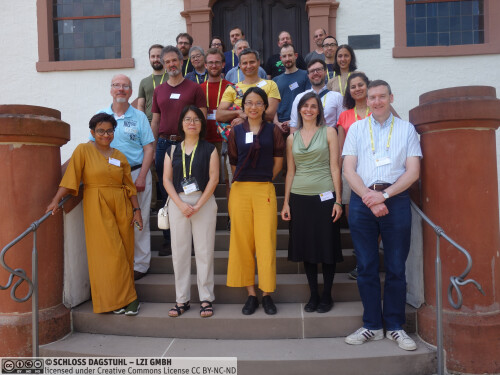
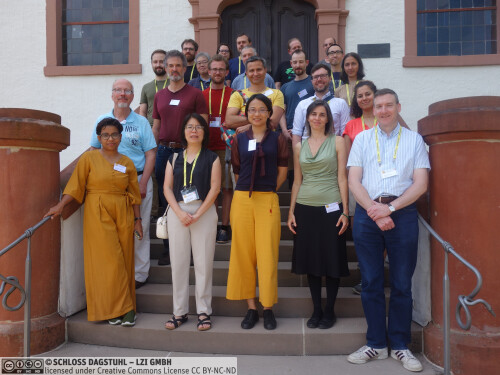
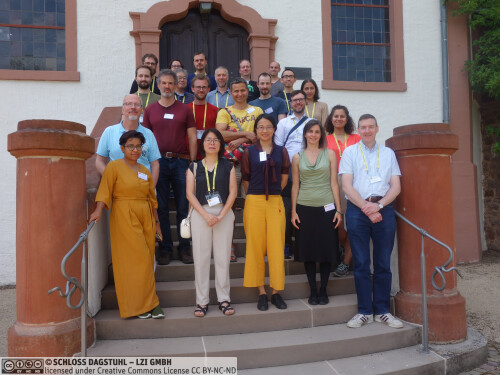
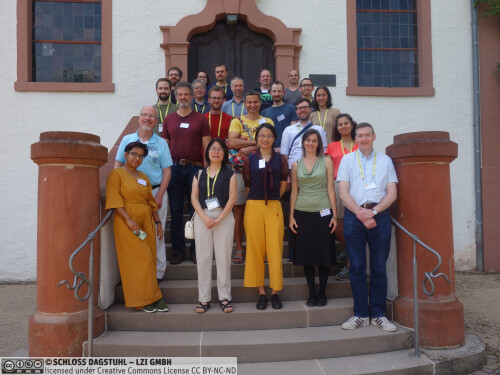
(zum Vergrößern in der Bildmitte klicken)
Permalink
Bitte benutzen Sie folgende Kurz-Url zum Verlinken dieser Seite:
https://www.dagstuhl.de/25342
Organisatoren
- Jiehua Chen (TU Wien, AT)
- Christine Cheng (University of Wisconsin - Milwaukee, US)
- David Manlove (University of Glasgow, GB)
- Ildikó Schlotter (HUN-REN KRTK - Budapest, HU)
Kontakt
- Andreas Dolzmann (für wissenschaftliche Fragen)
- Susanne Bach-Bernhard (für administrative Fragen)
Programm
Matching Under Preferences (MATCH-UP) is a research field which investigates the complexities and algorithms of matching markets, where agents or entities are paired based on individual preferences to meet certain criteria such as stability or fairness. Although matching markets have broad real-world applications – including labor allocation, organ exchanges, and educational placements – the computational landscape of the problems therein often presents as NP-complete or beyond.
Parameterized Complexity Theory (PCT), established by Downey and Fellows in 1980s, has emerged as a robust framework for dissecting the computational intricacies of NPhard problems. However, the primary application of PCT has largely been confined to graph-theoretical challenges.
In the last five to ten years, there has been a surge in parameterized investigations of problems that fall within the MATCH-UP area. However, such research only constitutes a small part of the literature, and there are numerous topics where our understanding of the computational complexity of the problems involved, and the parameters influencing them, is insufficient.
This seminar addressed a fundamental gap: the lack of comprehensive parameterized analysis across the MATCH-UP landscape. By convening experts from the MATCH-UP and PCT communities, we aimed to identify which structural restrictions render hard matching problems tractable, and which parameters provably cannot help under standard complexity assumptions.
Seminar Composition and Structure
The seminar brought together 23 researchers from the USA, UK, Japan, India, and across Europe. The balanced composition of PCT and MATCH-UP experts enabled genuine bidirectional knowledge transfer between communities that rarely interact at traditional venues.
The week-long program comprised:
- Two tutorials providing crash courses on parameterized algorithmics, covering fixed-parameter tractability, kernelization techniques, and treewidth-based algorithm design
- Two survey talks on recent parameterized complexity results for MATCH-UP problems and structural properties of stable matchings
- One application-focused talk highlighting real-world deployment challenges in matching markets
- Eight contributed talks presenting current research on MATCH-UP and PCT
- Two rump sessions for open problem proposals and challenge identification
- Seven working group sessions for intensive collaborative investigation
- Multiple plenary discussions where working groups reported progress and input was obtained from the wider audience
Notably, the assignment of working groups was computed using an optimal matching tool developed by one of the organizers (David Manlove) to produce a popular matching respecting participant preferences.
Outcomes and Impact
The seminar enabled productive exchange between the PCT and MATCH-UP communities, establishing shared vocabulary and research frameworks. The seven working groups explored fundamental questions including:
- Identifying structural parameters specific to MATCH-UP instances, such as agent types
- Designing dynamic algorithms for stable matching
- Parameterized complexity of weighted envy-free matchings
- Computing competitive equilibrium in house allocation
- Parameterized approximation for stable matching variants
Conclusion
The organizers thank the Dagstuhl staff for their outstanding professional support, all participants for their engaging contributions to tutorials, talks, and working groups, and Manuel Sorge for collecting abstracts of contributed talks and working group results.
 Creative Commons BY 4.0
 Jiehua Chen, Christine Cheng, David Manlove, and Ildikó Schlotter
Matching Under Preferences (MATCH-UP) is a research field which investigates the complexities and algorithms of matching markets, where agents or entities are paired based on individual preferences to meet certain criteria such as stability or fairness. Although matching markets have broad real-world applications—including labor allocation, organ exchanges, and educational placements—the computational landscape of the problems therein often presents as NP-complete or beyond.
Parameterized Complexity Theory (PCT), established by Downey and Fellows in the 1980s, has emerged as a robust framework for dissecting the computational intricacies of NP-hard problems. However, the primary application of PCT has largely been confined to graph-theoretical challenges.
In this interdisciplinary Dagstuhl Seminar, we intend to catalyze a synergy between MATCH-UP and PCT experts. The aim is to collaboratively explore how cutting-edge parameterized techniques can be employed to develop exact algorithms that tackle the inherent computational difficulties in matching markets.
Participants will engage in intensive cross-disciplinary discussions, with a spotlight on deploying parameterized methods to bypass or mitigate computational challenges within the scope of MATCH-UP. The topics under consideration will include, but are not limited to:
- Classical problems with new and natural parameterizations. Despite the many NP-hard problems in the MATCH-UP area, only a few parameterizations are known for which they admit FPT-algorithms. Problems that are likely to be of interest include hard variants of the Hospitals / Residents problem (e.g., involving couples, lower quotas or ties) where we seek an arbitrary or maximum-size stable matching. Structural parameters could be considered here, relating to the structure of the underlying “acceptability graph”. Other parameters could be based on distance from certain structured preference domains (e.g., where all residents are uniformly ranked in a “master list” or have single-peaked preferences).
- Dynamic models, online matching, multi-modal settings. As opposed to static models, there is a relative dearth of research dealing with dynamic, online or multi-modal settings where preferences or the underlying graph may be subject to change, or each agent has multiple preferences each depending on a different issue. A notable exception in the dynamic setting is the Incremental Stable Matching problem where the task is to adapt a given stable matching to modified preferences.
- Stable hypergraph matching. Hypergraphs are a powerful generalization of graphs that enable us to model situations where relations are not necessarily binary. Problems that fall into the framework of stable hypergraph matchings include the Multi-dimensional Stable Roommates problem and the Hospitals/Residents with Couples.
- Control and manipulation. When there is no solution that meets the requirements imposed, a central planner may have the ability to adjust the problem instance in ways that can facilitate a more favorable outcome. The task of such a central planner or authority is to take certain control actions (as few as possible) in order to achieve their goals.
- Different solution concepts. Besides stability, other notions of fairness or optimality are also of interest. Such notions might be motivated by different applications, or they may arise as a compromise in situations when stability cannot be achieved. Among these optimality concepts, popularity is an important one, which is not only easily motivated by applications when an election lies at the heart of a decision-making process, but additionally has a very strong theoretical background.
Jiehua Chen, Christine Cheng, David Manlove, and Ildikó Schlotter
- Péter Biró (HUN-REN KRTK - Budapest, HU) [dblp]
- Robert Bredereck (TU Clausthal, DE) [dblp]
- Jiehua Chen (TU Wien, AT) [dblp]
- Christine Cheng (University of Wisconsin - Milwaukee, US) [dblp]
- Gergely Csáji (Eötvös Lorand University - Budapest, HU) [dblp]
- Henning Fernau (Universität Trier, DE) [dblp]
- Tamás Fleiner (Budapest University of Technology & Economics, HU) [dblp]
- Sushmita Gupta (The Institute of Mathematical Sciences - Chennai, IN) [dblp]
- Thekla Hamm (TU Eindhoven, NL) [dblp]
- Naoyuki Kamiyama (Kyushu University - Fukuoka, JP) [dblp]
- Dušan Knop (Czech Technical University - Prague, CZ) [dblp]
- David Manlove (University of Glasgow, GB) [dblp]
- Dániel Marx (CISPA - Saarbrücken, DE) [dblp]
- Simon Mauras (INRIA Saclay - Île-de-France, FR) [dblp]
- Shuichi Miyazaki (University of Hyogo - Kobe, JP) [dblp]
- Matthias Mnich (TU Hamburg, DE) [dblp]
- Viktória Nemkin (Budapest University of Technology & Economics, HU)
- Marcin Pilipczuk (University of Warsaw, PL) [dblp]
- Baharak Rastegari (University of Southampton, GB) [dblp]
- Will Rosenbaum (University of Liverpool, GB) [dblp]
- Ildikó Schlotter (HUN-REN KRTK - Budapest, HU) [dblp]
- Manuel Sorge (TU Wien, AT) [dblp]
- Danielius Sukys (University of Glasgow, GB)
Klassifikation
- Computer Science and Game Theory
- Data Structures and Algorithms
- Multiagent Systems
Schlagworte
- Algorithmic Matching Markets
- Stable Matching
- Parameterized Algorithmics