
Dagstuhl-Seminar 25292
New Frontiers in AI for Game Design
( 13. Jul – 18. Jul, 2025 )
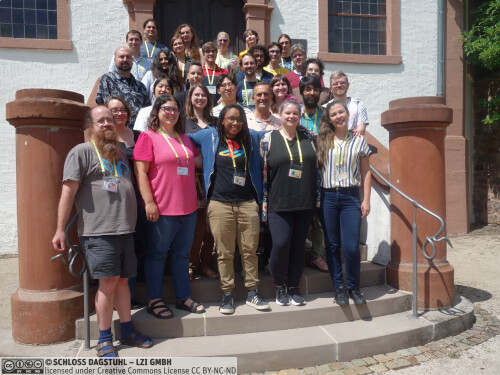
(zum Vergrößern in der Bildmitte klicken)
Permalink
Bitte benutzen Sie folgende Kurz-Url zum Verlinken dieser Seite:
https://www.dagstuhl.de/25292
Organisatoren
- M Charity (University of Richmond, US)
- Michael Cook (King's College London, GB)
- Nicolaas Vas (Billund, DK)
- Georgios N. Yannakakis (University of Malta - Msida, MT)
Kontakt
- Andreas Dolzmann (für wissenschaftliche Fragen)
- Simone Schilke (für administrative Fragen)
- DagRing, a list of webpages related to or maintained by this Dagstuhl Seminar's participants, among them an itch.io page collecting their created games.
- Game Generator Generator Game, a game by Younès Rabii, Michael Cook, Rémy Devaux, Brian Bucklew, Claus Aranha, Florence Smith Nicholls, and Matthew Guzdial published by Matthew Guzdial on his itch.io page on September 22, 2025.
- Breath Checkers, a game by Rémy Devaux and Gillian Smith published by Rémy Devaux on his itch.io page.
The relationship between games research and game design is as old as it is complicated. If we track back through the history of research in and around games, we find many researchers were also designers, and research touching on games was often playful in nature. Similarly, game design is an exploratory creative practice that often asks new questions about technology and art, and in turn drives innovations elsewhere. Today, the overlapping space in between these two spaces is richer than ever, with many game designers also working as researchers, and vice versa. On a community scale, however, many barriers and gaps remain. Does a researcher have to become a practitioner to impact game design? Does a game designer have to know all the literature and theory to engage with research? How does one start out learning to make games, or understanding how to make sense of existing research?
As a creative practice, game design itself is richer, and more important, than ever. Games are a vast cultural space that has spilled out of consoles and mobile phones into museums, cinemas and schools, and their economic, artistic and social importance has never been clearer. Game design is thus not simply of relevance to a few hundred people working as professionals in large commercial companies, but a skill that is important to tens of thousands of independent creators and artists, and millions of hobbyists all around the world. Roblox, the most popular videogame with young people in America, is a game design toolbox at its core, a many of its millions of players use it for exactly this purpose. As of mid-2025, when this seminar took place, it is estimated that Roblox alone contained nearly 50,000,000 games and interactive experiences – the majority of which have been designed by its younger players.
Games and game design has always been a rapidly-changing and tumultuous space, particularly in the area of digital games. Major technological shifts have transformed the industry almost every decade, from the shift away from arcades, the introduction of personal computers, the transition to 3D graphics, the wider availability of the Internet, the expansion of digital storefronts, and the broadening access to game development tools. One factor that, as we write this, has an unclear future impact on game design is the advent of “generative AI”. AI as a general field has a long and rich history with games, and games are one of the key domains that shaped the history of AI into what it is today. The impact of generative AI on design remains unclear, but the split opinions over the technology and its uses also provides a reason for us to re-examine how research and technology in general are used to shape creative fields like game design – what is useful, what is harmful, and how can we include the people most affected in the research process?
All of this brings us to the motivation for this seminar, tentatively titled New Frontiers in AI for Game Design. Inspired by some of the past seminars focusing on games research, we wanted to create a week of big ideas, bold experiments and lots of rich discussion and plan-making. Given the practical nature of our chosen topic, however, we also wanted to explore a more practical approach to a Dagstuhl Seminar, centred around play, exploration and application. Our invitee list included a wide variety of backgrounds, including awardwinning independent game designers, industry-leading experts on play and creativity, and world-class researchers. Most of our attendees had some experience making games, whether that be physical or digital, alone or in groups, as a commercial product or a freely distributed project. Our hope was that by bringing people with so many distinct – but overlapping – perspectives on design and play, we could explore not only new frontiers for game design, but also new frontiers for how research and practice can talk, share ideas, collaborate and grow closer.
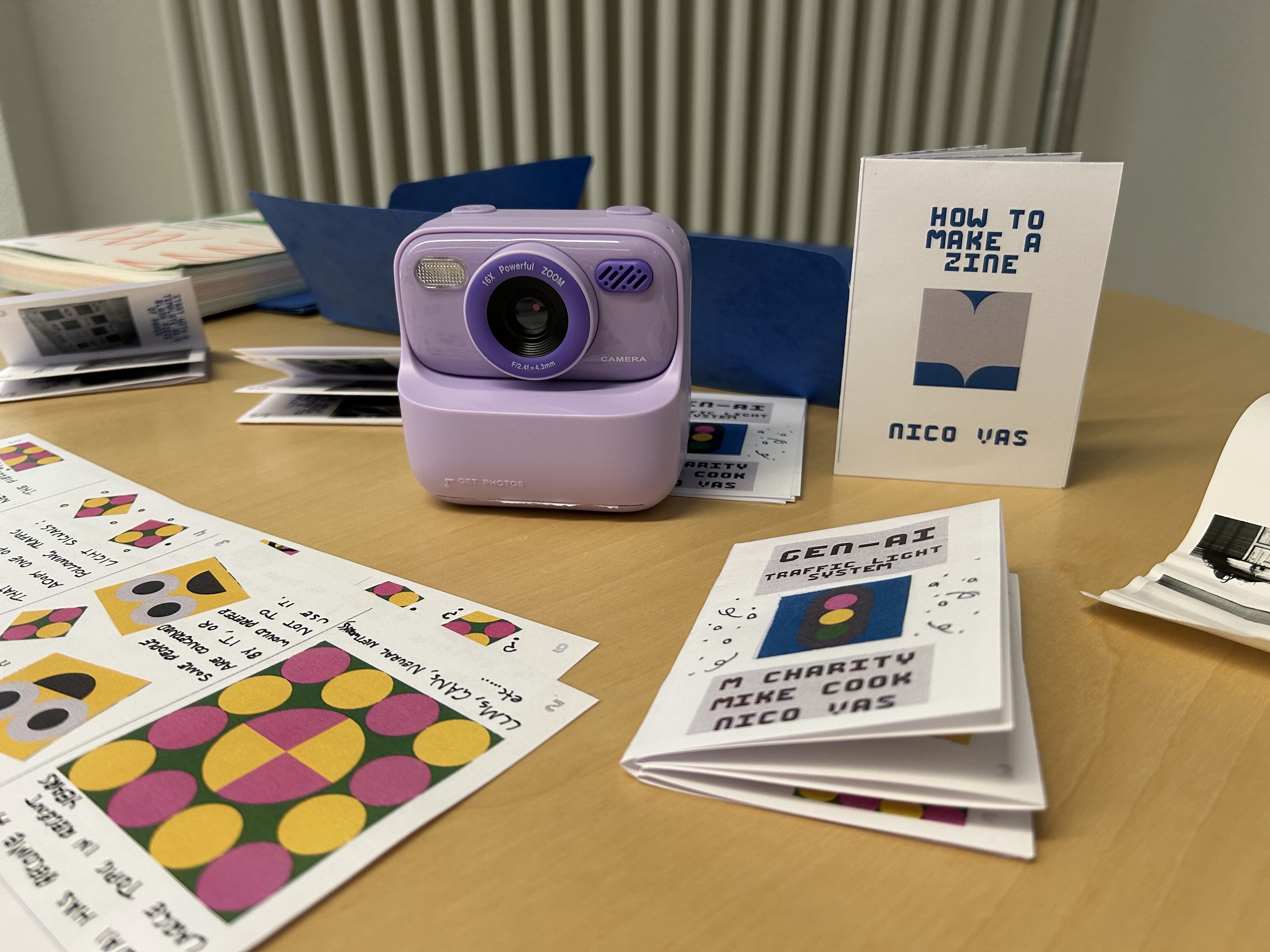
Figure 1 Some of the zines we provided at the start of the seminar - including zines about making zines. The purple cameras were used in the icebreaker namebadge-making, but also used throughout the week for projects and recording the seminar. They printed directly onto thermal paper from the camera itself, making them a useful tool for rapid creative projects.
Bringing people together with different backgrounds, experiences and ways of working always presents challenges. It can also be daunting to turn up to a new community and be sure that your contributions will be accepted, or that you will be able to understand your peers' perspectives. We took some steps to help set the tone for the seminar. Nicolaas, one of the organising team, meticulously designed a wonderful icebreaking session where invitees helped each other make their own alternative physical nametags. As part of this, they also got a taste of Dagstyle, a creativity system designed by Nicolaas for use during the week, as an inspiration and a source of things to hack and repurpose during the week of workshops. Dagstyle is a visual language of sorts, that can be used for many things. An abstract later in the full report provides an overview of the system, should any future Dagstuhl Seminar want to use it in their own work. Most of our working groups used Dagstyle in some form or another, with one of the most prominent uses of it in Section \ref{sec:vvgdl}, where it is used as a prototype for a visual programming language.
During the week, we followed the traditions of the previous games research seminars held at Dagstuhl, by inviting working group proposals at the start of each day and allowing people to self-organise into groups. Each group would then report at the end of the day on their work. The full report record many of the working groups that took place during the seminar, covering topics such as a design language for gameplay curves (Sec. 3.5 of the full report), an examination of design intent (Sec. 3.6 of the full report) and a study of generative AI in the context of rapid prototyping (Sec. 3.8 of the full report).
Generative AI’s impact on discourse in both computer science research and on the games industry was impossible to ignore in 2025, and we wanted to ensure people were able to explore and experiment freely during the week, without being trapped in projects they didn’t want to be a part of. To fit this, we instituted a “traffic light” system, suggested by Florence Smith Nicholls, which allowed working group organisers to label their group and how they planned to use generative AI for their project, if they chose to use it at all.
A project labeled as “green” meant that generative AI would be the focus or core of the project design. The projects proposed under this category often focused on the use of large language models, text-to-image generation, or other commercial or open-sourced generative AI models as part of the final prototype or in the design process.
A project labeled as “red” meant that the use of generative AI would be avoided entirely for the project design. Many of the projects proposed under this category focused on more analog forms of game design and content creation or the conceptual practice of game design and around user intent and social dynamics of games.
A project labeled as “yellow” meant that the use of generative AI would not necessarily be the focus and could be used agnostically. Many of the projects proposed and completed for working groups during this seminar fell under this category. By defining these clear categories for the directions of the projects proposed, seminar attendees were able to understand which projects they were interested in joining and comfortably set boundaries before committing to a working group.
One of the great joys of bringing together so many creative, generous and kind people is that a community almost instantly forms, and unexpected things emerge from it. In addition to our working groups during the day, our attendees put on a wide variety of social activities in the evening which helped attendees get to know one another better, and to play. Our thanks to Tiago Machado for organising a tango lesson, to Mike Cook and Gillian Smith for leading a livecoding workshop, to Emily Short for running a collaborative game writing night about AI fear, and to Claus Aranha for ending the week by putting together a night of Slideshow Karaoke.
We encouraged our participants to think broadly and explore what they were passionate about during the week, particularly as it was an opportunity to work with a unique combination of people and skillsets. However, we welcomed working groups that were centred around prototypes and small working examples, where it made sense for the questions being considered. We were delighted to see many prototypes and interactive projects emerge from the week, including almost a dozen playable games, some of which have already been archived online. Parallel to this, we provided plentiful crafting materials and support for making zines in conjunction with working group outputs. Zines are small booklets, traditionally made using cut-and-paste techniques and photocopiers. We encouraged the use of Nathalie Lawhead’s Electric Zine Maker, and several participants made zines as part of their participation – notably as a key part of the output for the working group on Keepsake Games in Section 3.12 of the full report. Many of the zines made during the seminar are included as part of this report, including Nicolaas’ Dagstyle zine on making zines, which we presented at the beginning of the week.
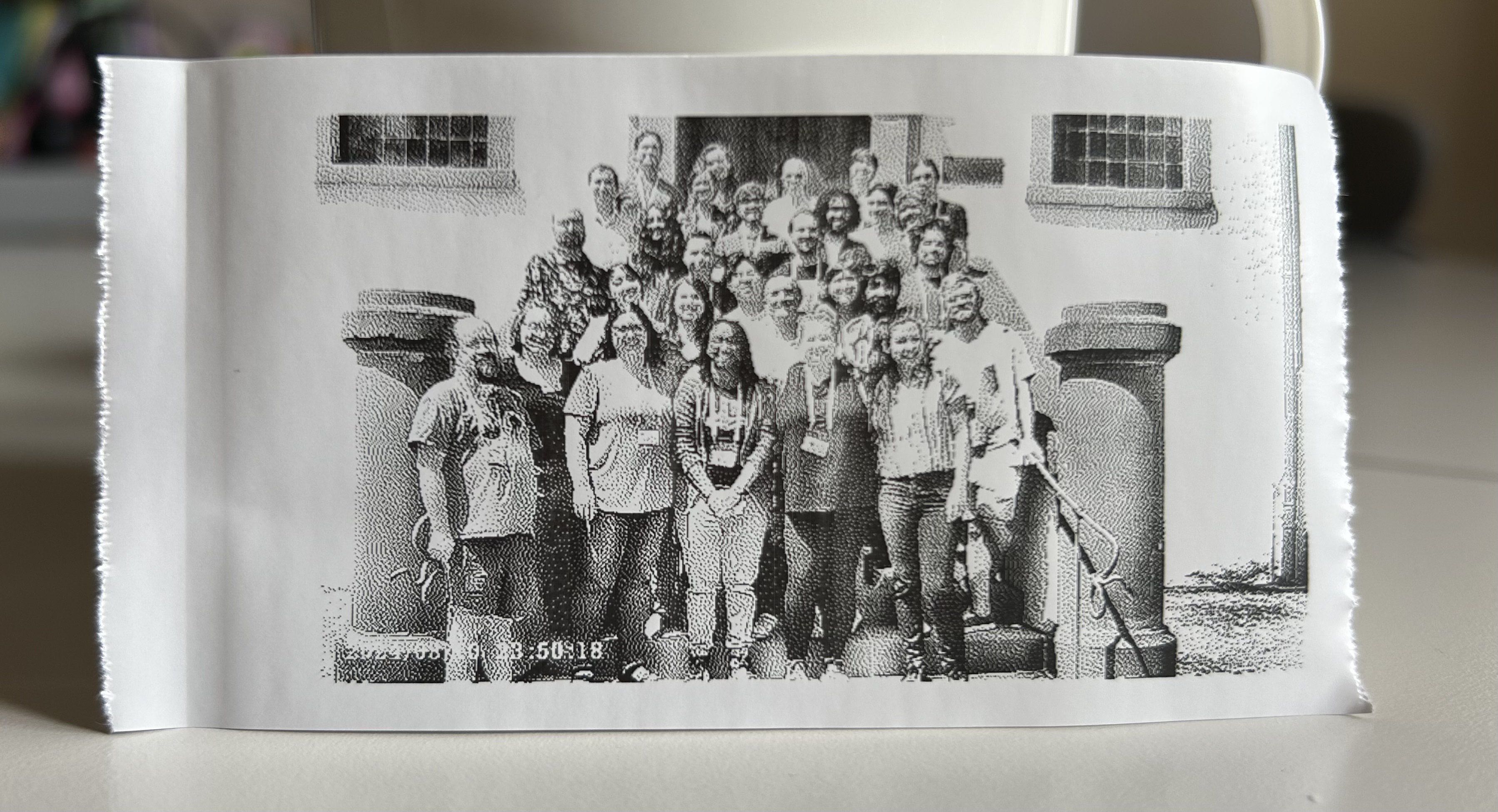
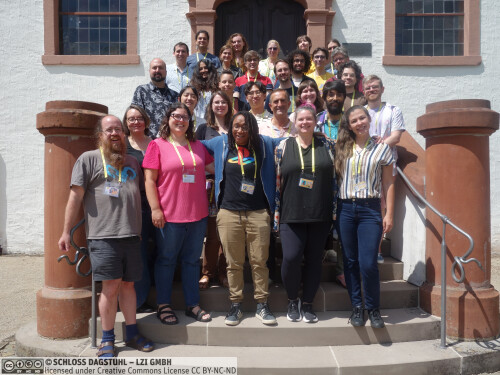
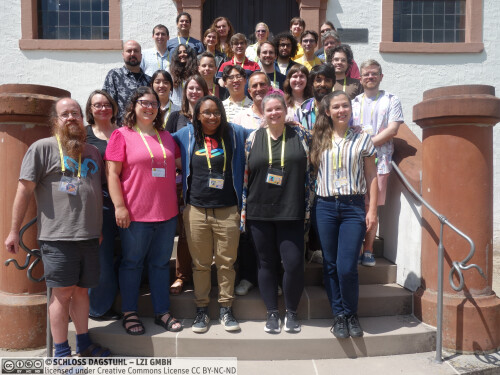
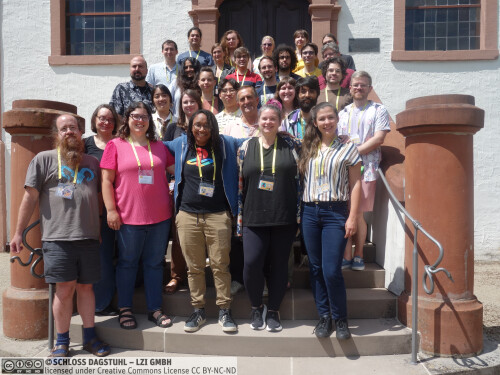
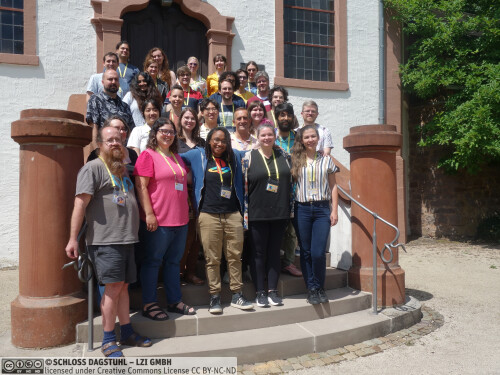
Figure 1 Our seminar's group photo, captured on one of the cheap cameras we supplied to participants, printed on thermal paper. Thanks to the Dagstuhl staff for taking extra photos for us!
Dagstuhl Seminars often have an otherworldly quality to them - a gathering of people that often seems impossible or improbable, in a beautiful, isolated setting, where all the traditional rules for how we work are thrown out of the window for a few days. Our stated aim was to explore how AI and related technologies might impact game design, and vice versa. Our working groups embraced this challenge in various ways: thinking about new ways to integrate design and theory; finding new applications for established approaches; testing the limits of, and our assumptions about, new technology; and much more besides. The seminar has already given rise to new international collaborations, game projects and funding plans. On a meta-level, though, the seminar \textit{itself} was also an exploration of how research and design can meet in the same place and find play there. It was a week about play that was also playful, where people from different fields, industries and backgrounds could find new ways to communicate, share and collaborate through games and creativity. As organisers, we are incredibly grateful for everyone who came and gave their time, their ideas and their energy to the impromptu community we built over the course of the week.
One of the games created during the week was by Anne Sullivan. Anne brought a wide variety of painting supplies to the seminar, encouraging everyone to use them both for work and play. As part of the working group on Keepsake Games, Anne designed a keepsake game specifically for playing while at a Dagstuhl Seminar. The player is randomly given, or chooses, a series of creative prompts and then designs a postcard to give to another attendee at the seminar. The prompts provide suggestions for what to put on the postcard (for example: something representing a working group), and who to give the postcard to (for example: someone new you met at the seminar). We concluded the week by inviting all attendees to create postcards using Anne's game, using the leftover crafting supplies and Anne's brush pens, and exchange them with other attendees before leaving. It was a brilliant opportunity for reflection at the end of the week, and for strengthening the community ties that had been created over the preceding days.
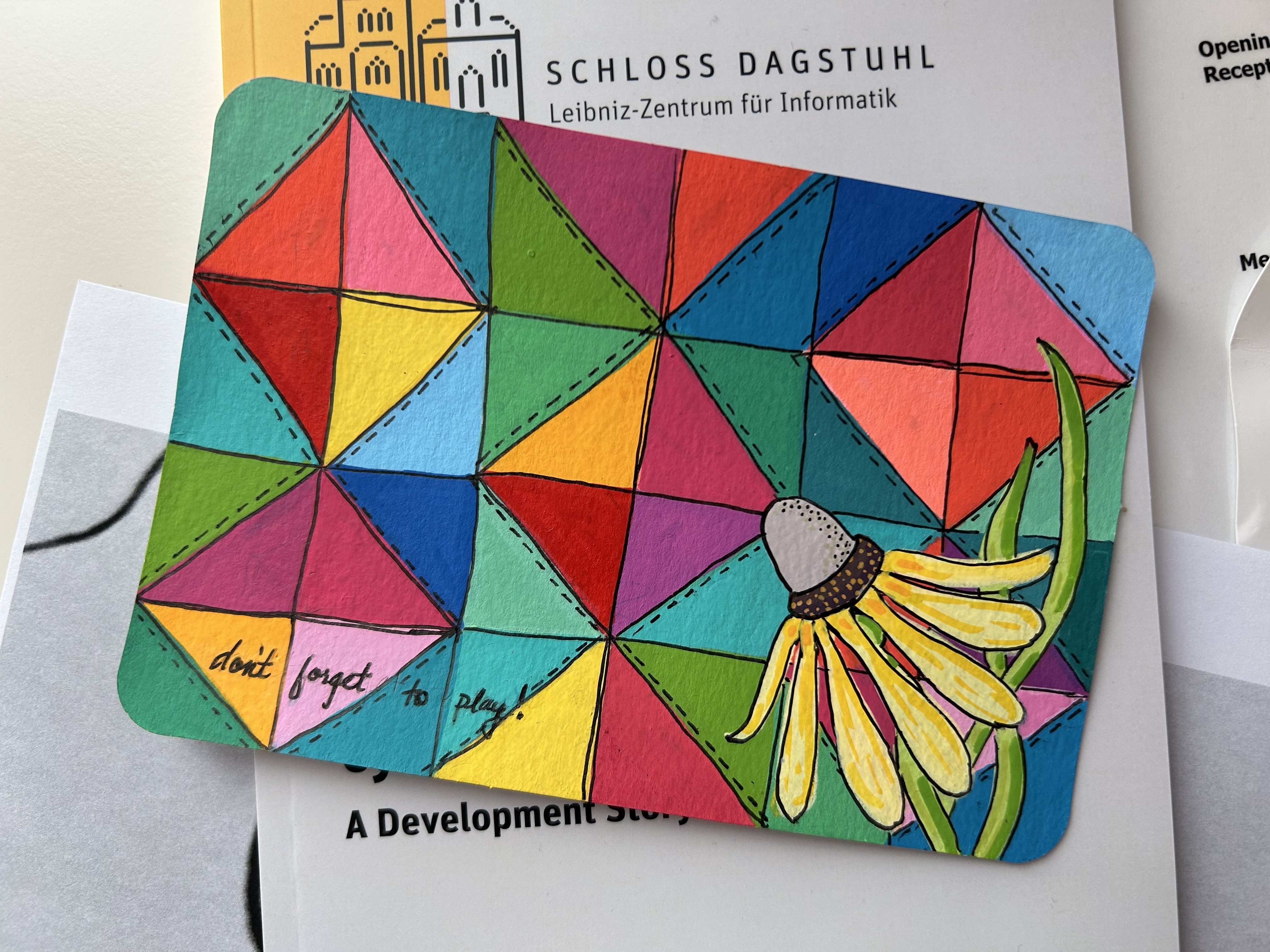
Figure 1 One of the postcards made on the final day, in this case by the postcard game's designer, Anne Sullivan. The postcard features patterned designs from Calico, a boardgame which was played at the seminar, and a flower that Anne spotted around Dagstuhl itself.
References
- The Experimental Gameplay Workshop. Online: https://www.experimentalgameworkshop.org
 Creative Commons BY 4.0
 Michael Cook, M Charity, and Nicolaas Vas
From the first thrown dice and lots to modern VR and AR headsets, technology has always driven, and been driven by, the ways in which we play with one another. Today, AI is a major driving force behind innovation in creative and playful spaces, as well as the field of game design. AI has been leveraged in a variety of ways over the past few decades, from breathing life into fictional characters that walk around game worlds, to analyzing gameplay and assisting developers. New technology doesn’t simply increase profit margins – it brings games to new audiences, helps people overcome barriers to play, and empowers designers to design completely new kinds of experience. This Dagstuhl Seminar focuses on bringing together world-leading researchers, makers, artists and engineers to devise and discuss the next generation of playful experiences and technologies.
Tools and technology drive huge shifts in the games industry. Several of the top-selling games from the last decade, for instance, were built on top of procedural content generation, a technology that has been a core focus of game AI research for decades. Novel game design tools such as Inky, PICO-8 and Puzzlescript have changed how games are made and who can make them, which has reshaped the landscape of the games industry. Bringing academics into contact with the practicalities of making both games and game-making tools is crucial to driving progress both for the commercial games industry and the millions of people around the world making games for other purposes. As such, this seminar will focus on practical building, prototyping and testing, alongside discussion groups and tutorial sessions. By the end of the seminar, we aim to have not only identified new research questions and fostered collaborations between attendees, but also have a suite of games and prototypes to present alongside our traditional Dagstuhl Seminar report.
The goal of this Dagstuhl Seminar is to bring together researchers and designers in the game design and game AI spaces to explore the current and future uses of AI in the practice of game design. This seminar will cover a wide breadth of topics within AI including the following: automated game design; generative AI, procedural content generation; computational creativity; co-creative assistance and mixed-initiative design; speculative design tools and interfaces, including computational craft; game evaluation; human-computer interaction; heuristic search methods; evolutionary design; online community science; and topics within game design practice. Our work will not be limited to the digital: we will be bringing many physical creativity and building systems to the event, as well as inviting several well-known designers of physical installation artworks and games. Part of our goal is to investigate how both AI research and videogames can bridge the gap to the physical world, and explore game AI in a more embodied sense – through toys, creativity and physical games. We aim for this seminar to be guided by, and built around, a sense of fun and play – and in doing so, to find new avenues for research and practice to explore together.
M Charity, Michael Cook, Nicolaas Vas, and Georgios N. Yannakakis
- Dagstuhl Reports 2025
Blog entry by Mike Cook, published July 21, 2025.
- Claus Aranha (University of Tsukuba, JP) [dblp]
- Maren Awiszus (Viscom AG - Hannover, DE) [dblp]
- In-Chang Baek (Gwangju Institute of Science & Technology, KR) [dblp]
- June Bhartia (Télécom Paris, FR)
- Rafael Bidarra (TU Delft, NL) [dblp]
- Brian Bucklew (Freehold Games - Walkerton, US) [dblp]
- Duygu Cakmak (Creative Assembly - Horsham, GB) [dblp]
- M Charity (University of Richmond, US) [dblp]
- Kate Compton (Vejle, DK) [dblp]
- Michael Cook (King's College London, GB) [dblp]
- Alena Denisova (University of York, GB) [dblp]
- Rémy Devaux (Punkcake Délicieux - Cenon, FR)
- Alexander Dockhorn (University of Southern Denmark - Odense, DK) [dblp]
- Matthew J. Guzdial (University of Alberta - Edmonton, CA) [dblp]
- Emily Halina (University of Alberta - Edmonton, CA) [dblp]
- Max Kreminski (Midjourney - Santa Clara, US) [dblp]
- Antonios Liapis (University of Malta - Msida, MT) [dblp]
- Tiago Machado (IBM Research - Sao Paulo, BR) [dblp]
- Timothy Merino (NYU - New York, US) [dblp]
- Younès Rabii (Queen Mary University of London, GB) [dblp]
- Dipika Rajesh (University of California at Santa Cruz, US) [dblp]
- Emily Short (Oxford, GB) [dblp]
- Adam M. Smith (University of California - Santa Cruz, US) [dblp]
- Gillian Smith (Worcester Polytechnic Institute, US) [dblp]
- Florence Smith Nicholls (Queen Mary University of London, GB) [dblp]
- Anne Sullivan (York University - Toronto, CA) [dblp]
- Yuqian Sun (Royal College of Art - London, GB) [dblp]
- Nicolaas Vas (Billund, DK)
- Sabine Wieluch (Universität Ulm, DE)
Verwandte Seminare
- Dagstuhl-Seminar 27292: New Frontiers in HCI and Narrative Design (2027-07-18 - 2027-07-23) (Details)
Klassifikation
- Artificial Intelligence
- Human-Computer Interaction
Schlagworte
- game design
- artificial intelligence
- computational creativity
- procedural content generation
- human-computer interaction