
Dagstuhl-Seminar 25291
(Actual) Neurosymbolic AI: Combining Deep Learning and Knowledge Graphs
( 13. Jul – 18. Jul, 2025 )
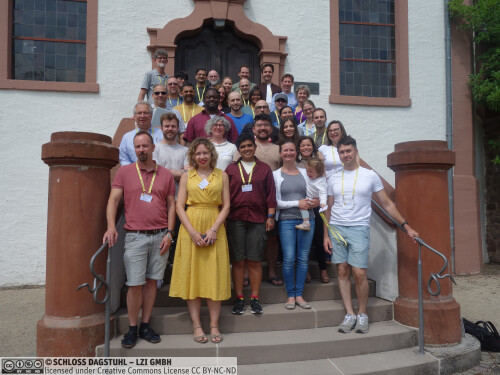
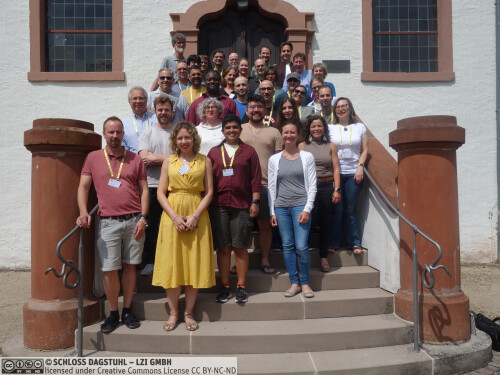
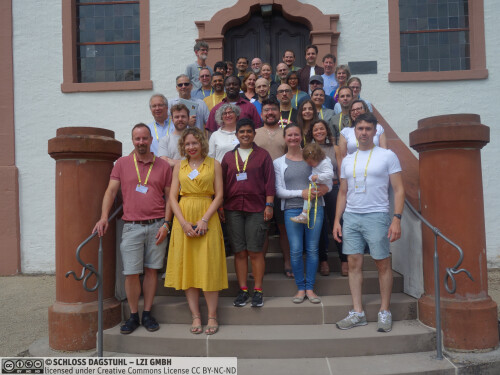
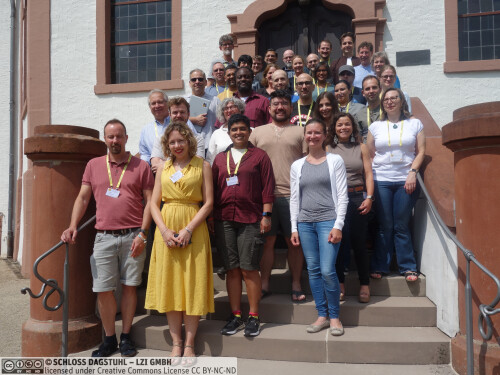

(zum Vergrößern in der Bildmitte klicken)
Permalink
Bitte benutzen Sie folgende Kurz-Url zum Verlinken dieser Seite:
https://www.dagstuhl.de/25291
Organisatoren
- Pascal Hitzler (Kansas State University - Manhattan, US)
- Cogan Shimizu (Wright State University - Dayton, US)
- Daria Stepanova (Bosch Center for AI - Renningen, DE)
- Frank van Harmelen (VU Amsterdam, NL)
Kontakt
- Marsha Kleinbauer (für wissenschaftliche Fragen)
- Simone Schilke (für administrative Fragen)
Run un-conference style, with merely three set presentations for topic introductions, the participants decided on themes of discussion groups within the theme of the seminar, and on the goal of providing a written account, found in the full report, of the emerging themes, structured into definitions, ambitions, challenges, and the state of the art. The themes that emerged are the themes of the Breakout Group Reports found therein: Defining Neurosymbolic Systems; Symbol Emergence; Small Data and Neurosymbolic AI; Explainable AI; Neurosymbolic AI in the Age of Generative AI; Knowledge Graphs and Ontologies in Neurosymbolic Systems; Cognition and Neurosymbolic AI; Benchmarks in the Neurosymbolic Ecosystem; and Real-World Applications in Neurosymbolic Artificial Intelligence. Additional discussions evolved around the general question of how the two major outlets for Neurosymbolic AI -- the Neurosymbolic Learning and Reasoning Conference and the Neurosymbolic AI journal -- can best support the nascent community. Key drivers of both outlets were in attendance at the seminar and have already begun to set some of the discussion results into motion.
The Seminar
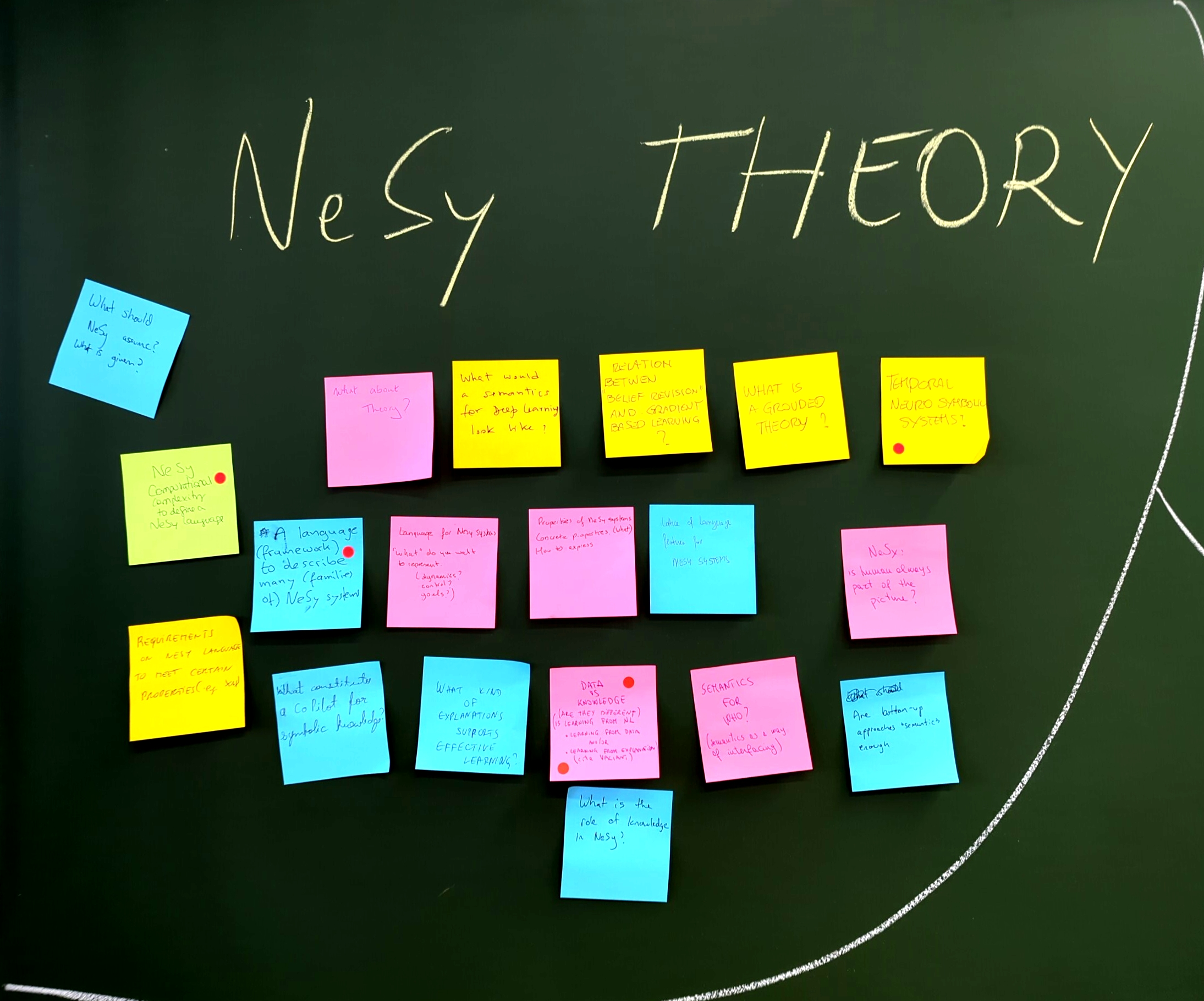
Figure 1 A picture of the NeSy Theory cluster of topics. The specific colors do not have meaning. The dots signify a "vote" rather than repeating a new version of the sticky.
Thirty-four participants were finally able to attend the seminar. We believe that the diversity of our attendees was both fair, broad, and representative of the breadth of the fields: bridging seniority, gender diversity, geographic location, industry vs. academia, and expertise in neural or symbolic (or both) AI systems. But even through the variety, there were interesting through-lines and other connections.
We began introductions through a novel experience: announcing an interesting or otherwise memorable failure [of our own]. In particular, we were interested in "What have you tried, that just didn't seem to work?" This process set us on even ground: we are equal in our setbacks, and we were there to help each other overcome them.
This seminar followed an unconference-style. This means that there was only a very loose structure. There were only three imposed talks, given at the start of the first three days. These talks were given by well-regarded figures (see Section 3 of the full report, to give broad, deep, and historical perspectives of neurosymbolic AI. The remainder of each day was organized into breakouts. These breakout groups were self-selected and even self-generated. After the initial roll-call, we performed a group exercise:
We wrote down any number of topics that we wanted to tackle this week onto a sticky.
We placed the topic-sticky onto the chalkboard at the front of the seminar room.
Small dot stickers were provided for attendees to upvote specific topic-stickies.
We collectively clustered the stickies and identified a theme.
While this reliance on attendee-participation was high-risk, it was also certainly high-reward. However, it was our intuition that the selected participants would be both amenable to this style, but also collegiate in their collective regard for each other, allowing for open, fluid, and vibrant discussion. Indeed, we believe that our risk paid off, and has culminated in the full report, as follows.
Overview of the Report
The report is organized into two parts. Section 3 of the full report provides the abstracts for the opening talks of the first three days of this seminar. Section 4 of the full report contains reports that are jointly written by each breakout group, as described above. Each report provides an overview of the topic, addresses ambitions and challenges, and describes the state of the art.
 Creative Commons BY 4.0
 Cogan Shimizu, Pascal Hitzler, Daria Stepanova, and Frank van Harmelen
In the past decade, both deep learning (DL) and knowledge graphs (KGs) have seen astonishing growth and groundbreaking milestones – DL due to newly available resources (e.g., accessibility of (modern) web scale data), previously un-scalable techniques (e.g., transformers), and modern hardware; KGs due to successful standardization, web-scale integration, and previously un-scalable techniques for querying and inference. This has brought new and increased interest to both fields, and especially in how they can complement each other.
DL systems have been successfully applied in a massive collection of use-cases. Especially prominent in the zeitgeist, are large language models (LLMs), many of which are based on transformers, and are increasingly accessible and diverse. Notably, LLMs are not great at distinguishing fact from fiction, generally due to the nature of their construction, but also through the quality or type of data used in training. One way to overcome this problem is through structured, human-curated knowledge, and a prominent form of this are KGs, which are widely used as a platform for knowledge management and symbolic data representation. They have quickly become a major paradigm for the creation, extraction, integration, representation, and visualization of data, based on long-established W3C standards and recommendations. This is especially the case when an ontology is used as schema. Yet, the construction of KGs and the development of a high-quality ontology can be very effort intensive. Furthermore, symbolic representations are brittle, in contrast to the DL models, which can learn from (possibly) noisy data manner.
This Dagstuhl Seminar will focus on bridging the gap between deep learning and knowledge graphs, and will discuss their integration: neurosymbolic AI. The aim is to advance the understanding of how symbolic knowledge - in the form of KGs - can be used to improve the capabilities of DL systems, and how DL can advance KG construction and applications. Our participants will include experts and emerging researchers deeply embedded in both fields, which span the (non-exhaustive) lines of investigation:
- Grounding of DL models in facts sourced from symbolic models (e.g., KGs).
- Utilization of symbolic knowledge to improve the explainability, robustness, interpretability, generalization, and transferability of DL models and their behaviors.
- Fusion of strategies where a neural or symbolic approach excels, but the other does not.
- Incorporating common-sense and domain knowledge into systems for improved causal analysis.
- The usage of DL models to extract symbolic knowledge from data.
- Vectorization of data with symbolic knowledge and the vectorization of knowledge with data.
Additionally, time will be set aside to tackle blue sky ideas, such as the integration of biologically inspired DL systems as they translate to the human-level learning, retention, and execution of procedural knowledge.
Pascal Hitzler, Cogan Matthew Shimizu, Daria Stepanova, and Frank van Harmelen
- Mehwish Alam (Institut Polytechnique de Paris, FR) [dblp]
- Vaishak Belle (University of Edinburgh, GB) [dblp]
- Roberto Confalonieri (University of Padova, IT) [dblp]
- Claudia d'Amato (University of Bari, IT) [dblp]
- Artur d'Avila Garcez (City - University of London, GB) [dblp]
- Jennifer D'Souza (Leibniz Universität Hannover, DE) [dblp]
- Luc De Raedt (KU Leuven, BE) [dblp]
- Natalia Díaz-Rodríguez (University of Granada, DE) [dblp]
- Anna Lisa Gentile (IBM Almaden Center - San Jose, US) [dblp]
- Dagmar Gromann (Universität Wien, AT) [dblp]
- Pascal Hitzler (Kansas State University - Manhattan, US) [dblp]
- Filip Ilievski (VU Amsterdam, NL) [dblp]
- Ernesto Jiménez-Ruiz (City - University of London, GB) [dblp]
- Mena Leemhuis (Free University of Bozen-Bolzano, IT)
- Bertram Ludäscher (University of Illinois at Urbana-Champaign, US) [dblp]
- Giuseppe Marra (KU Leuven, BE) [dblp]
- Hande McGinty (Kansas State University - Manhattan, US) [dblp]
- Raghava Mutharaju (IIITD - New Dehli, IN) [dblp]
- Axel-Cyrille Ngonga Ngomo (Universität Paderborn, DE) [dblp]
- Stefan Ollinger (Universität Trier, DE) [dblp]
- Alessandro Oltramari (Carnegie Bosch Institute - Pittsburgh, US) [dblp]
- Catia Pesquita (University of Lisbon, PT) [dblp]
- Jay Pujara (USC - Marina del Rey, US) [dblp]
- Michael L. Raymer (Wright State University - Dayton, US) [dblp]
- Ute Schmid (Universität Bamberg, DE) [dblp]
- Luciano Serafini (Bruno Kessler Foundation - Trento, IT) [dblp]
- Cogan Shimizu (Wright State University - Dayton, US) [dblp]
- Gustav Šír (Czech Technical University in Prague, CZ) [dblp]
- Daria Stepanova (Bosch Center for AI - Renningen, DE) [dblp]
- Valentina Tamma (University of Liverpool, GB) [dblp]
- Annette ten Teije (VU Amsterdam, NL) [dblp]
- Riccardo Tommasini (INSA - Lyon, FR) [dblp]
- Frank van Harmelen (VU Amsterdam, NL) [dblp]
- Eugene Vasserman (Kansas State University - Manhattan, US) [dblp]
Klassifikation
- Artificial Intelligence
- Logic in Computer Science
- Machine Learning
Schlagworte
- neurosymbolic ai
- knowledge graphs
- deep learning