
Dagstuhl-Seminar 08361
Programming Multi-Agent Systems
( 31. Aug – 05. Sep, 2008 )
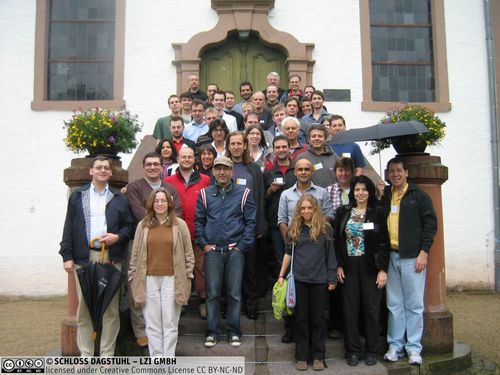
(zum Vergrößern in der Bildmitte klicken)
Permalink
Bitte benutzen Sie folgende Kurz-Url zum Verlinken dieser Seite:
https://www.dagstuhl.de/08361
Organisatoren
- Rafael H. Bordini (Federal University of Rio Grande do Sul, BR)
- Mehdi Dastani (Utrecht University, NL)
- Jürgen Dix (TU Clausthal, DE)
- Amal El Fallah-Seghrouchni (Université Paris VI, FR)
Kontakt
- Annette Beyer (für administrative Fragen)
Presse/News
-
Multiagentensysteme werden zu Katastrophenhelfern
Bericht von Gerd Martin in der Computer Zeitung Online am 6.10.2008 -
Wie bei einer Katastrophe künstliche Agenten zusammenarbeiten
Press Release 12.08.2008 (German only)
Intelligent agents and multi-agent systems (MAS) play an important role in today's software development. In fact, they constitute a new and interesting paradigm to implement complex systems, by offering relevant abstractions for the engineering of such intricate type of software. Several application domains, some at industrial level, take benefit from MAS technology. For almost two decades, the MAS community has developed and offers a large and rich set of concepts, architectures, interaction techniques, and general approaches to the analysis and the specification of MAS.
One of the main challenges of the MAS community in recent years has been to combine the existing practical tools and theoretical approaches in order to provide practitioners with mature programming languages and platforms that help them to design, implement, and deploy efficiently a new generation of complex software built as MAS. The organisers of this seminar, and also the participants, share the conviction that the success of agent-based systems can only be guaranteed if expressive programming languages and well-developed platforms are available, so that the concepts and techniques of multi-agent systems can be easily and directly used in practice
The aim of this seminar was to bring together researchers from both academia and industry for bridging this gap and identifying interesting lines of research within multi-agent systems. In this respect, the seminar topic is also very relevant for industrial research and development.
The seminar concluded with very positive results, both in regards to the scientific content as well as a networking opportunity. Meanwhile, we have secured a special issue of the Journal of Autonomous Agents and Multi-Agent Systems for the best papers based on talks given by the participants of this Dagstuhl seminar. An internal call for papers has been issued and we aim for publication in the second half of 2009.
In summary, it is our impression that the participants enjoyed the great scientific atmosphere offered by Schloss Dagstuhl, and the technical programme of the seminar. We are grateful for having had the opportunity to organise this fruitful seminar, specially because it was another Dagstuhl seminar which helped us, six years ago, to start an outstanding international cooperation in the domain of Multi-Agent Programming (see references). Special thanks are due to the whole Dagstuhl staff for their assistance in the organisation and the running of the seminar.
- Lacramioara Astefanoaei (CWI - Amsterdam, NL)
- Matteo Baldoni (University of Turin, IT) [dblp]
- Cristina Baroglio (University of Turin, IT) [dblp]
- Tristan Behrens (TU Clausthal, DE)
- Olivier Boissier (Ecole des Mines - St. Etienne, FR) [dblp]
- Rafael H. Bordini (Federal University of Rio Grande do Sul, BR) [dblp]
- Lars Braubach (Universität Hamburg, DE) [dblp]
- Nils Bulling (TU Clausthal, DE) [dblp]
- Keith L. Clark (Imperial College London, GB) [dblp]
- Rem Collier (University College Dublin, IE) [dblp]
- Mehdi Dastani (Utrecht University, NL) [dblp]
- Louise A. Dennis (University of Liverpool, GB) [dblp]
- Jürgen Dix (TU Clausthal, DE) [dblp]
- Amal El Fallah-Seghrouchni (Université Paris VI, FR) [dblp]
- Michael Fisher (University of Liverpool, GB) [dblp]
- Roberto Grenna (University of Turin, IT)
- Koen V. Hindriks (TU Delft, NL) [dblp]
- Jomi Fred Hübner (Ecole des Mines - St. Etienne, FR) [dblp]
- Wojtek Jamroga (University of Luxembourg, LU) [dblp]
- Catholijn M. Jonker (TU Delft, NL) [dblp]
- Michael Koester (TU Clausthal, DE)
- João A. Leite (Universidade Nova de Lisboa, PT) [dblp]
- John W. Lloyd (Australian National University, AU)
- Bruno Mermet (University of Le Havre, FR)
- Sanjay Modgil (King's College London, GB) [dblp]
- Álvaro Moreira (Federal University of Rio Grande do Sul, BR) [dblp]
- Berndt Müller (Durham University, GB)
- Peter Novák (TU Clausthal, DE) [dblp]
- Andrea Omicini (University of Bologna, IT) [dblp]
- Michele Piunti (CNR - Rome, IT)
- Alexander Pokahr (Universität Hamburg, DE) [dblp]
- Alessandro Ricci (University of Bologna, IT) [dblp]
- Patricia Shaw (Durham University, GB)
- Jaime Sichman (University São Paulo, BR) [dblp]
- Bas Steunebrink (Utrecht University, NL)
- Patrick Taillibert (Thales - Elancourt, FR)
- Nick Tinnemeier (Utrecht University, NL)
- Paolo Torroni (University of Bologna, IT)
- Leon van der Torre (University of Luxembourg, LU) [dblp]
- Birna Van Riemsdijk (LMU München, DE) [dblp]
- Renata Vieira (PUCRS - Porto Alegre, BR)
Verwandte Seminare
- Dagstuhl-Seminar 02481: Programming Multi Agent Systems based on Logic (2002-11-24 - 2002-11-29) (Details)
- Dagstuhl-Seminar 06261: Foundations and Practice of Programming Multi-Agent Systems (2006-06-25 - 2006-06-30) (Details)
- Dagstuhl-Seminar 12342: Engineering Multi-Agent Systems (2012-08-19 - 2012-08-24) (Details)
Klassifikation
- artificial intelligence / robotics
- modelling / simulation
- programming languages / compiler
- semantics / specification / formal methods
Schlagworte
- Multi-agent systems
- multi-agent programming
- programming distributed systems
- software methodologies for distributed systems