
Dagstuhl Seminar 12271
AI meets Formal Software Development
( Jul 01 – Jul 06, 2012 )
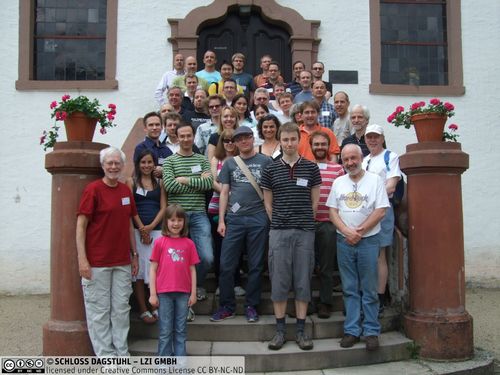
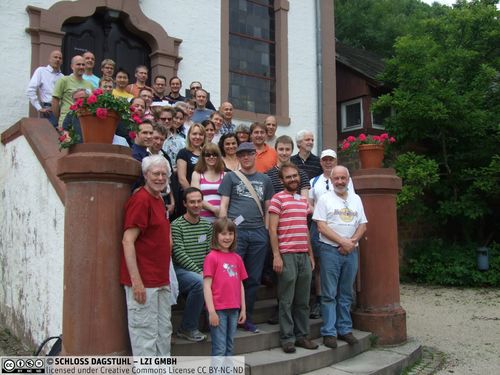
(Click in the middle of the image to enlarge)
Permalink
Please use the following short url to reference this page:
https://www.dagstuhl.de/12271
Organizers
- Alan Bundy (University of Edinburgh, GB)
- Dieter Hutter (DFKI - Bremen, DE)
- Cliff B. Jones (University of Newcastle, GB)
- J Strother Moore (University of Texas - Austin, US)
Contact
- Susanne Bach-Bernhard (for administrative matters)
This seminar brought together researchers from formal methods and AI. The participants addressed the issue of how AI can aid the formal software development process, including modelling and proof. There was a pleasing number of participants from industry and this made it possible to ground the discussions on industrial-scale problems.
Industrial use of formal methods is certainly increasing but in order to make it more mainstream, the cost of applying formal methods, in terms of mathematical skill level and development time, must be reduced --- and we believe that AI can help with these issues.
Rigorous software development using formal methods allows the construction of an accurate characterisation of a problem domain that is firmly based on mathematics; by applying standard mathematical analyses, these methods can be used to prove that systems satisfy formal specifications. A recent ACM computing survey describes over sixty industrial projects and discusses the effect formal methods have on time, cost, and quality. It shows that with tools backed by mature theory, formal methods are becoming cost effective and their use is easier to justify, not as an academic exercise or legal requirement, but as part of a business case. Furthermore, the use of such formal methods is no longer confined to safety critical systems: the list of industrial partners in the DEPLOY project is one indication of this broader use. Most methods tend to be posit-and-prove, where the user posits a development step (expressed in terms of specifications of yet-to-be-realised components) that has to be justified by proofs. The associated properties that must be verified are often called proof obligations (POs) or verification conditions. In most cases, such proofs require mechanical support by theorem provers.
One can distinguish between automatic and interactive provers, where the latter are generally more expressive but require user interaction. Examples of state-of-the-art interactive theorem provers are ACL2, Isabelle, HOL, Coq and PVS, while E, SPASS, Vampire and Z3 are examples of automatic provers.
AI has had a large impact on the development of provers. In fact, one of the first AI application was a theorem prover and all theorem provers now contain heuristics to reduce the search space that can be attributed to AI. Nevertheless, theorem proving research and (pure) AI research have diverged, and theorem proving is barely considered to be AI-related anymore.
- Rob Arthan (Lemma 1 Ltd. - Twyford, GB) [dblp]
- Serge Autexier (DFKI - Bremen, DE) [dblp]
- Alan Bundy (University of Edinburgh, GB)
- Simon Colton (Imperial College London, GB) [dblp]
- David Crocker (Escher Technologies - Aldershot, GB)
- Jorge R. Cuéllar (Siemens AG - München, DE) [dblp]
- Ewen W. Denney (NASA - Moffett Field, US) [dblp]
- Leo Freitas (University of Newcastle, GB) [dblp]
- Dimitra Giannakopoulou (NASA - Moffett Field, US) [dblp]
- Gudmund Grov (University of Edinburgh, GB) [dblp]
- Reiner Hähnle (TU Darmstadt, DE) [dblp]
- Dieter Hutter (DFKI - Bremen, DE)
- Andrew Ireland (Heriot-Watt University Edinburgh, GB)
- Moa Johansson (Chalmers UT - Göteborg, SE) [dblp]
- Cliff B. Jones (University of Newcastle, GB) [dblp]
- Ekaterina Komendantskaya (University of Dundee, GB) [dblp]
- Thierry Lecomte (CLEARSY - Aix-en-Provence, FR) [dblp]
- K. Rustan M. Leino (Microsoft Corporation - Redmond, US) [dblp]
- Michael Leuschel (Heinrich-Heine-Universität Düsseldorf, DE) [dblp]
- Yu Hui Lin (University of Edinburgh, GB)
- Maria Teresa Llano Rodriguez (Heriot-Watt University Edinburgh, GB)
- Christoph Lüth (DFKI - Bremen, DE) [dblp]
- Ursula Martin (Queen Mary University of London, GB)
- Stephan Merz (LORIA - Nancy, FR) [dblp]
- Rosemary Monahan (NUI Maynooth, IE) [dblp]
- J Strother Moore (University of Texas - Austin, US) [dblp]
- Michal Moskal (Microsoft Corporation - Redmond, US)
- Yannick Moy (AdaCore - Paris, FR) [dblp]
- José Nuno Oliveira (University of Minho - Braga, PT) [dblp]
- Thomas Santen (European Microsoft Innovation Center - Aachen, DE) [dblp]
- Stephan Schulz (TU München, DE) [dblp]
- Volker Sorge (University of Birmingham, GB)
- Mark Staples (NICTA - Eveleigh, AU) [dblp]
- Kurt Stenzel (Universität Augsburg, DE)
- Werner Stephan (DFKI - Saarbrücken, DE) [dblp]
- Helen Treharne (University of Surrey, GB) [dblp]
- Josef Urban (Radboud University Nijmegen, NL) [dblp]
- Andrius Velykis (University of Newcastle, GB)
- Laurent Voisin (SYSTEREL Aix en Provence, FR) [dblp]
- Martin Wehrle (Universität Basel, CH) [dblp]
Classification
- Artificial intelligence/robotics
- Semantics/formal methods
- Verification/logic
Keywords
- Learning of proof processes and strategies
- Theory Development
- Formal Software Development
- Automated reasoning
- Formal modelling
- Industrial use of formal methods