
Dagstuhl Seminar 12191
Artificial and Computational Intelligence in Games
( May 06 – May 11, 2012 )
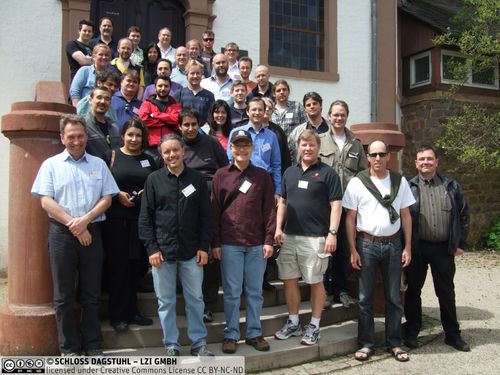
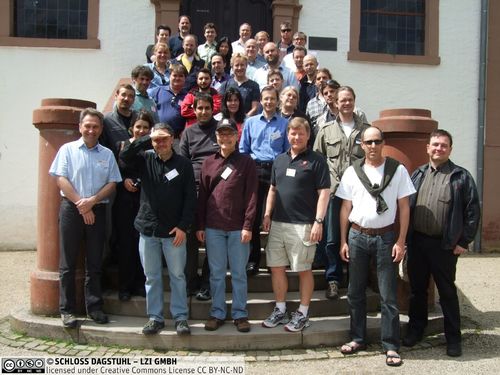
(Click in the middle of the image to enlarge)
Permalink
Please use the following short url to reference this page:
https://www.dagstuhl.de/12191
Organizers
- Simon M. Lucas (University of Essex, GB)
- Michael Mateas (University of California - Santa Cruz, US)
- Mike Preuß (TU Dortmund, DE)
- Pieter Spronck (Tilburg University, NL)
- Julian Togelius (IT University of Copenhagen, DK)
Coordinator
- Nicola Hochstrate (Lübeck, DE)
Contact
Publications
- Artificial and Computational Intelligence in Games (Dagstuhl Seminar 12191). Simon M. Lucas, Michael Mateas, Mike Preuss, Pieter Spronck, and Julian Togelius. In Dagstuhl Reports, Volume 2, Issue 5, pp. 43-70, Schloss Dagstuhl - Leibniz-Zentrum für Informatik (2012)
- Artificial and Computational Intelligence in Games. Simon M. Lucas, Michael Mateas, Mike Preuss, Pieter Spronck, and Julian Togelius (Eds.). Dagstuhl Follow-Ups, Volume 6. November 18, 2013
Impacts
- A comparison of methods for player clustering via behavioral telemetry : article in FDG 2013, the 8th International Conference on the Foundations of Digital Games - Drachen, Anders; Thurau, Christian; Sifa, Rafet; Bauckhage, Christian - http://www.fdg2013.org/, 2013. - pp. 245-252.
- A Panorama of Artificial and Computational Intelligence in Games : article : pp. 317-335 - Yannakakis, Georgios N.; Togelius, Julian - Los Alamitos : IEEE, 2014 - (IEEE Transactions on Computational Intelligence and AI in Games ; 7. 2015, 4).
- An Extensible Description Language for Video Games : article - Schaul, Tom - Los Alamitos : IEEE, 2014. - pp. 325-331 - (IEEE Transactions on Computational Intelligence and AI in Games ; 6. 2014, 5 : article).
- Archetypical Motion : Supervised Game Behavior Learning with Archetypal Analysis : article in "The Proceedings of the IEEE Conference on Computational Intelligence in Games 2013" - Sifa, Rafet; Bauckhage, Christian - Los Alamitos : IEEE, 2013. - pp. 89-96.
- Artificial and Computational Intelligence in Games - Lucas, Simon M.; Mateas, Michael; Preuss, Mike; Spronck, Pieter; Togelius, Julian - Wadern : LZI, 2013. - XIV, 108 S. - (Dagstuhl Follow-Ups ; 6). ISBN: 978-3-939897-62-0 / 3-939897-62-0.
- Computacion Efimera : identicando retos para la investigacion en videojuegos - Vazquez-Nunez, Ariel Eduardo; Fernandez-Leiva, Antonio J. - Aachen : CEUR, 2016. - 10 pp. - (CEUR workshop series ; 1682).
- Dagstuhl Manifesto : Artificial and Computational Intelligence in Games : pp. 410-412 : article - Lucas, Simon M.; Mateas, Michael; Preuss, Mike; Spronck, Pieter; Togelius, Julian - Berlin : Springer, 2013 - (Informatik Spektrum : 36. 2013, 4).
- Game Data Mining : chapter 12 : "Game Analytics : Maximizing the Value of Player Data" - Drachen, Anders; Thurau, Christian; Togelius, Julian; Yannakakis, Georgios N.; Bauckhage, Christian - Berlin : Springer, 2013. - pp. 205-253.
- General Video Game Artificial Intelligence - Perez Liebana, Diego; Lucas, Simon M.; Gaina, Raluca D.; Togelius, Julian; Khalifa, Ahmed; Liu, Jialin - San Rafael : Morgan & Claypool Publishers, 2020. - XIII, 177 S. - (Synthesis lectures on games and computational intelligence ; 5).
- The 2014 General Video Game Playing Competition : article, pp. 229-243 - Perez, Diego; Samothrakis, Spyridon; Togelius, Julian; Couetoux, Adrien; Lee, Jerry; Thompson, Tommy; Lim, Chong-U; Lucas, Simon M.; Schaul, Tom - Los Alamitos : IEEE, 2015. - (IEEE Transactions on Computational Intelligence and AI in Games ; 9. 2016, 3).
The video game industry is the largest of the entertainment industries and growing rapidly. The foundations of this industry are techniques from computer science. New developments within video games pose fresh challenges to computer scientists. Around the world, the number of dedicated study programs producing the workforce of the game industry is increasing steadily, as is the number of computer science academics dedicating their careers to solving problems and developing algorithms related to video games. Such problems often require domain knowledge from various research domains, such as psychology and the arts, leading to an inherently interdisciplinary research field.
Artificial intelligence (AI) and computational intelligence (CI), in one form or another, can be found at the heart of almost any video game, controlling the non-player characters (NPCs) as well as many aspects of the game world. They are also used throughout the game design and development process. Academic research within these domains in games aims to solve problems and enable innovation, pertaining to game design, game development, and gameplay. A main focus is on solving algorithmic problems to make game mechanisms more intelligent and efficient, thus making games more immersive, interesting, and entertaining. In the context of serious and educational games, such improvements enable these games to fulfill their societal objectives better.
Artificial intelligence seeks to simulate intelligent behavior in any possible way with human intelligence as a paradigm. Computational intelligence is an umbrella term for nature-inspired computational methods for optimization, learning and controlling. The main methods are evolutionary algorithms, artificial neural networks, fuzzy logic, swarm intelligence, and artificial immune systems. Nowadays, the borders between both disciplines are blurred, and state-of-the-art solutions use hybrid techniques combining elements of symbolical AI systems, CI algorithms and methods from statistical machine learning.
The aim for the Dagstuhl Seminar on Artificial and Computational Intelligence in Games was to bring together creative experts in an intensive meeting with the common goals of gaining a deeper understanding of various aspects of games, and of further improving games. It was meant to enforce the communication of different communities and the collaboration with the games industry. The exchange of different views and competencies was to help identify the main challenges in game AI research and the most promising venues to deal with them. This could lead to a common vision of what kind of games could be made possible in the future.
The Seminar was held from Sunday, May 6, 2012, until Friday, May 11, 2012. Over 40 researchers came together at Schloss Dagstuhl, many of them highly-respected and well-known researchers in their field, but also several talented young researchers and even a few representatives from the AI specialists of the game industry. In contrast to what is common for such gatherings, very little time was spent on plenary talks. Instead, the focus was on workgroups which discussed particular topics. However, several plenary sessions were held in which the workgroups reported on their results, and new topics for discussion were brought up. To allow researchers to present their recent work, a poster session was held during the second day of the Seminar, and the posters remained up until the end.
The topics of the workgroups, in alphabetical order, were the following:
- AI Architectures for Commercial Games
- AI Clearing House
- AI for Modern Board Games
- Computational Narratives
- Evaluating Game Research
- Game AI for Mobile Devices
- General Game Playing
- Learning in Games
- Pathfinding
- Player Modeling
- Procedural Content Generation
- Search
- Social Simulation Games
- Video Game Description Languages
As organizers we are really pleased with how the Seminar turned out. It proved to be the stimulating and inspirational environment that we had hoped for. We found that most, if not all participants agreed with us on that. A lot of this success is due to the excellent facilities provided by the people of Schloss Dagstuhl. We are highly grateful for having had the opportunity to be their guests for the Seminar. We definitely hope to return in the future.
- Elisabeth André (Universität Augsburg, DE) [dblp]
- Ruth Aylett (Heriot-Watt University Edinburgh, GB) [dblp]
- Christian Bauckhage (Fraunhofer IAIS - St. Augustin, DE) [dblp]
- Michal Bida (Charles University - Prague, CZ)
- Adi Botea (IBM Research - Dublin, IE) [dblp]
- Bruno Bouzy (Paris Descartes Unversity, FR) [dblp]
- Paolo Burelli (IT University of Copenhagen, DK) [dblp]
- Michael Buro (University of Alberta - Edmonton, CA) [dblp]
- Martin V. Butz (Universität Tübingen, DE) [dblp]
- Alex J. Champandard (AiGameDev.com KG - Wien, AT) [dblp]
- Clare Bates Congdon (University of Southern Maine - Portland, US) [dblp]
- Peter I. Cowling (University of Bradford, GB) [dblp]
- Marc Ebner (Universität Greifswald, DE)
- Richard Evans (Linden Lab - Oxford, GB) [dblp]
- Philip F. Hingston (Edith Cowan University - Perth, AU) [dblp]
- Graham Kendall (University of Nottingham, GB) [dblp]
- Pier Luca Lanzi (Polytechnic University of Milan, IT) [dblp]
- John M. Levine (University of Strathclyde, GB) [dblp]
- Daniele Loiacono (Polytechnic University of Milan, IT)
- Simon M. Lucas (University of Essex, GB) [dblp]
- Michael Mateas (University of California - Santa Cruz, US) [dblp]
- Risto Miikkulainen (University of Texas - Austin, US) [dblp]
- Hector Munoz-Avila (Lehigh University - Bethlehem, US)
- Dana S. Nau (University of Maryland - College Park, US)
- Ana Paiva (IST - TU of Lisbon, PT & INESC-ID, PT) [dblp]
- Mirjam Palosaari Eladhari (University of Malta, MT) [dblp]
- Mike Preuß (TU Dortmund, DE) [dblp]
- Günter Rudolph (TU Dortmund, DE) [dblp]
- Tom Schaul (New York University, US) [dblp]
- Moshe Sipper (Ben Gurion University - Beer Sheva, IL) [dblp]
- Pieter Spronck (Tilburg University, NL) [dblp]
- Kenneth O. Stanley (University of Central Florida - Orlando, US) [dblp]
- Tommy Thompson (The University of Derby, GB) [dblp]
- Julian Togelius (IT University of Copenhagen, DK) [dblp]
- Georgios N. Yannakakis (IT University of Copenhagen, DK) [dblp]
- R. Michael Young (North Carolina State University - Raleigh, US) [dblp]
Related Seminars
- Dagstuhl Seminar 15051: Artificial and Computational Intelligence in Games: Integration (2015-01-25 - 2015-01-30) (Details)
- Dagstuhl Seminar 17471: Artificial and Computational Intelligence in Games: AI-Driven Game Design (2017-11-19 - 2017-11-24) (Details)
- Dagstuhl Seminar 19511: Artificial and Computational Intelligence in Games: Revolutions in Computational Game AI (2019-12-15 - 2019-12-20) (Details)
- Dagstuhl Seminar 22251: Human-Game AI Interaction (2022-06-19 - 2022-06-24) (Details)
- Dagstuhl Seminar 24261: Computational Creativity for Game Development (2024-06-23 - 2024-06-28) (Details)
Classification
- Artficial intelligence
- soft computing / evolutionary algorithms
- modelling / simulation
- optimization
- multimedia
- computational intelligence
- games
- learning
- interdisciplinary
Keywords
- Experimental analysis
- meta-heuristics
- multi-agent systems
- dynamical systems
- efficient algorithms
- entertainment modeling
- player satisfaction
- game design
- serious games
- game theory