
Dagstuhl Seminar 12111
Normative Multi-Agent Systems
( Mar 11 – Mar 16, 2012 )
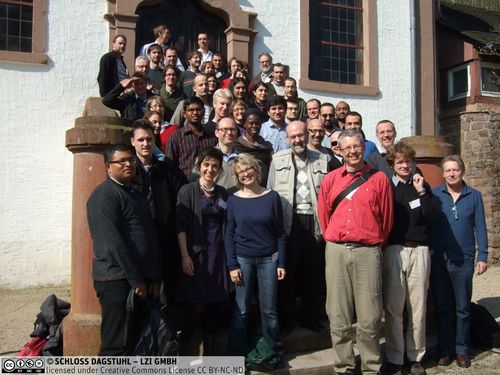
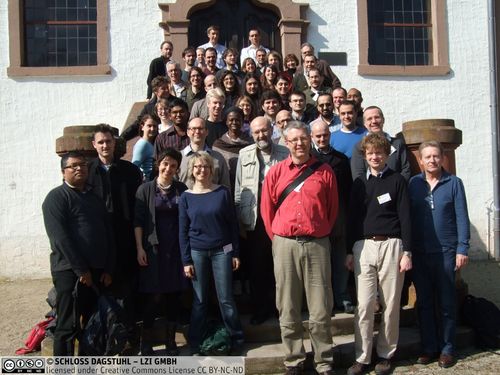
(Click in the middle of the image to enlarge)
Permalink
Please use the following short url to reference this page:
https://www.dagstuhl.de/12111
Organizers
- Giulia Andrighetto (European University Institute, IT)
- Guido Governatori (NICTA - Brisbane, AU)
- Pablo Noriega (IIIA - CSIC - Barcelona, ES)
- Leon van der Torre (University of Luxembourg, LU)
Contact
- Simone Schilke (for administrative matters)
Publications
- Normative Multi-Agent Systems (Dagstuhl Seminar 12111). Giulia Andrighetto, Guido Governatori, Pablo Noriega, and Leon van der Torre. In Dagstuhl Reports, Volume 2, Issue 3, pp. 23-49, Schloss Dagstuhl - Leibniz-Zentrum für Informatik (2012)
- Normative Multi-Agent Systems. Giulia Andrighetto, Guido Governatori, Pablo Noriega, and Leendert W. N. van der Torre (Eds.). Dagstuhl Follow-Ups, Volume 4. April 29, 2013
The multi-disciplinary workshop on Normative Multi Agents attracted leading international scholars from different research fields (e.g., theoretical computer science, programming languages, cognitive sciences and social sciences).
The workshop was organised as follows: the organisers identified several relevant areas of research covering a wide and comprehensive spectrum of topics in the filed of Normative Agents. For each area, a prominent researcher was appointed as chair for the area. In the months preceding the workshop the chairs collected material from the participants. During the first day they presented an overview of the areas they were in charge with special emphasis on some open questions and direction for future research.
The participants were divided in groups corresponding to the areas (due to some last minute cancellations some topics were under-represented and the scholars in those areas joined groups for closely related topics). Each group was allocated a morning session during which each member of the group had five minutes to provide an overview of their personal contribution to Normative Multi-Agents (plus some time for QA).
The format was well received by the participants and conducive to discussion. It gave them the opportunity to give very focused presentations while keeping the audience attention. The afternoon sessions, other the contrary, were dedicated to group work and group discussions. The aim of these sessions was to build consensus material of the specific topics and to identify fundamental research directions. The material is expected to be refined and to be articulated in chapters intended as a first step for the development for a road-map for this emerging area of computer-science with close interactions with other disciplines.
During the seminar, participants split in seven working groups, centered around seven discussion themes.
The findings of the working groups were reported and discussed during the morning plenary sessions, and led to lively debate. During the seminar, each working group drafted a document presenting the main outputs achieved. Further work within the groups (by email correspondence) followed the end of the seminar, allowing finalizing the documents.
After a review process, the contributions of the working groups will be collected in a volume of the novel Dagstuhl Follow-up Series titled A Prospective view of Normative--Multi Agent Systems, aimed to become a standard reference in the field and to provide guidelines for future research in normative multi-agent systems.
In addition, The Journal of Logic and Computation and Artificial Intelligence and Law have agreed to publish special issues based on expanded and revised versions of the material presented at the seminar.
- Natasha Alechina (University of Nottingham, GB) [dblp]
- Giulia Andrighetto (European University Institute, IT) [dblp]
- Tina Balke-Visser (University of Surrey - Guildford, GB) [dblp]
- Jan M. Broersen (Utrecht University, NL) [dblp]
- Cristiano Castelfranchi (CNR - Rome, IT) [dblp]
- Amit K. Chopra (University of Trento, IT) [dblp]
- Rob Christiaanse (TU Delft, NL) [dblp]
- Silvano Colombo Tosatto (University of Luxembourg, LU) [dblp]
- Stephen Cranefield (University of Otago, NZ) [dblp]
- Natalia Criado Pacheco (Technical University of Valencia, ES) [dblp]
- Célia da Costa Pereira (University of Nice, FR) [dblp]
- Mehdi Dastani (Utrecht University, NL) [dblp]
- Marina De Vos (University of Bath, GB) [dblp]
- Gennaro Di Tosto (Utrecht University, NL)
- Frank Dignum (Utrecht University, NL) [dblp]
- Yehia Elrakaiby (University of Luxembourg, LU)
- Nicoletta Fornara (University of Lugano, CH) [dblp]
- Dov M. Gabbay (King's College London, GB) [dblp]
- Aditya K. Ghose (University of Wollongong, AU) [dblp]
- Guido Governatori (NICTA - Brisbane, AU) [dblp]
- Joris Hulstijn (TU Delft, NL) [dblp]
- Max Knobbout (Utrecht University, NL) [dblp]
- Brian Logan (University of Nottingham, GB) [dblp]
- Henrique Lopes-Cardoso (University of Porto, PT)
- Maite López Sánchez (University of Barcelona, ES) [dblp]
- Emiliano Lorini (Paul Sabatier University - Toulouse, FR) [dblp]
- Samhar Mahmood (King's College London, GB)
- Eunate Mayor Villalba (GET - Toulouse, FR)
- John McBreen (Wageningen University, NL)
- Pablo Noriega (IIIA - CSIC - Barcelona, ES) [dblp]
- Mario Paolucci (CNR - Rome, IT)
- Xavier Parent (University of Luxembourg, LU) [dblp]
- Simon Parsons (Brooklyn College, US) [dblp]
- David Pearce (Technical University of Madrid, ES)
- Antonino Rotolo (University of Bologna, IT) [dblp]
- Bastin Tony Roy Savarimuthu (University of Otago, NZ) [dblp]
- Fernando Schapachnik (University of Buenos Aires, AR)
- Francois Schwarzentruber (ENS - Cachan, FR) [dblp]
- Munindar P. Singh (North Carolina State University - Raleigh, US) [dblp]
- Paolo Turrini (University of Luxembourg, LU) [dblp]
- Leon van der Torre (University of Luxembourg, LU) [dblp]
- Wamberto Vasconcelos (University of Aberdeen, GB) [dblp]
- Harko Verhagen (Stockholm University, SE) [dblp]
- Serena Villata (INRIA Sophia Antipolis - Méditerranée, FR) [dblp]
Related Seminars
- Dagstuhl Seminar 07122: Normative Multi-agent Systems (2007-03-18 - 2007-03-23) (Details)
- Dagstuhl Seminar 09121: Normative Multi-Agent Systems (2009-03-15 - 2009-03-20) (Details)
- Dagstuhl Seminar 15131: Normative Multi-Agent Systems (2015-03-22 - 2015-03-27) (Details)
- Dagstuhl Seminar 18171: Normative Multi-Agent Systems (2018-04-22 - 2018-04-27) (Details)
Keywords
- normative systems
- mulit-agent systems
- artificial intelligence
- business compliance