
Dagstuhl Seminar 12041
Learning in Multiobjective Optimization
( Jan 22 – Jan 27, 2012 )
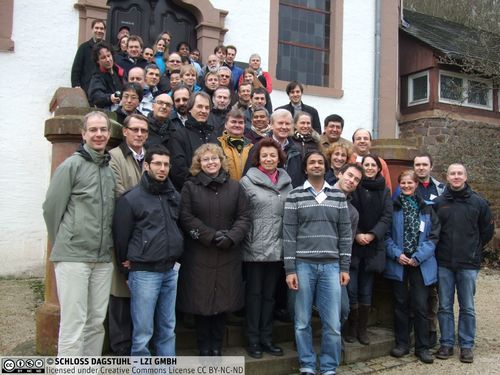
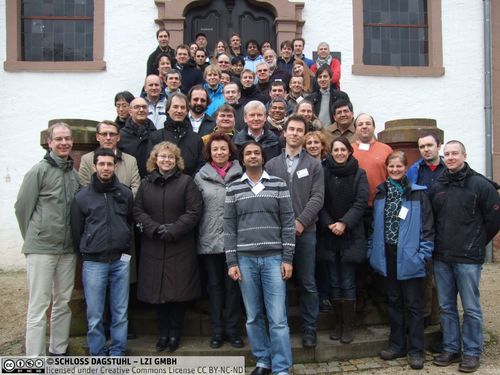
(Click in the middle of the image to enlarge)
Permalink
Please use the following short url to reference this page:
https://www.dagstuhl.de/12041
Organizers
- Salvatore Greco (Università di Catania, IT)
- Joshua D. Knowles (University of Manchester, GB)
- Kaisa Miettinen (University of Jyvaskyla, FI & KTH Royal Institute of Technology - Stockholm, SE)
- Eckart Zitzler (PH Bern, CH)
Contact
- Annette Beyer (for administrative matters)
Sponsors
The Dagstuhl Foundation gratefully acknowledges the donation from

Schedule
Multiobjective optimization is the study of optimization under competing interests, goals or criteria; it concerns the search for nondominated solutions (or Pareto optima) that offer different trade-offs of the competing criteria, as well as methods for choosing among the alternative solutions by the consideration of preferences. Multiobjective optimization problems arise naturally in several areas: engineering, economics, operations research/management, and the natural sciences, and today a significant portion of research into optimization is concerned with these problems. The present seminar, the fourth in a series on Multiobjective Optimization (following 04461, 06501 and 09041) dating back to 2004, renewed its ambitions to unite researchers from the two main communities studying multiobjective optimization, MCDM (multiple criteria decision making) and EMO (evolutionary multiobjective optimization) to stimulate new research directions crossing these discipline boundaries.
As with earlier meetings in the series, we chose a strong theme for the seminar, which this time was Learning. In multiobjective optimization, learning has a key role to play because, uniquely to the multiobjective case, optimization involves both an exploration of trade-offs and a consideration of user (or decision maker) preferences, which are usually implicit in the mind(s) of decision maker(s) at the start of the solution process. Solving a problem therefore involves at least two simultaneous learning processes: the decision maker (DM) learning about the problem, and the optimization process itself learning about the DM's preferences (to achieve a steering of the search toward a preferred solution). Our aim in the seminar was to focus centrally on this learning aspect to give it, for the first time, due attention, as in previous seminars it arose rather peripherally to other themes.
The seminar took place January 22nd--27th 2012. The main goals of the seminar were to explore in depth three different aspects of learning in multiobjective optimization which may be briefly summarized as:
- [Focus 1: User preferences] What should be learnt from user interactions and how should user preferences be captured?
- [Focus 2: Problem understanding] What should be learnt about the problem structure and how can useful information for the DM be extracted?
- [Focus 3: The problem solving process] How do we know if a decision maker has learned? How does a decision maker learn? What factors influence how and what a decision maker learns?
- What type of interdependence is there between the DM's learning and the model's learning?
Participants were given some written materials prior to the seminar to orient them to these different aspects and to help them prepare relevant contributions to the seminar programme.
During the seminar, the programme was updated on a daily basis to maintain flexibility and, through this system, we were able to give adequate time both to prepared material and to evolving discussions, mostly taking place in working groups. In particular, breakout working groups were organized initially by lottery (to be purposely disruptive of existing groupings) and then by forming subtopics that individuals could sign up to for the remainder of the week. Six groups emerged in this way.
The prepared part of the programme included four invited talks of forty-five minutes each and sixteen contributed talks of twenty minutes each. These were spaced to allow time for discussion, and the evenings were kept free to allow further reflection and relaxation. The full programme can be found in Section, and the abstracts of all talks are given in the sequel to this summary.
Other notable events during the week included: (i) an interactive demonstration given by Pekka Korhonen on rationality in decision making, which reminded us all of the limits of human (including our own "expert") rationality in the face of complex data; (ii) a presentation session to allow us to share details of upcoming events in our research community; and (iii), rather less formally, a wine and cheese party was offered by Dagstuhl in the name of ESTECO to express appreciation to ESTECO for giving a donation to the Dagstuhl Foundation.
Many thanks to the Dagstuhl office and its helpful and patient staff; huge thanks to the organizers of the previous seminars in the series for setting us up for success; and thanks to all the participants, who worked hard and were amiable company all week.
- Richard Allmendinger (University College London, GB) [dblp]
- Anne Auger (University of Paris South XI, FR) [dblp]
- Jürgen Branke (University of Warwick, GB) [dblp]
- Heinrich Braun (SAP SE - Walldorf, DE) [dblp]
- Dimo Brockhoff (INRIA - University of Lille 1, FR) [dblp]
- Susanne Bürklen (Robert Bosch GmbH - Stuttgart, DE)
- Carlos A. Coello Coello (CINVESTAV - Mexico, MX) [dblp]
- Salvatore Corrente (Università di Catania, IT) [dblp]
- Kalyanmoy Deb (Indian Inst. of Technology - Kanpur, IN) [dblp]
- Matthias Ehrgott (University of Auckland, NZ) [dblp]
- Michael Emmerich (Leiden University, NL) [dblp]
- José Rui Figueira (IST - Lisbon, PT) [dblp]
- Jörg Fliege (University of Southampton, GB) [dblp]
- Carlos M. Fonseca (University of Coimbra, PT) [dblp]
- Simon French (University of Warwick, GB)
- Tobias Friedrich (Universität Jena, DE) [dblp]
- Xavier Gandibleux (University of Nantes, FR) [dblp]
- Antonio Gaspar-Cunha (University of Minho - Guimarães, PT)
- Martin Josef Geiger (Helmut-Schmidt-Universität - Hamburg, DE) [dblp]
- Salvatore Greco (Università di Catania, IT) [dblp]
- Jussi Hakanen (University of Jyväskylä, FI) [dblp]
- Markus E. Hartikainen (University of Jyväskylä, FI)
- Hisao Ishibuchi (Osaka Prefecture University, JP) [dblp]
- Milosz Kadzinski (Poznan University of Technology, PL) [dblp]
- Kathrin Klamroth (Bergische Universität Wuppertal, DE) [dblp]
- Joshua D. Knowles (University of Manchester, GB) [dblp]
- Pekka Korhonen (Aalto University, FI) [dblp]
- Karl Heinz Küfer (Fraunhofer ITWM - Kaiserslautern, DE) [dblp]
- Manuel López-Ibáñez (Free University of Brussels, BE) [dblp]
- Mariano Luque (University of Malaga, ES) [dblp]
- Kaisa Miettinen (University of Jyvaskyla, FI & KTH Royal Institute of Technology - Stockholm, SE) [dblp]
- Sanaz Mostaghim (KIT - Karlsruher Institut für Technologie, DE) [dblp]
- Vincent Mousseau (Ecole Centrale Paris, FR) [dblp]
- Boris Naujoks (FH Köln, DE) [dblp]
- Amos H. C. Ng (University of Skövde, SE)
- Akira Oyama (JAXA - Sagamihara, JP) [dblp]
- Dmitry Podkopaev (University of Jyväskylä, FI)
- Silvia Poles (EnginSoft S.p.A. - Padova, IT) [dblp]
- Enrico Rigoni (ESTECO SpA - Trieste, IT) [dblp]
- Günter Rudolph (TU Dortmund, DE) [dblp]
- Pradyumn Kumar Shukla (KIT - Karlsruher Institut für Technologie, DE) [dblp]
- Johannes Siebert (Universität Bayreuth, DE) [dblp]
- Karthik Sindhya (University of Jyväskylä, FI) [dblp]
- Roman Slowinski (Poznan University of Technology, PL) [dblp]
- Theodor J. Stewart (University of Cape Town, ZA) [dblp]
- El-ghazali Talbi (INRIA - University of Lille 1, FR) [dblp]
- Tamara Ulrich (ETH Zürich, CH)
- Jyrki Wallenius (Aalto University, FI) [dblp]
- Margaret M. Wiecek (Clemson University, US) [dblp]
- Katrin Witting (Universität Paderborn, DE)
- Eckart Zitzler (PH Bern, CH)
Related Seminars
- Dagstuhl Seminar 04461: Practical Approaches to Multi-Objective Optimization (2004-11-07 - 2004-11-12) (Details)
- Dagstuhl Seminar 06501: Practical Approaches to Multi-Objective Optimization (2006-12-10 - 2006-12-15) (Details)
- Dagstuhl Seminar 09041: Hybrid and Robust Approaches to Multiobjective Optimization (2009-01-18 - 2009-01-23) (Details)
- Dagstuhl Seminar 15031: Understanding Complexity in Multiobjective Optimization (2015-01-11 - 2015-01-16) (Details)
- Dagstuhl Seminar 18031: Personalized Multiobjective Optimization: An Analytics Perspective (2018-01-14 - 2018-01-19) (Details)
- Dagstuhl Seminar 20031: Scalability in Multiobjective Optimization (2020-01-12 - 2020-01-17) (Details)
- Dagstuhl Seminar 23361: Multiobjective Optimization on a Budget (2023-09-03 - 2023-09-08) (Details)
- Dagstuhl Seminar 26041: Uncertainty Quantification in Multiobjective Optimization (2026-01-18 - 2026-01-23) (Details)
- Dagstuhl Seminar 29031: Sequential Multiobjective Decision Making (2029-01-14 - 2029-01-19) (Details)
Classification
- Artificial intelligence
- optimization
- soft computing
- evolutionary algorithms
Keywords
- Nonlinear multiobjective optimization
- multiple criterion decision making
- evolutionary multiobjective optimization
- MCDM
- EMO
- hybrid methods
- learning
- human-computer interaction
- multi-criterion optimization