
Dagstuhl Seminar 10402
Inter-Vehicular Communication
( Oct 03 – Oct 06, 2010 )
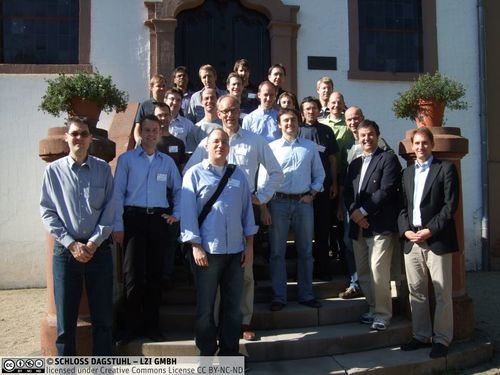
(Click in the middle of the image to enlarge)
Permalink
Please use the following short url to reference this page:
https://www.dagstuhl.de/10402
Organizers
- Falko Dressler (Universität Innsbruck, AT)
- Frank Kargl (University of Twente, NL)
- Jörg Ott (Aalto University, FI)
- Ozan K. Tonguz (Carnegie Mellon University - Pittsburgh, US)
- Lars Wischhof (Audi Electronics Venture GmbH - Gaimersheim, DE)
Contact
- Annette Beyer (for administrative matters)
Press/News
Schedule
- Schloss Dagstuhl: Kooperative Kommunikation zwischen Fahrzeugen könnte Leben schützen
Wolfgang Back und Wolfgang Rudolph im Gespräch mit Prof. Falko Dressler - Wissenschaftler tüfteln am mitdenkendem Auto
SZ-Redakteurin Margit Stark berichtet - Kooperative Kommunikation zwischen Fahrzeugen könnte Leben schützen
Press Release 30.9.2010 (German only)
The management and control of network connections among vehicles and between vehicles and an existing network infrastructure is currently one of the most challenging research fields in the networking domain. Using the terms Vehicular Ad-hoc Networks (VANETs), Inter-Vehicle Communication (IVC), Car-2-X (C2X), or Vehicle-2-X (V2X), many applications – as interesting as challenging – have been envisioned and (at least) partially realized. In this context, a very active research fields has developed. There is a long list of desirable applications that can be grouped into four categories:
- eSafety applications that try to make driving safer, e.g. road hazard warning;
- traffic efficiency applications aiming at more efficient and thus greener traffic, e.g. detection of traffic jams;
- manufacturer oriented applications, e.g. automatic software updates; and
- comfort applications, e.g. automatic map updates.
While there are some similarities with fields like mobile ad-hoc networks or wireless sensor networks, the specific characteristics of vehicular networks require different communication paradigms, different approaches to security and privacy, or different wireless communication systems. For example, the nodes usually do not have severe power and form factor constraints, and they might be always on. On the other hand, due to high relative speeds, wireless connections may not be stable for a longer time period and the network density is expected to vary from sparse to very dense networks. Another challenging issue is the efficient use of available infrastructure, such as road side units or even cellular networks. Furthermore, IVC has strong links to other research domains, e.g. geo-informatics as it requires very precise localization and precise maps or highly scalable simulations that are a requirement for analyzing traffic systems with hundreds or thousands of vehicles.
In the past, many specific solutions for IVC have been identified and now, industry and other stakeholders are already calling for standardization. Still, we believe that many important research questions have only been partially answered and the approaches discussed in the standardization bodies are based only on a minimum consensus of simplest solutions. Security and privacy, scalability, use of advanced communication patterns like aggregation, transmit power control, and optimal medium access are just a few of such issues.
The main goal of this seminar was to bring together leading researchers both from academia and industry to discuss and evaluate the state of the art and to highlight where sufficient solutions exist today, where better alternatives need to be found, and also to give directions where to look for such alternatives. Furthermore, it was the goal of this workshop to go on step beyond and identify where IVC can contribute to the basic foundations of computer science or where previously unconsidered foundations can contribute to IVC.
For example, IVC has triggered active research on reactive and dynamic security systems that do not try to provide security in a cryptographic sense at usually high costs, but create a tunable security-performance trade-off using reputation and consistency-checking mechanisms that are not unlike human and social mechanisms to estimate trust in information. It remains to be seen if such mechanisms can be generalized and be applied to future networks that will be dynamic and self-organizing in nature.
For example, IVC has triggered active research on reactive and dynamic security systems that do not try to provide security in a cryptographic sense at usually high costs, but create a tunable security-performance trade-off using reputation and consistency-checking mechanisms that are not unlike human and social mechanisms to estimate trust in information. It remains to be seen if such mechanisms can be generalized and be applied to future networks that will be dynamic and self-organizing in nature.
We organized four working groups on some of the most challenging issues in inter-vehicular communication:
- Fundamental Limits (Hannes Hartenstein),
- Communication Principles and Patterns (Ozan Tonguz),
- Security & Privacy (Elmar Schoch), and
- Simulation and Modeling (Martin Treiber and Christoph Sommer).
The workshop gathered a roster of highly qualified senior participants and several talented young researchers from both academia and industry, who convened to discuss issues in the listed working groups. We kept a very loose schedule with four invited speeches by leading experts in their respective domains as a starting point for each working group. Most of the time was spend in working group discussions. The key outcome of our working groups is available as a report in the Dagstuhl Seminar proceedings.
- Levente Buttyan (Budapest University of Technology & Economics, HU) [dblp]
- Claudio Casetti (Polytechnic University of Torino, IT) [dblp]
- Falko Dressler (Universität Innsbruck, AT) [dblp]
- David Eckhoff (Universität Erlangen-Nürnberg, DE) [dblp]
- Lars Eggert (NOKIA Research Center - Helsinki, FI) [dblp]
- Jérôme Härri (EURECOM - Biot, FR) [dblp]
- Hannes Hartenstein (KIT - Karlsruher Institut für Technologie, DE) [dblp]
- Mahbub Hassan (UNSW - Sydney, AU)
- Geert Heijenk (University of Twente, NL) [dblp]
- Frank Kargl (University of Twente, NL) [dblp]
- Stefan Lämmer (TU Dresden, DE)
- Martin Mauve (Heinrich-Heine-Universität Düsseldorf, DE) [dblp]
- Jens Mittag (KIT - Karlsruher Institut für Technologie, DE) [dblp]
- Jörg Ott (Aalto University, FI) [dblp]
- Panagiotis Papadimitratos (KTH Royal Institute of Technology, SE) [dblp]
- Björn Scheuermann (Heinrich-Heine-Universität Düsseldorf, DE) [dblp]
- Felix Schmidt-Eisenlohr (KIT - Karlsruher Institut für Technologie, DE)
- Elmar Schoch (Volkswagen AG - Wolfsburg, DE) [dblp]
- Christoph Sommer (Universität Erlangen-Nürnberg, DE) [dblp]
- Ozan K. Tonguz (Carnegie Mellon University - Pittsburgh, US) [dblp]
- Martin Treiber (TU Dresden, DE)
- Lars Wischhof (Audi Electronics Venture GmbH - Gaimersheim, DE) [dblp]
- Lars Wolf (TU Braunschweig, DE) [dblp]
Related Seminars
- Dagstuhl Seminar 13392: Inter-Vehicular Communication - Quo Vadis (2013-09-22 - 2013-09-25) (Details)
- Dagstuhl Seminar 18202: Inter-Vehicular Communication Towards Cooperative Driving (2018-05-13 - 2018-05-16) (Details)
- Dagstuhl Seminar 21262: Inter-Vehicular Communication - From Edge Support to Vulnerable Road Users (2021-06-28 - 2021-06-28) (Details)
- Dagstuhl Seminar 22512: Inter-Vehicular Communication – From Edge Support to Vulnerable Road Users II (2022-12-18 - 2022-12-21) (Details)
Classification
- mobile computing
- networks
- security / cryptography
Keywords
- Intelligent transportation systems
- Vehicle-to-vehicle communication
- Vehicle-to-infrastructure communication
- Vehicular ad hoc networks
- Traffic information system
- Traffic flow optimization
- Energy and emission efficiency