
Dagstuhl Seminar 10361
Theory of Evolutionary Algorithms
( Sep 05 – Sep 10, 2010 )
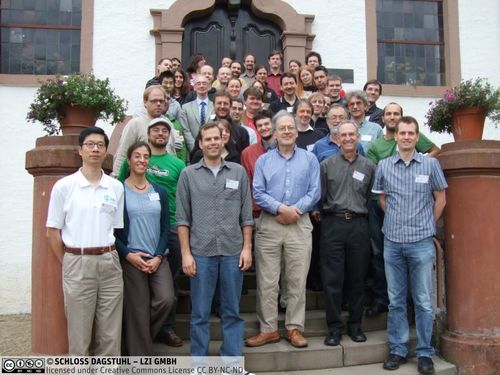
(Click in the middle of the image to enlarge)
Permalink
Please use the following short url to reference this page:
https://www.dagstuhl.de/10361
Organizers
- Anne Auger (University of Paris South XI, FR)
- Jonathan L. Shapiro (University of Manchester, GB)
- Darrell Whitley (Colorado State University, US)
- Carsten Witt (Technical University of Denmark - Lyngby, DK)
Contact
- Simone Schilke (for administrative matters)
Impacts
- Computing the moments of k-bounded pseudo-Boolean functions over Hamming spheres of arbitrary radius in polynomial time : article : pp. 17-33 - Sutton, Andrew M.; Whitley, L. Darrell; Howe, Adele - Amsterdam : Elsevier, 2012 - (Theoretical computer science : 425. 2012, pp. 58-74).
- Evolutionary algorithms and dynamic programming : article : pp. 6020-6035 - Doerr, Benjamin; Eremeev, Anton V.; Neumann, Frank; Theile, Madeleine; Thyssen, Christian - Amsterdam : Elsevier, 2011 - (Theoretical computer science : 412. 2011, 43).
- Fitness Function Distributions over Generalized Search Neighborhoods in the q-ary Hypercube : article : pp. 561-590 - Sutton, Andrew M.; Chicano, Francisco; Whitley, L. Darrell - Cambridge : MIT Press, 2013 - (Evolutionary computation : 21. 2013, 4).
- How crossover helps in pseudo-boolean optimization : article : GECCO 2011 : pp. 989-996 - Kötzing, Timo; Sudholt, Dirk, Theile, Madeleine - New York : ACM, 2011 - (GECCO 2011 Proceedings of the 13th annual conference on Genetic and evolutionary computation : article pp. 989-996).
- Information-Geometric Optimization Algorithms : a Unifying Picture via Invariance Principles : article - Ollivier, Yann; Arnold, Ludovic; Auger, Anne; Hansen, Nikolaus - jmrl.org, 2017. - 65 pp. - (Journal of machine learning research ; 18. 2017).
- On geometrically fast convergence to optimal dominated hypervolume of set-based multiobjective evolutionary algorithms : article in CEC 2011, IEEE Congress on Evolutionary Computation : pp. 1719-1723 - Rudolph, Günter - Piscataway : IEEE, 2011 : pp. 1719-1723.
- On the Analysis of the Immune-Inspired B-Cell Algorithm for the Vertex Cover Problem : article in LNCS 6825, ICARIS 2011 : pp. 117-131 - Jansen, Thomas; Oliveto, Pietro S.; Zarges, Christine - Berlin : Springer, 2011 - (Lecture notes in computer science : 6825 ; article).
- Proceedings of the 2011 ACM / SIGEVO Foundations of Genetic Algorithms XI : January 5 - 9, 2011, Schwarzenberg, Austria = FOGA '11 - Beyer, Hans-Georg; Langdon, William B. - New York : ACM, 2011. - VII, 253 S.. ISBN: 978-1-4503-0633-1 / 1-4503-0633-0.
- The component model for elementary landscapes and partial neighborhoods : article : pp. 59-75 - Whitley, L. Darrell; Sutton, Andrew M.; Ochoa, Gabriela; Chicano, Gabriela - Amsterdam : Elsevier, 2014 - (Artificial intelligence : 545. 2014).
- The unbiased black-box complexity of partition is polynomial : article : pp. 275-286 - Doerr, Benjamin; Doerr, Carola; Kötzing, Timo - Amsterdam : Elsevier, 2014 - (Artificial intelligence : 216. 2014).
- Too fast unbiased black-box algorithms : article in GECCO '11 Proceedings of the 13th annual conference on Genetic and evolutionary computation : pp. 2043-2050 - Doerr, Benjamin; Kötzing, Timo; Winzen, Carola - New York : ACM, 2011 - (GECCO '11 Proceedings of the 13th annual conference on Genetic and evolutionary computation : article).
- Unbiased Black-Box Complexities of Jump Functions : article : pp. 641-670 - Doerr, Benjamin; Doerr, Carola; Kötzing, Timo - Cambridge : MIT Press, 2015 - (Evolutionary computation : 23. 2015, 4).
- Unbiased black-box complexities of jump functions : how to cross large plateaus : article in GECCO '14 Proceedings of the 2014 Annual Conference on Genetic and Evolutionary Computation : pp. 769-776 - Doerr, Benjamin; Doerr, Carola; Kötzing, Timo - New York : ACM, 2014 - (GECCO '14 Proceedings of the 2014 Annual Conference on Genetic and Evolutionary Computation : article).
Evolutionary algorithms (EAs) are stochastic optimization methods that are based on principles derived from natural evolution. Mutation, recombination, and selection are iterated with the goal of driving a population of candidate solutions toward better and better regions of the search space. From a more general perspective, EAs are one instance of bio-inspired search heuristics. Other examples include Ant Colony Optimization (ACO) and Particle Swarm Optimization (PSO), where the search behaviors of ant colonies or insect swarms inspired a randomized search technique. Since the underlying ideas of bio-inspired search are easy to grasp and easy to apply, EAs and different bio-inspired search heuristics are widely used in many practical disciplines, mainly in computer science and engineering.
It is a central goal of theoretical investigations of search heuristics to assist practitioners with the tasks of selecting and designing good strategy variants and operators. Due to the rapid pace at which new strategy variants and operators are being proposed, theoretical foundations of EAs and other bio-inspired search heuristics still lag behind practice. However, EA theory has gained much momentum over the last few years and has made numerous valuable contributions to the field of evolutionary computation.
The theory of EAs today consists of a wide range of different approaches. Run-time analysis, schema theory, analyses of the dynamics of EAs, and systematic empirical analysis all consider different aspects of EA behavior. Moreover, they employ different methods and tools for attaining their goals, such as Markov chains, infinite population models, or ideas based on statistical mechanics or population dynamics. In the most recent seminar, more recent types of bio-inspired search heuristics were discussed. Results regarding the runtime have been generalized from EAs to ACO and PSO. Although the latter heuristics follow a different design principle than EAs, the theoretical analyses reveal surprising similarities in terms of the underlying stochastic process. New analytic approaches were also surveyed.
The goals of the 2010 Dagstuhl seminar were twofold. The first goal was to discuss the potential and limitations of a unified theory of all types of bio-inspired search heuristics with focus on how to analyze the runtime of estimation-of-distribution algorithms, which themselves can be considered as a generalized model of ACO, PSO and EAs. The second goal of the seminar was to bridge the gap with the classical optimization community.
Fruitful and stimulating discussions among varying groups of participants occurred throughout the week of the Dagstuhl seminar on ``Theory of Evolutionary Algorithms''. Besides the presentations, the unconventional format of the working parties was successful in provoking discussions and stimulating the exchange of new ideas. The spotlight talks provided a great opportunity for new PhD students to introduce themselves to the community. The Dagstuhl seminars are firmly established in the community as biannual event, and we hope to be able to build on this success and continue to promote discussions between researchers in different areas of EA theory at further workshops in the future.
- Youhei Akimoto (Tokyo Institute of Technology, JP) [dblp]
- Anne Auger (University of Paris South XI, FR) [dblp]
- Hans-Georg Beyer (Fachhochschule Vorarlberg, AT) [dblp]
- Dimo Brockhoff (Ecole Polytechnique - Palaiseau, FR) [dblp]
- Francisco Chicano (University of Malaga, ES) [dblp]
- Benjamin Doerr (MPI für Informatik - Saarbrücken, DE) [dblp]
- Carola Doerr (MPI für Informatik - Saarbrücken, DE) [dblp]
- Anton V. Eremeev (Sobolev Institute of Mathematics - Omsk, RU) [dblp]
- Steffen Finck (Fachhochschule Vorarlberg, AT)
- Tobias Friedrich (MPI für Informatik - Saarbrücken, DE) [dblp]
- Marcus Gallagher (The University of Queensland - Brisbane, AU) [dblp]
- Walter J. Gutjahr (Universität Wien, AT)
- Nikolaus Hansen (University of Paris South XI, FR) [dblp]
- Verena Heidrich-Meisner (Ruhr-Universität Bochum, DE)
- Nicola Hochstrate (TU Dortmund, DE)
- Christian Horoba (TU Dortmund, DE)
- Christian Igel (University of Copenhagen, DK) [dblp]
- Thomas Jansen (University College Cork, IE) [dblp]
- Daniel Johannsen (MPI für Informatik - Saarbrücken, DE) [dblp]
- Timo Kötzing (MPI für Informatik - Saarbrücken, DE) [dblp]
- William B. Langdon (University College London, GB) [dblp]
- Per Kristian Lehre (Technical University of Denmark - Lyngby, DK) [dblp]
- Alexander Melkozerov (Tomsk State University, RU)
- Silja Meyer-Nieberg (Universität der Bundeswehr - München, DE) [dblp]
- Christian Müller (ETH Zürich, CH)
- Frank Neumann (MPI für Informatik - Saarbrücken, DE) [dblp]
- Gabriela Ochoa (University of Nottingham, GB) [dblp]
- Pietro S. Oliveto (University of Birmingham, GB) [dblp]
- Adam Prugel-Bennett (University of Southampton, GB) [dblp]
- Jonathan Rowe (University of Birmingham, GB) [dblp]
- Günter Rudolph (TU Dortmund, DE) [dblp]
- Jonathan L. Shapiro (University of Manchester, GB) [dblp]
- Dirk Sudholt (University of Birmingham, GB) [dblp]
- Andrew M. Sutton (Colorado State University, US) [dblp]
- Olivier Teytaud (University of Paris South XI, FR) [dblp]
- Madeleine Theile (TU Berlin, DE)
- Lothar Thiele (ETH Zürich, CH) [dblp]
- Leslie Valiant (Harvard University - Cambridge, US) [dblp]
- Sebastien Verel (INRIA - University of Lille 1, FR) [dblp]
- Darrell Whitley (Colorado State University, US) [dblp]
- R. Paul Wiegand (University of Central Florida - Orlando, US)
- Carsten Witt (Technical University of Denmark - Lyngby, DK) [dblp]
- Alden Wright (University of Montana - Missoula, US)
- Xin Yao (University of Birmingham, GB) [dblp]
- Christine Zarges (TU Dortmund, DE) [dblp]
Related Seminars
- Dagstuhl Seminar 00071: Theory of Evolutionary Algorithms (2000-02-13 - 2000-02-18) (Details)
- Dagstuhl Seminar 02031: Theory of Evolutionary Algorithms (2002-01-13 - 2002-01-18) (Details)
- Dagstuhl Seminar 04081: Theory of Evolutionary Algorithms (2004-02-15 - 2004-02-20) (Details)
- Dagstuhl Seminar 06061: Theory of Evolutionary Algorithms (2006-02-05 - 2006-02-10) (Details)
- Dagstuhl Seminar 08051: Theory of Evolutionary Algorithms (2008-01-27 - 2008-02-01) (Details)
- Dagstuhl Seminar 13271: Theory of Evolutionary Algorithms (2013-06-30 - 2013-07-05) (Details)
- Dagstuhl Seminar 15211: Theory of Evolutionary Algorithms (2015-05-17 - 2015-05-22) (Details)
- Dagstuhl Seminar 17191: Theory of Randomized Optimization Heuristics (2017-05-07 - 2017-05-12) (Details)
- Dagstuhl Seminar 19431: Theory of Randomized Optimization Heuristics (2019-10-20 - 2019-10-25) (Details)
- Dagstuhl Seminar 22081: Theory of Randomized Optimization Heuristics (2022-02-20 - 2022-02-25) (Details)
- Dagstuhl Seminar 24271: Theory of Randomized Optimization Heuristics (2024-06-30 - 2024-07-05) (Details)
- Dagstuhl Seminar 27291: Theory of Randomized Optimization Heuristics (2027-07-18 - 2027-07-23) (Details)
Classification
- evolutionary algorithms
- search heuristics
- artificial intelligence
- algorithms
- optimization
Keywords
- evolutionary algorithms
- bio-inspired search heuristics
- theoretical analysis
- optimization time