
Dagstuhl Seminar 10302
Learning paradigms in dynamic environments
( Jul 25 – Jul 30, 2010 )
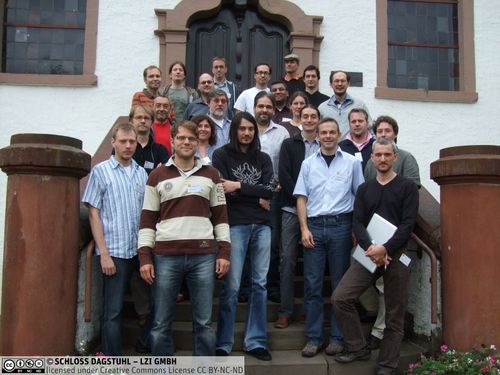
(Click in the middle of the image to enlarge)
Permalink
Please use the following short url to reference this page:
https://www.dagstuhl.de/10302
Organizers
- Barbara Hammer (Universität Bielefeld, DE)
- Pascal Hitzler (Wright State University - Dayton, US)
- Wolfgang Maass (TU Graz, AT)
- Marc Toussaint (TU Berlin, DE)
Contact
- Annette Beyer (for administrative matters)
The seminar centered around problems which arise in the context of machine learning in dynamic environments. Particular emphasis was put on a couple of specific questions in this context: how to represent and abstract knowledge appropriately to shape the problem of learning in a partially unknown and complex environment and how to combine statistical inference and abstract symbolic representations; how to infer from few data and how to deal with non i.i.d. data, model revision and life-long learning; how to come up with efficient strategies to control realistic environments for which exploration is costly, the dimensionality is high and data are sparse; how to deal with very large settings; and how to apply these models in challenging application areas such as robotics, computer vision, or the web.
Machine learning techniques such as neural networks and statistical counterparts constitute particularly successful tools with numerous applications ranging from industrial tasks up to the investigation and simulation of biological systems. Unlike their biological paragon, however, they are often restricted to very narrow settings such as dedicated classification and regression tasks and simple data structures such as real vectors, neglecting the rich repertoire of biological networks in complex dynamic behavior, hierarchical organization, and implicit evolution of structures. In particular, classical learning models such as neural networks, decision trees, or vector quantizers are often restricted to purely feedforward settings and simple vectorial data instead of dynamic environments which include rich structure. Further, the learning scenario which is usually considered in technological settings is by far too restricted not only concerning recurrence, but concerning the integration and emergence of structure, cooperation, and autonomous behavior. Although promising approaches can be found in the literature, we are lacking general learning paradigms for complex dynamical systems which go beyond the standard comparably narrow setting as usually formalized and successfully tackled in classical learning theory. The goal of the proposed seminar was to further the understanding of complex dynamic learning scenarios and to bridge the gap from powerful biological systems towards learning in technical applications by bringing together researchers in the fields of autonomous learning, structure learning, and biological or psychological investigations of dynamical behavior, structure formation and structure perception.
Within the seminar, a number of dedicated techniques such as echo state networks, evolutionary learning, deep learner, or techniques from statistical relational learning have been discussed as well as diverse learning paradigms which help to bridge the gap towards more realistic settings in autonomous learning. Further, a few dedicated problem areas which are closely connected to the rather fundamental issue of autonomous learning and which focus the problem complex towards relevant aspects which can be fruitfully discussed and addressed within the limited time span of a Dagstuhl seminar have been considered:
- How can structures be dealt with in autonomous environments and how does structure emerge to shape complex environments accordingly? This question concerns topics related to neural-symbolic integration, statistical relational learning, the automatic formation of hierarchies, and similar.
- How can we dal with statistically sparse settings and high dimensionality, how can we deal with non i.i.d. settings? This question concerns topics such as inference from very few samples, online algorithms for large data sets, dimensionality reduction in complex environments, etc.?
- How can we develop control strategies in complex environments, what are possible strategies capable of dealing with only limited reinforcement signals, ill-posed domains, or partially underspecified settings?
Important application areas of these challenges concern diverse topics such as robotics, computer vision, or the semantic web, as discussed in the seminar.
26 experts from 6 different countries joined the seminar, including a mixture of established scientists and promising young researchers working in the field. According to the topic, the main subjects of the researchers covered heterogeneous fields including computational neuroscience, pattern recognition / neuroinformatics, reinformcement learning, and logic / relational learning. In spite of the diverse backgrounds, the participants shared a common strong interest in the application of machine learning system to complex environments. This setup allowed us to discuss salient issues in a way that integrated perspectives from several scientific disciplines, thereby providing valuable new insights and research contacts for the participants. Correspondingly, a wide range of topics was covered during discussions and brainstorming in the seminar.
Overall, the presentations and discussions revealed that the topic of learning in dynamic environments constitutes a highly diverse and evolving field which opens interesting perspectives to machine learning.
- Sebastian Bader (Universität Rostock, DE)
- Sven Behnke (Universität Bonn, DE) [dblp]
- Mikio Braun (TU Berlin, DE)
- Silvano Colombo Tosatto (University of Luxembourg, LU) [dblp]
- Claudia d'Amato (University of Bari, IT) [dblp]
- Artur d'Avila Garcez (City University - London, GB) [dblp]
- Paolo Frasconi (University of Florence, IT) [dblp]
- Andrej Gisbrecht (Universität Bielefeld, DE) [dblp]
- Barbara Hammer (Universität Bielefeld, DE) [dblp]
- Pascal Hitzler (Wright State University - Dayton, US) [dblp]
- Christian Igel (University of Copenhagen, DK) [dblp]
- Kristian Kersting (Fraunhofer IAIS - St. Augustin, DE) [dblp]
- Stefan J. Kiebel (MPI für Kognitions- und Neurowissenschaften, DE)
- Tobias Lang (TU Berlin, DE)
- Bassam Mokbel (Universität Bielefeld, DE) [dblp]
- Günther Palm (Universität Ulm, DE) [dblp]
- Subramanian Ramamoorthy (University of Edinburgh, GB) [dblp]
- Martin Riedmiller (Universität Freiburg, DE) [dblp]
- Helge Ritter (Universität Bielefeld, DE) [dblp]
- Ute Schmid (Universität Bamberg, DE) [dblp]
- Jürgen Schmidhuber (IDSIA - Manno, CH) [dblp]
- Benjamin Schrauwen (Ghent University, BE)
- Jochen J. Steil (Universität Bielefeld, DE)
- Peter Tino (University of Birmingham, GB) [dblp]
- Marc Toussaint (TU Berlin, DE) [dblp]
- Heiko Wersing (Honda Research Europe - Offenbach, DE)
Related Seminars
- Dagstuhl Seminar 08041: Recurrent Neural Networks - Models, Capacities, and Applications (2008-01-20 - 2008-01-25) (Details)
Classification
- Artificial intelligence / robotics
- soft computing / evolutionary algorithms
Keywords
- Recurrent neural networks
- dynamic systems
- speech processing
- neurobiology
- neural-symbolic integration
- autonomous learning