
Dagstuhl Seminar 10241
Information Visualization
( Jun 13 – Jun 18, 2010 )
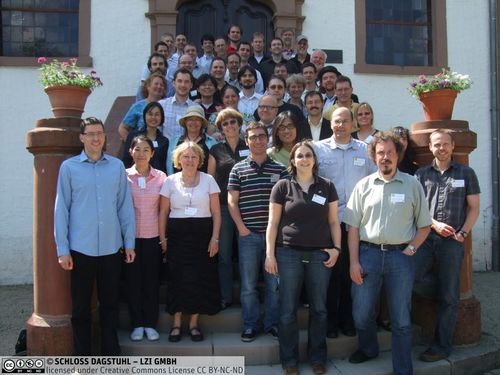
(Click in the middle of the image to enlarge)
Permalink
Please use the following short url to reference this page:
https://www.dagstuhl.de/10241
Organizers
- Andreas Kerren (Linnaeus University - Växjö, SE)
- Catherine Plaisant (University of Maryland - College Park, US)
- John T. Stasko (Georgia Institute of Technology - Atlanta, US)
Contact
Impacts
- Empirical Studies in Information Visualization: Seven Scenarios : article pp. 1520-1536 - Lam, Heidi; Bertini, Enrico; Isenberg, Petra; Plaisant, Catherine; Carpendale, Sheelagh - Piscataway : IEEE, 2012 - (IEEE transactions on visualization and computer graphics : 18. 2012, 9).
- State of the Field and New Research Directions : Special Issue : pp. 269-371 - Kerren, Andreas; Plaisant, Catherine; Stasko, John T. - Thousand Oaks : Sage Science Press, 2011 - (Information Visualization ; 10. 2011, 4).
Information Visualization (InfoVis) focuses on the use of visualization techniques to help people understand and analyze data. While related fields such as Scientific Visualization involve the presentation of data that has some physical or geometric correspondence, Information Visualization centers on abstract information without such correspondences.
The aim of this seminar was to bring together theoreticians and practitioners from the field with a special focus on the intersection of InfoVis and Human-Computer Interaction. To support discussions that are related to the visualization of real world data, researchers from selected application areas also attended and contributed. During the seminar, working groups on eight different topics were formed and enabled a critical reflection on ongoing research efforts, the state of the field, and key research challenges today.
Information Visualization (InfoVis) is a research area that focuses on the use of visualization techniques to help people understand and analyze data. While related fields such as Scientific Visualization involve the presentation of data that has some physical or geometric correspondence, Information Visualization centers on abstract information without such correspondences, i.e., it is not possibile to map this information into the physical world in most cases. Examples of such abstract data are symbolic, tabular, networked, hierarchical, or textual information sources. The ever increasing amount of data generated or made available every day confirms the urgent need for suitable InfoVis tools. As prerequisite for building a successful visualization, InfoVis combines several aspects of different research areas, such as Computer Graphics, Graph Drawing, Data Mining, Information Design, Cognitive Psychology, and Human-Computer Interaction (HCI), among many others.
One main goal of this second Dagstuhl Seminar on Information Visualization was to bring together theoreticians and practitioners from the addressed research areas with a special focus on the intersection of InfoVis and Human-Computer Interaction. Many researchers are active in both of these fields, thus the seminar was especially attractive to those people. To support discussions that are related to the visualization of real world data, we also invited researchers from selected application areas, such as Bioinformatics and the GeoSciences.
We would like to thank all participants of the seminar for the lively discussions during the seminar as well as the scientific directorate of Dagstuhl Castle for giving us the possibility of organizing this event. Ilir Jusufi gathered the abstracts for the abstract collection and the talks of all presenters. These talks can be found on the materials site of the seminar. In addition, many attendees agreed to take notes during the breakout sessions. These notes were the basis for writing this executive summary and are also available for download on the Dagstuhl web page of the seminar. Last but not least, the seminar would not have been possible without the great help of the staff of Dagstuhl Castle. We would like to acknowledge all of them and their assistance.
- Fabian Beck (Universität Trier, DE) [dblp]
- Enrico Bertini (Universität Konstanz, DE) [dblp]
- Dominique Brodbeck (FH Nordwestschweiz - Muttenz, CH)
- Paolo Buono (University of Bari, IT) [dblp]
- Sheelagh Carpendale (University of Calgary, CA) [dblp]
- Daniel Cernea (TU Kaiserslautern, DE)
- Christopher Collins (UOIT - Oshawa, CA) [dblp]
- Stephan Diehl (Universität Trier, DE) [dblp]
- Tim Dwyer (Microsoft Corporation - Redmond, US) [dblp]
- Jason Dykes (City University - London, GB) [dblp]
- Achim Ebert (TU Kaiserslautern, DE) [dblp]
- Niklas Elmqvist (Purdue University - West Lafayette, US) [dblp]
- Jean-Daniel Fekete (University of Paris South XI, FR) [dblp]
- Manuel Freire-Moran (Universidad Autónoma de Madrid, ES)
- Michael Gleicher (University of Wisconsin - Madison, US) [dblp]
- Hans Hagen (TU Kaiserslautern, DE) [dblp]
- Charles D. Hansen (University of Utah - Salt Lake City, US) [dblp]
- Jeffrey Michael Heer (Stanford University, US) [dblp]
- Nathalie Henry Riche (Microsoft Corporation - Redmond, US) [dblp]
- Petra Isenberg (University of Paris South XI, FR) [dblp]
- T. J. Jankun-Kelly (Mississippi State University, US) [dblp]
- Ilir Jusufi (Linnaeus University - Växjö, SE)
- Daniel A. Keim (Universität Konstanz, DE) [dblp]
- Jessie Kennedy (Edinburgh Napier University, GB) [dblp]
- Andreas Kerren (Linnaeus University - Växjö, SE) [dblp]
- Heidi Lam (Google Inc. - Mountain View, US) [dblp]
- Bongshin Lee (Microsoft Corporation - Redmond, US) [dblp]
- Yarden Livnat (University of Utah, US)
- Kwan-Liu Ma (University of California - Davis, US) [dblp]
- Tamara Munzner (University of British Columbia - Vancouver, CA) [dblp]
- Stephen North (AT&T Labs Research - Florham Park, US) [dblp]
- Adam Perer (IBM - Haifa, IL) [dblp]
- Catherine Plaisant (University of Maryland - College Park, US) [dblp]
- Helen C. Purchase (University of Glasgow, GB) [dblp]
- Harald Reiterer (Universität Konstanz, DE) [dblp]
- Jonathan C. Roberts (Bangor University, GB) [dblp]
- Jean Scholtz (Pacific Northwest National Lab. - Richland, US)
- Falk Schreiber (IPK Gatersleben, DE) [dblp]
- Heidrun Schumann (Universität Rostock, DE) [dblp]
- John T. Stasko (Georgia Institute of Technology - Atlanta, US) [dblp]
- Hendrik Strobelt (Universität Konstanz, DE) [dblp]
- Frank van Ham (IBM ILOG Research - France, FR) [dblp]
- Jarke J. van Wijk (TU Eindhoven, NL) [dblp]
- Andrew Vande Moere (KU Leuven, BE) [dblp]
- Matthew O. Ward (Worcester Polytechnic Institute, US) [dblp]
- Chris Weaver (University of Oklahoma - Norman, US) [dblp]
- Jing Yang (University of North Carolina - Charlotte, US) [dblp]
Related Seminars
Classification
- computer graphics
- computer vision
- society
- human-computer interaction
- interdisciplinary
Keywords
- Information Visualization
- Data Visualization
- Visualization
- Human-Computer Interaction
- Collaboration
- Display Technologies