
Dagstuhl Seminar 10201
Event Processing
( May 16 – May 21, 2010 )
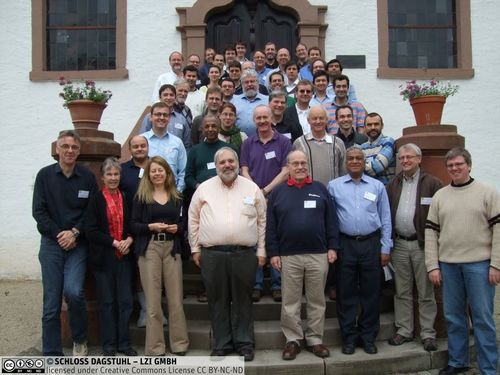
(Click in the middle of the image to enlarge)
Permalink
Please use the following short url to reference this page:
https://www.dagstuhl.de/10201
Organizers
- K. Mani Chandy (CalTech - Pasadena, US)
- Opher Etzion (IBM - Haifa, IL)
- Rainer von Ammon (CITT GmbH - Regensburg, DE)
Contact
- Annette Beyer (for administrative matters)
Schedule
Event processing (EP) is an area in the field of information technology that is central to many systems on which our society depends. These systems include energy, healthcare, the environment, transportation, finance, services, and manufacturing.
Event processing consists of methods and tools to filter, transform, and detect patterns in events, in order to react to changing conditions, typically under some time constraints.
We present this Manifesto to introduce the area of event processing, explain its pertinence to other fields, and to provide information to enable relevant business opportunities. We also aim to establish guidelines for how event processing can fit into current standards and to put forth short- and long-term goals for event processing professionals in industry and academia.
Event processing systems perform the following four main functions:
- Obtain data from multiple sources in real or near-real time
- Aggregate and analyze this data to detect patterns that indicate the presence of critical situations requiring a response
- Determine the best response for such situations
- Monitor the execution of that response
- Why is event processing of increased importance now, when even the earliest rule engines and business processes had mechanisms used to detect critical situations and respond accordingly?
Today's world is much more dependent on IT systems than it ever was. All of us are much more interconnected and interdependent than ever. Systems must be able to react to events anywhere on the globe. An outbreak of Ebola on one continent, for example, demands a response in countries everywhere. Responses must occur ever quicker, sometimes in milliseconds, as the pace of the stock exchange illustrates.
The costs of inappropriate responses can be staggering, as we see in the cases of certain defense applications. In many telecommunication systems, the volume of data that must be analyzed in near-real time is torrential. In addition, the variety and types of data that must be analyzed in event processing systems is enormous. Such data may be in the form of structured text, natural language, images, audio, or video. The data may be delivered to the system, or it may have to be extracted by the system. In many systems, security is an overarching concern.
Coming decades will see many more applications with event processing capabilities, as society demands smarter ways for managing electric power, water, health, retail and distribution, traffic, and safety—smarter meaning responding better and faster to changing conditions. The interconnected nature of the modern world means that researchers, designers, and students can no longer develop event processing for a single domain, such as the smart grid, without incorporating developments related to event processing technologies in other domains, such as smart healthcare. To step up to these challenges, we are in urgent need of event processing theory, design methods, and tools. This document is an important step toward that goal.
- Darko Anicic (FZI - Karlsruhe, DE) [dblp]
- Stefan Appel (TU Darmstadt, DE)
- Jean Bacon (University of Cambridge, GB) [dblp]
- Robert Berry (Aston University - Birmingham, GB)
- Pedro Bizarro (University of Coimbra, PT)
- Andrey Brito (TU Dresden, DE)
- Simon Brodt (LMU München, DE)
- François Bry (LMU München, DE) [dblp]
- Alejandro P. Buchmann (TU Darmstadt, DE) [dblp]
- Sharma Chakravarthy (University of Texas at Arlington, US) [dblp]
- Badrish Chandramouli (Microsoft Corporation - Redmond, US) [dblp]
- K. Mani Chandy (CalTech - Pasadena, US) [dblp]
- Christoph Emmersberger (Senacor Technologies AG - München, DE)
- Opher Etzion (IBM - Haifa, IL) [dblp]
- Patrick Thomas Eugster (Purdue University - West Lafayette, US) [dblp]
- Dieter Gawlick (Oracle Labs., US)
- Annika M. Hinze (University of Waikato, NZ) [dblp]
- Martin Hirzel (IBM TJ Watson Research Center - Yorktown Heights, US) [dblp]
- Mark K. Horsburgh (Progress Software - Cambridge, GB)
- Hans-Arno Jacobsen (University of Toronto, CA) [dblp]
- Boris Koldehofe (Universität Stuttgart, DE) [dblp]
- Alexander Kozlenkov (Betfair Pty Ltd. - London, GB) [dblp]
- Wolfgang May (Universität Göttingen, DE)
- Daniel I. Meiron (CalTech - Pasadena, US)
- Ken Moody (University of Cambridge, GB) [dblp]
- Peter Niblett (IBM United Kingdom Ltd. - Winchester, GB)
- Adrian Paschke (FU Berlin, DE) [dblp]
- Udo Pletat (IBM Deutschland - Böblingen, DE)
- Olga Poppe (LMU München, DE) [dblp]
- Tore Risch (Uppsala University, SE) [dblp]
- Harald Schöning (Software AG - Darmstadt, DE) [dblp]
- W. Roy Schulte (Gartner Inc. - Madison, US)
- Bernhard Seeger (Universität Marburg, DE) [dblp]
- Marco Seiriö (RuleCore - Göteborg, SE)
- Guy Sharon (IBM - Haifa, IL)
- Plamen L. Simeonov (JSRC - Berlin, DE)
- Florian Springer (Senacor Technologies AG - München, DE)
- Nenad Stojanovic (FZI - Karlsruhe, DE) [dblp]
- John Sutcliffe-Braithwaite (University of Reading, GB)
- Richard Tibbetts (Streambase Systems Inc. - Lexington, US) [dblp]
- Ronen Vaisenberg (University of California - Irvine, US)
- Paul Vincent (Tibco Staffware Inc. - Nottingham, GB)
- Agnès Voisard (FhG - ISST Berlin, DE) [dblp]
- Rainer von Ammon (CITT GmbH - Regensburg, DE)
- Christian Wolff (Universität Regensburg, DE)
- Carlo Zaniolo (UCLA, US)
- Holger Ziekow (HU Berlin, DE) [dblp]
Related Seminars
- Dagstuhl Seminar 07191: Event Processing (2007-05-06 - 2007-05-11) (Details)
Classification
- inter-disciplinary
- including – databases
- artificial intelligence
- distributed computing
- semantics
- programming languages
- modeling/simulation and software engineering