
Dagstuhl Seminar 10191
Program Composition and Optimization: Autotuning, Scheduling, Metaprogramming and Beyond
( May 09 – May 12, 2010 )
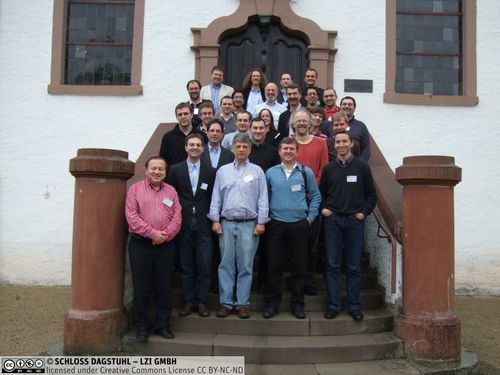
(Click in the middle of the image to enlarge)
Permalink
Please use the following short url to reference this page:
https://www.dagstuhl.de/10191
Organizers
- Christoph W. Kessler (Linköping University, SE)
- Welf Löwe (Linnaeus University - Växjö, SE)
- David Padua (University of Illinois - Urbana-Champaign, US)
- Markus Püschel (ETH Zürich, CH)
Contact
- Simone Schilke (for administrative matters)
Schedule
Components are a well-proven means of handling software complexity. Reusable components and software composition support the construction of large and reliable software systems from pre-defined and tested partial solutions. When maximizing reusability, we end up with components that are very general and do not fit one particular scenario perfectly. Therefore, adaptation, especially optimization, is established as a technique to deal with such mismatches.
A main motivation for us to initiate this Dagstuhl seminar was our observation that composition and optimization are discussed almost in isolation in two different scientific communities. Composition is understood as a problem in software engineering for general-purpose computing; techniques include meta-/generative programming, configuration and (self-)adaptation, and architecture and component systems. Optimization is typically understood as a problem of high-performance and stream computing, and compiler construction; techniques include auto-tuning, scheduling, parallelization, just-in-time compilation, run-time optimizations, and performance prediction.
The goal of this Dagstuhl seminar was thus to bring together outstanding researchers from these two communities. We focused on a common topic of interest: the optimized generation and composition of programs from components, which includes the automatic adaptation to advanced execution platforms. Hence, the topic addresses solutions for both sequential and parallel components and target systems. This issue requires the integration of techniques from both subdomains.
A longer introduction to the main issues in composition and optimization is given in a separate paper.
The seminar started with a round of short self-presentations by all 26 participants. Based on the 17 presentation proposals submitted by the participants in advance, the 2.5 days of the seminar were organized into three main topic areas:Software composition (Monday), Autotuning (Tuesday) and Multicore issues (Wednesday). Each topic area was opened by a survey presentation of 30 minutes, followed by sessions with 30-minutes technical presentations, and concluded with a panel discussion each.
After some initial effort of understanding specific terminology and concepts used and problems discussed by the respective other group, there were lively and productive discussions across the two communities. In particular, we collected, during discussions, a longer list of research challenges and open problems in optimized composition, which we intend to condense into a common paper in the next months.
At the end of the seminar, we received positive feedback from several of the participants indicating that the seminar took up relevant topics, provided sufficient room for discussion in spite of the tight schedule of a short seminar, and inspired concrete plans for cooperations both within and beyond community boundaries.
In summary, we conclude that the seminar was constructive and largely met its goals. Dagstuhl provided a productive and interactive atmosphere that stimulated a cross-fertilization between the two groups. We consider the seminar a first step in a beginning process of getting the two communities closer to each other.
- Mehmet Aksit (University of Twente, NL)
- Marco Aldinucci (University of Turin, IT)
- Sven Apel (Universität Passau, DE) [dblp]
- Uwe Aßmann (TU Dresden, DE) [dblp]
- Paolo Bientinesi (RWTH Aachen, DE) [dblp]
- Massimo Coppola (University of Pisa, IT)
- Marco Danelutto (University of Pisa, IT)
- Usman Dastgeer (Linköping University, SE)
- Franz Franchetti (Carnegie Mellon University, US) [dblp]
- Sergei Gorlatch (Universität Münster, DE)
- Robert Hirschfeld (Hasso-Plattner-Institut - Potsdam, DE) [dblp]
- Jendrik Johannes (TU Dresden, DE)
- Paul H. J. Kelly (Imperial College London, GB) [dblp]
- Christoph W. Kessler (Linköping University, SE) [dblp]
- Christian Lengauer (Universität Passau, DE) [dblp]
- Welf Löwe (Linnaeus University - Växjö, SE) [dblp]
- David Padua (University of Illinois - Urbana-Champaign, US)
- Victor Pankratius (KIT - Karlsruher Institut für Technologie, DE) [dblp]
- Sabri Pllana (Universität Wien, AT) [dblp]
- Markus Püschel (ETH Zürich, CH) [dblp]
- Thomas Rauber (Universität Bayreuth, DE) [dblp]
- Lawrence Rauchwerger (Texas A&M University - College Station, US) [dblp]
- Gudula Rünger (TU Chemnitz, DE) [dblp]
- Mario Südholt (Ecole des Mines de Nantes, FR)
- Jesper Larsson Träff (Universität Wien, AT) [dblp]
- Richard Vuduc (Georgia Institute of Technology - Atlanta, US) [dblp]
Classification
- optimization / scheduling
- programming languages / compiler
- software engineering
- data structures / algorithms / complexity
Keywords
- Software composition
- program optimization
- components
- parallel computing
- scheduling
- autotuning
- adaptivity
- performance prediction
- library synthesis
- meta-programming