
Dagstuhl Seminar 10171
Equilibrium Computation
( Apr 25 – Apr 30, 2010 )
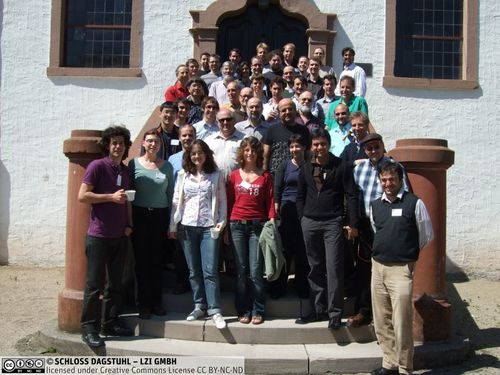
(Click in the middle of the image to enlarge)
Permalink
Please use the following short url to reference this page:
https://www.dagstuhl.de/10171
Organizers
- Edith Elkind (Nanyang TU - Singapore, SG)
- Nimrod Megiddo (IBM Almaden Center, US)
- Peter Bro Miltersen (Aarhus University, DK)
- Vijay V. Vazirani (Georgia Institute of Technology - Atlanta, US)
- Bernhard von Stengel (London School of Economics, GB)
Contact
- Annette Beyer (for administrative matters)
Dagstuhl Seminar Wiki
- Dagstuhl Seminar Wiki (Use personal credentials as created in DOOR to log in)
Shared Documents
- Dagstuhl Materials Page (Use personal credentials as created in DOOR to log in)
Schedule
The focus of this seminar was the algorithmic problem of computing equilibria in games and market models, viewed from both the theoretical and practical perspective. The equilibrium computation problem is one of the central topics in the rapidly expanding field of algorithmic game theory.
The seminar was a follow-up to Seminar 07471, on the same topic, but with three new organizers, and with a focus on some of the aspects of this problem that received relatively little attention in Seminar 07471. One of the major themes of this seminar was dynamics, i.e., exploring the agents' behavior (at both individual and collective level) that leads to the discovery of equilibria, and, more generally, adaptive changes in the collective behavior. Discussed were the classic game-theoretic approaches to this topic (organizer: von Stengel) as well as more recent computational and simulation-based techniques, as studied by the multi-agent community (organizer: Elkind). Another key emphasis was on algorithms and complexity results for market equilibria and their applications to Nash Bargaining Games (organizer: Vazirani). We also compared these approaches with computational and geometric aspects of the central Linear Complementarity Problem (LCP) in mathematical programming (organizer: Megiddo). Finally, since the last seminar there was significant progress understanding the complexity of important algorithms, such as strategy iteration, for solving two-player zero-sum games of infinite duration. Progress in this area has strong connections to mathematical programming and was discussed and extended (organizer: Miltersen).
The following abstracts indicate the diversity of topics and their rich interconnections that were explored during a very successful seminar.
- Ahmad Abu-Khazneh (London School of Economics, GB)
- Imre Barany (Alfréd Rényi Institute of Mathematics - Budapest, HU)
- Marta Maria Casetti (London School of Economics, GB)
- Richard Cole (New York University, US) [dblp]
- Constantinos Daskalakis (MIT - Cambridge, US) [dblp]
- Xiaotie Deng (City University - Hong Kong, HK)
- Nikhil Devanur Rangarajan (Microsoft Corporation - Redmond, US) [dblp]
- Edith Elkind (Nanyang TU - Singapore, SG) [dblp]
- Kousha Etessami (University of Edinburgh, GB) [dblp]
- Angelo Fanelli (Nanyang TU - Singapore, SG) [dblp]
- Felix Fischer (Harvard University - Cambridge, US) [dblp]
- Oliver Friedmann (LMU München, DE) [dblp]
- Martin Gairing (University of Liverpool, GB) [dblp]
- Hugo Gimbert (University of Bordeaux, FR) [dblp]
- Gagan Goel (Georgia Institute of Technology - Atlanta, US)
- Erich Grädel (RWTH Aachen, DE) [dblp]
- Gianluigi Greco (University of Calabria, IT) [dblp]
- Bjarke Hammersholt Roune (Aarhus University, DK)
- Kristoffer Arnsfelt Hansen (Aarhus University, DK) [dblp]
- Thomas Dueholm Hansen (Aarhus University, DK) [dblp]
- Sergiu Hart (The Hebrew Univ. of Jerusalem, IL) [dblp]
- Florian Horn (University of Paris VII, FR)
- Rasmus Ibsen-Jensen (Aarhus University, DK) [dblp]
- Marcin Jurdzinski (University of Warwick - Coventry, GB) [dblp]
- Kevin Leyton-Brown (University of British Columbia - Vancouver, CA) [dblp]
- Andrew McLennan (The University of Queensland - Brisbane, AU)
- Nimrod Megiddo (IBM Almaden Center, US) [dblp]
- Julian Merschen (London School of Economics, GB)
- Peter Bro Miltersen (Aarhus University, DK) [dblp]
- Walter Morris (George Mason Univ. - Fairfax, US)
- James B. Orlin (MIT - Camridge, US)
- Christos H. Papadimitriou (University of California - Berkeley, US) [dblp]
- Maria Polukarov (University of Southampton, GB) [dblp]
- Evangelia Pyrga (LMU München, DE) [dblp]
- Rahul Savani (University of Liverpool, GB) [dblp]
- Guido Schäfer (CWI - Amsterdam, NL) [dblp]
- Alexander Skopalik (RWTH Aachen, DE) [dblp]
- Troels Bjerre Sørensen (University of Warwick - Coventry, GB) [dblp]
- Michael J. Todd (Cornell University, US)
- Pushkar Tripathi (Georgia Institute of Technology - Atlanta, US)
- Vijay V. Vazirani (Georgia Institute of Technology - Atlanta, US) [dblp]
- Angelina Vidali (MPI für Informatik - Saarbrücken, DE)
- Bernhard von Stengel (London School of Economics, GB) [dblp]
- Lei Wang (Georgia Institute of Technology - Atlanta, US)
- Mihalis Yannakakis (Columbia University - New York, US) [dblp]
- Boyu Zhang (Universität Wien, AT)
- Uri Zwick (Tel Aviv University, IL) [dblp]
Related Seminars
Classification
- seminar
- ds/alg/compl
- www
- interdisciplinary
Keywords
- algorithmic game theory
- equilibrium
- economic models