
Dagstuhl Seminar 10152
Relationships, Objects, Roles, and Queries in Modern Programming Languages
( Apr 11 – Apr 16, 2010 )
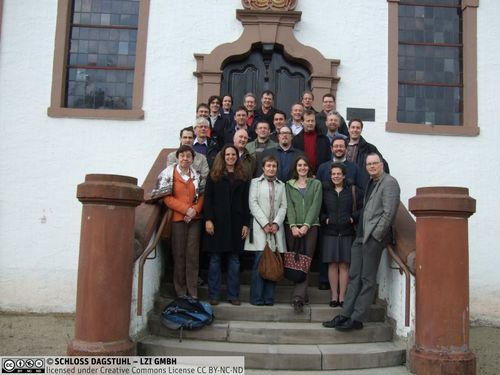
(Click in the middle of the image to enlarge)
Permalink
Please use the following short url to reference this page:
https://www.dagstuhl.de/10152
Organizers
- Guido Boella (University of Turin, IT)
- Erik Meijer (Microsoft Corporation - Redmond, US)
- David J. Pearce (Victoria University - Wellington, NZ)
- Friedrich Steimann (Fernuniversität in Hagen, DE)
- Frank Tip (IBM TJ Watson Research Center - Yorktown Heights, US)
Contact
- Simone Schilke (for administrative matters)
Dagstuhl Seminar Wiki
- Dagstuhl Seminar Wiki (Use personal credentials as created in DOOR to log in)
Shared Documents
- Dagstuhl Materials Page (Use personal credentials as created in DOOR to log in)
Press Review
-
Passen relationale Datenbanken in die objektorientierte Welt?
Wolfgang Back vom Computerclub Zwei im Gespräch mit Prof. Friedrich Steimann
During the 4 days of the seminar, 21 talks, 4 tutorials and 6 demos were given by the participants. In addition, a beauty contest was run on the last day, where participants were invited to solve a benchmark problem using their system.
On Monday, Dr. Stephen Fink gave a tutorial examining state-of-the art practices in programming non-relational stores. This is particularly relevant to web-based systems, and many well-known systems adopt the discussed approaches, including: Facebook, Amazon, YouTube, Craig's List, Yahoo and Twitter. In particular, the main challenge faced by such systems is the potential for significant demand generated from the Internet. Following on from this, were a number talks focusing on the implementation of relationships and roles in programming languages. In the evening, some of these systems were demonstrated, giving the audience a chance to see how far along in development they were.
Tuesday began with a tutorial by Prof. James Noble which surveyed several techniques for implementing roles and relationships in modern programming languages. James focused on the connection between programming languages and models of the real world and, in particular, the current mismatch between them. The morning talk session looked at different techniques for reducing the mismatch between SQL-style querying and modern programming languages. In the afternoon session, further talks were given looking at advances in programming language design which support roles, relationships and querying. In the evening, demos were given on related systems.
Wednesday was a half-day, which saw participants taking an excursion to Trier. A highlight of this was dinner and wine-tasting in the famous Mosel wine region. Prof. Friedrich Steimann gave the morning tutorial on the meaning of roles in programming languages. Friedrich drew inspiration from several old texts looking at concepts and uses of spoken and written languages.
Serge Abiteboul, a participant from the (concurrent) Dagstuhl seminar 10151 on Enabling Holistic Approaches to Business Process Lifecycle Management, gave a tutorial on Thursday. This examined the rise and fall of object-oriented databases --- a particularly relevant topic for the participants. Serge brought an interesting and alternative view on this subject, and provided some valuable cross-fertilization of ideas. Following on from this, Stephan Herrmann gave a short tutorial on the Portable Common Tool Environment (PCTE), which is an EMCA standard. Talks on Thursday covered a range of relevant topics, including verification of relationship-based systems, and analysis of object behaviour protocols. Demos were given in the evening of related systems.
Friday saw many participants demonstrate their solutions to the hotly-contest Beauty Contest. This consisted of a real-world benchmark problem, put together by Friedrich Steimann, extracted from a (hypothetical) theater application intended to support play rehearsals. Participants were given just ten minutes to present their solution and argue why it was elegant. Highlights included several systems which imported the works of Shakespeare as test data. The solution by Christian Wende using a derivative of the EMFText system was declared the winner.
- Uwe Aßmann (TU Dresden, DE) [dblp]
- Guillaume Aucher (INRIA Rennes - Bretagne Atlantique, FR) [dblp]
- Stephanie Balzer (ETH Zürich, CH) [dblp]
- Eric Bodden (TU Darmstadt, DE) [dblp]
- Guido Boella (University of Turin, IT) [dblp]
- William R. Cook (University of Texas - Austin, US) [dblp]
- Mariangiola Dezani (University of Turin, IT) [dblp]
- Sophia Drossopoulou (Imperial College London, GB) [dblp]
- Erik Ernst (Aarhus University, DK) [dblp]
- Patrick Thomas Eugster (Purdue University - West Lafayette, US) [dblp]
- Joerg Evermann (University of Newfoundland, CA)
- Stephen J. Fink (IBM TJ Watson Research Center - Yorktown Heights, US)
- Thomas Gross (ETH Zürich, CH) [dblp]
- Stephan Herrmann (Berlin, DE)
- Ciera Jaspan (Carnegie Mellon University - Pittsburgh, US) [dblp]
- Paul Klint (CWI - Amsterdam, NL) [dblp]
- Keren Lenz (Technion - Haifa, IL)
- Alan Mycroft (University of Cambridge, GB) [dblp]
- James Noble (Victoria University - Wellington, NZ) [dblp]
- Kasper Østerbye (IT University of Copenhagen, DK)
- David J. Pearce (Victoria University - Wellington, NZ) [dblp]
- Michael Pradel (ETH Zürich, CH) [dblp]
- Friedrich Steimann (Fernuniversität in Hagen, DE) [dblp]
- Frank Tip (IBM TJ Watson Research Center - Yorktown Heights, US) [dblp]
- Tijs van der Storm (CWI - Amsterdam, NL) [dblp]
- Christian Wende (TU Dresden, DE)
- Tobias Wrigstad (Uppsala University, SE)
Classification
- Data bases / Information retrieval
- Modelling / Simulation
- Programming Languages / Compilers
- Semantics / Formal Methods
- Software Engineering
Keywords
- Relationships
- Associations
- Roles
- Object-Oriented Programming
- Querying
- UML