
Dagstuhl Seminar 10101
Computational Foundations of Social Choice
( Mar 07 – Mar 12, 2010 )
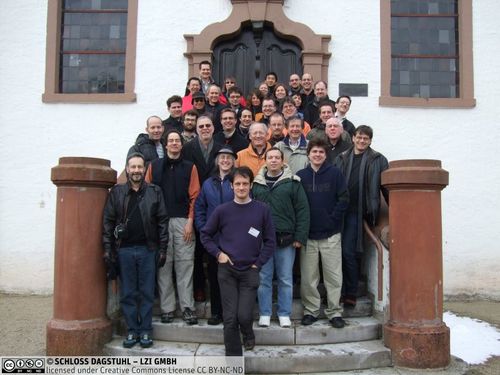
(Click in the middle of the image to enlarge)
Permalink
Please use the following short url to reference this page:
https://www.dagstuhl.de/10101
Organizers
- Felix Brandt (TU München, DE)
- Vincent Conitzer (Duke University - Durham, US)
- Lane Hemaspaandra (University of Rochester, US)
- Jean-Francois Laslier (Ecole Polytechnique - Palaiseau, FR)
- William S. Zwicker (Union College - Schenectady, US)
Contact
- Simone Schilke (for administrative matters)
Schedule
This seminar addressed some of the key issues in computational social choice, a novel interdisciplinary field of study at the interface of social choice theory and computer science. Computational social choice is concerned with the application of computational techniques to the study of social choice mechanisms, such as voting rules and fair division protocols, as well as with the integration of social choice paradigms into computing. The seminar brought together many of the most active researchers in the field and focussed the research community currently forming around these important and exciting topics.
Classical social choice theory deals with the design and analysis of methods for collective decision making and plays an important role within economic theory as witnessed by the Nobel prizes awarded to social choice theorists such as Kenneth Arrow and Amartya Sen. Examples of collective decision making mechanisms are voting rules and methods for the fair division of one or more goods among several agents. For a few years now, researchers from computer science, in particular AI and theory, have been taking an ever increasing interest in social choice. There are two main reasons for that, leading to two different lines of research.
The second line of research within computational social choice goes in the other direction, i.e., concepts and procedures from social choice theory are imported to solve questions that arise in computer science and AI application domains. This is, for instance, the case for managing societies of autonomous software agents, which calls for negotiation and voting procedures. Other examples are the application of techniques from social choice to the development of webpage ranking systems for Internet search engines or recommender systems for electronic commerce.
The seminar brought together 44 researchers who have worked on various aspects of computational social choice, and who have come to this area from very different backgrounds: theoretical computer science, artificial intelligence, economics, operations research, mathematics, and political science. Only half of the participants were computer scientists. Despite---or maybe because of---this heterogeneity, every talk was followed by a long and lively discussion. There was a total of 34 talks plus a rump session consisting of about ten short (5-minute) presentations. Participants originated from 19 different countries with the majority being from France, Germany, and the USA.
A wide variety of topics were discussed during the seminar. Common research themes that emerged included manipulability, approval voting, cake-cutting algorithms, tournaments, and abstention. We are currently preparing a special issue of the journal Mathematical Social Sciences (edited by Felix Brandt and Bill Zwicker) consisting of work presented at this seminar.
- Fuad Aleskerov (NRU Higher School of Economics - Moscow, RU)
- Alon Altman (Stanford University, US)
- Nadja Betzler (Universität Jena, DE)
- Steven J. Brams (New York University, US) [dblp]
- Felix Brandt (TU München, DE) [dblp]
- Markus Brill (TU München, DE) [dblp]
- Yann Chevaleyre (University of Paris North, FR) [dblp]
- Vincent Conitzer (Duke University - Durham, US) [dblp]
- Daniel Eckert (Universität Graz, AT)
- Edith Elkind (Nanyang TU - Singapore, SG) [dblp]
- Ulle Endriss (University of Amsterdam, NL) [dblp]
- Piotr Faliszewski (AGH University of Science & Technology - Krakow, PL) [dblp]
- Henning Fernau (Universität Trier, DE) [dblp]
- Felix Fischer (Harvard University - Cambridge, US) [dblp]
- Josep Freixas Bosch (UPC - Barcelona Tech, ES) [dblp]
- Paul W. Goldberg (University of Liverpool, GB) [dblp]
- Judy Goldsmith (University of Kentucky - Lexington, US) [dblp]
- Paul Harrenstein (TU München, DE) [dblp]
- Edith Hemaspaandra (Rochester Institute of Technology, US) [dblp]
- Lane Hemaspaandra (University of Rochester, US) [dblp]
- Olivier Hudry (ENST - Paris, FR)
- Marc Kilgour (Wilfrid Laurier University, CA) [dblp]
- Christian Klamler (Universität Graz, AT) [dblp]
- Bettina Klaus (University of Lausanne, CH) [dblp]
- László Á. Kóczy (Óbuda University, HU)
- Jérôme Lang (University Paris-Dauphine, FR) [dblp]
- Jean-Francois Laslier (Ecole Polytechnique - Palaiseau, FR) [dblp]
- Evangelos Markakis (Athens University of Economics and Business, GR) [dblp]
- Nicolas Maudet (University Paris-Dauphine, FR) [dblp]
- Marina Meila (University of Washington - Seattle, US) [dblp]
- Vincent Merlin (Caen University, FR) [dblp]
- Rolf Niedermeier (TU Berlin, DE) [dblp]
- Eric Pacuit (Tilburg University, NL) [dblp]
- Hans Peters (Maastricht University, NL)
- Clemens Puppe (KIT - Karlsruher Institut für Technologie, DE) [dblp]
- Francesca Rossi (University of Padova, IT) [dblp]
- Jörg Rothe (Heinrich-Heine-Universität Düsseldorf, DE) [dblp]
- M. Remzi Sanver (Istanbul Bilgi University, TR) [dblp]
- Arkadii Slinko (University of Auckland, NZ) [dblp]
- Toby Walsh (UNSW - Sydney, AU) [dblp]
- Lirong Xia (Duke University - Durham, US) [dblp]
- Makoto Yokoo (Kyushu University - Fukuoka, JP) [dblp]
- Aviv Zohar (The Hebrew University of Jerusalem, IL) [dblp]
- William S. Zwicker (Union College - Schenectady, US) [dblp]
Related Seminars
- Dagstuhl Seminar 07431: Computational Issues in Social Choice (2007-10-21 - 2007-10-26) (Details)
- Dagstuhl Seminar 12101: Computation and Incentives in Social Choice (2012-03-04 - 2012-03-09) (Details)
- Dagstuhl Seminar 15241: Computational Social Choice: Theory and Applications (2015-06-07 - 2015-06-12) (Details)
- Dagstuhl Seminar 17261: Voting: Beyond Simple Majorities and Single-Winner Elections (2017-06-25 - 2017-06-30) (Details)
Classification
- Artificial Intelligence
- Robotics
- Data structures
- Algorithms
Keywords
- Social Choice Theory
- Voting
- Fair Division
- Algorithms
- Computational Complexity
- Multiagent Systems