
Dagstuhl Seminar 10071
Scheduling
( Feb 14 – Feb 19, 2010 )
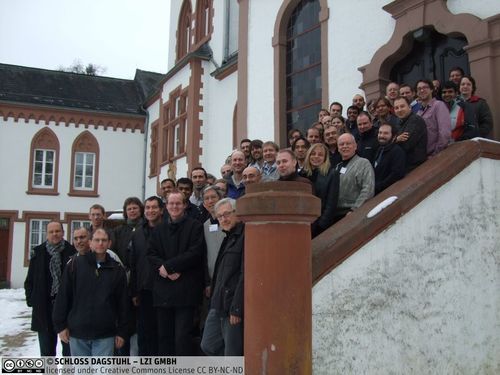
(Click in the middle of the image to enlarge)
Permalink
Please use the following short url to reference this page:
https://www.dagstuhl.de/10071
Organizers
- Susanne Albers (HU Berlin, DE)
- Sanjoy Baruah (University of North Carolina at Chapel Hill, US)
- Rolf H. Möhring (TU Berlin, DE)
- Kirk Pruhs (University of Pittsburgh, US)
Contact
- Simone Schilke (for administrative matters)
Impacts
- Analysis of Smith’s rule in stochastic machine scheduling : article pp. 570-575 - Jagtenberg, Caroline; Schwiegelshohn, Uwe; Uetz, Marc - Amsterdam : Elsevier, 2013. - pp. 570-575 - (Operations Research Letters ; 41. 2013, 6).
- Lower Bounds for Smith’s Rule in Stochastic Machine Scheduling : article in LNCS 6534 : pp. 142-153 - Jagtenberg, Caroline; Schwiegelshohn, Uwe; Uetz, Marc - Berlin : Springer, 2011. - pp. 142-153 - (Lecture notes in computer science ; 6534 : article).
Scheduling is a form of decision making that involves allocating scarce resources over time to achieve some objective. The primary objectives of this seminar were to bring together leading researchers working on scheduling problems in three different research communities – operations research, theoretical computer science, and real-time systems – to expose each community to the important problems addressed by the other communities; to enable and encourage cooperation among the researchers; and to facilitate a transfer of solution techniques from each community to the others. This is the second Dagstuhl seminar organized to further these objectives (the first – Dagstuhl Seminar 08071 – was held two years ago, in February 2008).
There were approximately sixty participants at the seminar, roughly evenly split between the three communities. Several of these participants had also attended the previous seminar. There was one common session each morning and one each afternoon of the seminar. During the first morning, there were presentations describing some of the research outcomes of the previous scheduling seminar. These presentations highlighted the success of the previous seminar in fostering collaborations between the communities. These talks also provided succinct snapshots of the remaining open problems in the domains addressed in these projects. The remaining sessions mostly consisted of one tutorial/survey talk presenting a line of research or a solution technique of a particular community in a manner that is accessible to researchers from the other communities, and many open problem talks, in which multiple short (5-10 minute) presentations that invited collaboration with the speaker on one of his/her favorite open problems. Write-ups of these open problems were collected and published.
Several clusters of seminar participants formed around common research interests. Ample time was built into the schedule to enable these clusters to meet multiple times to get to know each other better, to work on problems together, and to develop plans for continuing some of these collaborations after the seminar. We expect that, as happened in the last seminar, that several successful collaborations will have been formed that result in publications in prestigious conferences and journals.
In essence, this seminar continued the process initiated in Seminar#08071, of getting the real-time systems community on the one hand, and the operations research and theoretical CS communities on the other, better acquainted with each others’ formal models, interesting problems, and solution techniques. We consider these objectives to have largely been met.
- Susanne Albers (HU Berlin, DE) [dblp]
- James H. Anderson (University of North Carolina at Chapel Hill, US) [dblp]
- Bjorn Andersson (The Polytechnic Institute of Porto, PT)
- Yossi Azar (Tel Aviv University, IL) [dblp]
- Nikhil Bansal (IBM TJ Watson Research Center - Yorktown Heights, US) [dblp]
- Sanjoy Baruah (University of North Carolina at Chapel Hill, US) [dblp]
- Marko Bertogna (Scuola Superiore Sant'Anna - Pisa, IT) [dblp]
- Enrico Bini (Scuola Superiore Sant'Anna - Pisa, IT) [dblp]
- Vincenzo Bonifaci (MPI für Informatik - Saarbrücken, DE) [dblp]
- Marco Caccamo (University of Illinois - Urbana-Champaign, US) [dblp]
- Marek Chrobak (University of California - Riverside, US) [dblp]
- José R. Correa (University of Chile - Santiago de Chile, CL) [dblp]
- Liliana Cucu-Grosjean (INRIA Lorraine - Nancy, FR) [dblp]
- Robert Davis (University of York, GB) [dblp]
- Arvind Easwaran (The Polytechnic Institute of Porto, PT) [dblp]
- Jeff Edmonds (York University - Toronto, CA)
- Friedrich Eisenbrand (EPFL - Lausanne, CH) [dblp]
- Nathan Fisher (Wayne State University, US) [dblp]
- Gerhard Fohler (TU Kaiserslautern, DE) [dblp]
- Shelby Funk (University of Georgia, US) [dblp]
- Joel Goossens (University of Brussels, BE) [dblp]
- Sathish Gopalakrishnan (University of British Columbia - Vancouver, CA) [dblp]
- Elisabeth Günther (TU Berlin, DE)
- Wiebke Höhn (TU Berlin, DE) [dblp]
- Han Hoogeveen (Utrecht University, NL)
- Sungjin Im (University of Illinois - Urbana-Champaign, US) [dblp]
- Samir Khuller (University of Maryland - College Park, US) [dblp]
- Ravishankar Krishnaswamy (Carnegie Mellon University, US) [dblp]
- Jan Karel Lenstra (CWI - Amsterdam, NL)
- Alberto Marchetti-Spaccamela (Sapienza University of Rome, IT) [dblp]
- Monaldo Mastrolilli (IDSIA - Manno, CH) [dblp]
- Claire Mathieu (Brown University - Providence, US) [dblp]
- Nicole Megow (MPI für Informatik - Saarbrücken, DE) [dblp]
- Rolf H. Möhring (TU Berlin, DE) [dblp]
- Aloysius K. Mok (University of Texas - Austin, US) [dblp]
- Benjamin J. Moseley (University of Illinois - Urbana-Champaign, US) [dblp]
- Seffi Naor (Technion - Haifa, IL) [dblp]
- Martin Niemeier (EPFL - Lausanne, CH)
- Christopher Potts (University of Southampton, GB) [dblp]
- Kirk Pruhs (University of Pittsburgh, US) [dblp]
- Maurice Queyranne (University of British Columbia - Vancouver, CA)
- Adi Rosén (University of Paris VII, FR) [dblp]
- Thomas Rothvoss (EPFL - Lausanne, CH) [dblp]
- Nicolas Schabanel (University of Paris VII, FR)
- Uwe Schwiegelshohn (TU Dortmund, DE) [dblp]
- Jiri Sgall (Charles University - Prague, CZ) [dblp]
- David Shmoys (Cornell University, US) [dblp]
- René Sitters (VU University of Amsterdam, NL) [dblp]
- Martin Skutella (TU Berlin, DE) [dblp]
- Alexander Souza (HU Berlin, DE)
- Clifford Stein (Columbia University, US) [dblp]
- Sebastian Stiller (TU Berlin, DE) [dblp]
- Leen Stougie (CWI - Amsterdam, NL) [dblp]
- Marc Uetz (University of Twente, NL) [dblp]
- Steef van de Velde (Erasmus University - Rotterdam, NL)
- Rob van Stee (MPI für Informatik - Saarbrücken, DE) [dblp]
- Tjark Vredeveld (Maastricht University, NL) [dblp]
- Joel Wein (Polytechnic Institute of NYU - Brooklyn, US)
- Gerhard J. Woeginger (TU Eindhoven, NL) [dblp]
- Neal E. Young (University of California - Riverside, US)
Related Seminars
- Dagstuhl Seminar 08071: Scheduling (2008-02-10 - 2008-02-15) (Details)
- Dagstuhl Seminar 13111: Scheduling (2013-03-10 - 2013-03-15) (Details)
- Dagstuhl Seminar 16081: Scheduling (2016-02-21 - 2016-02-26) (Details)
- Dagstuhl Seminar 18101: Scheduling (2018-03-04 - 2018-03-09) (Details)
- Dagstuhl Seminar 20081: Scheduling (2020-02-16 - 2020-02-21) (Details)
- Dagstuhl Seminar 23061: Scheduling (2023-02-05 - 2023-02-10) (Details)
- Dagstuhl Seminar 25121: Scheduling (2025-03-16 - 2025-03-21) (Details)
- Dagstuhl Seminar 28081: Scheduling (2028-02-20 - 2028-02-25) (Details)
Classification
- optimization
- scheduling
Keywords
- Scheduling
- real-time