
Dagstuhl Seminar 10042
Semantic Challenges in Sensor Networks
( Jan 24 – Jan 29, 2010 )
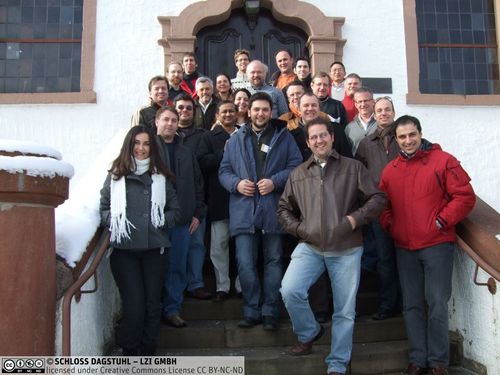
(Click in the middle of the image to enlarge)
Permalink
Please use the following short url to reference this page:
https://www.dagstuhl.de/10042
Organizers
- Karl Aberer (EPFL - Lausanne, CH)
- Avigdor Gal (Technion - Haifa, IL)
- Manfred Hauswirth (National University of Ireland - Galway, IE)
- Kai-Uwe Sattler (TU Ilmenau, DE)
- Amit P. Sheth (Wright State University - Dayton, US)
Contact
Schedule
There has been significant progress in the number and capabilities of mobile devices, wireless sensors, and sensor networks. These developments, combined with the improved ability to bridge between the physical and cyber world in a more seamless way, have fostered the broad availability of sensor data capturing the state of the physical world. Promising and already successful examples are applications in environmental monitoring, agriculture, surveillance and intrusion detection, public security, and supply chain management. Furthermore, ideas towards a Web of sensors have been proposed, which is to be understood as a (large scale) network of spatially distributed sensors. In particular, terms like "Internet of Things", "Collaborating Objects" and "Ambient Intelligence" emphasize the trend towards a tighter connection between the cyber space and the physical world.
The existence of a huge number of sensor sources producing data continuously results in tremendous data volumes which are often valid or useful only for certain period of time and are never inspected by humans. In order to make sensor data useful despite the lack of human supervision in the loop, semantic annotation and analysis becomes a key component in setting up sensor data-based applications: Only if sensors and sensor data are annotated and enriched by information describing their meanings, source, and validity scope, they can be automatically discovered, processed and combined with other data in an open world. The kind of useful semantics ranges from technical metadata describing the sensors and the measurements (time, location, sensor type, validity, measurement error etc. as partially captured by standardization proposals like SensorML) to emergent semantics derived by aggregating, combining, analyzing, and enriching the raw data, e.g., in the form of analytical models, annotations, correlations etc. on the other spectrum, the data collected by human-in-the-loop sensing is small but of significant verity and complexity (e.g., language nuances, and capturing sentiments and emotions), which offer additional challenges to annotation, integration and analysis of such data.
Modeling, representing, discovering and deriving as well as using semantics for sensor data raise several challenges which are related to different aspects of developing, deploying, and using sensor network based applications. Thus, the goal of this seminar was to bring together researchers from relevant areas, such as:
- sensor node providers and sensor networking,
- data fusion and data stream processing,
- sensor middleware,
- geospatial and uncertain data management,
- semantic integration and Semantic Web, and
- social computing and collective intelligence.
Semantics plays an important role in all of these areas, either by producing and enriching data with explicit semantics or by exploiting semantics for data processing. Therefore, sharing and exchanging knowledge and experiences among disciplines could result in significant synergy effects.
The seminar focused on the following major issues:
- methodologies and languages for modeling and representation, issues of sensing-perception-semantics,
- standards, ontologies, and middleware for semantic sensor networks,
- semantic annotation of high throughput machine sensor data as well as social/human-in-the-loop sensing data,
- emergent semantics in sensor networks and sensor data processing,
- exploiting sensor data semantics for geospatial and uncertainty data management, and
- specific use cases and applications of semantic sensor networks.
- review of related community efforts that directly relevant to the seminar topic, especially W3C's XG on Semantic Sensor Networking,
The objectives set out by the organizers were to analyze the state of the art in the different areas with respect to semantics, discuss problems, specific methodologies and applications of semantic-aware sensor networks and emergent semantics as well as to identify future trends and research directions.
The seminar was well attended: 27 researchers from Europe, Asia, and North America actively contributed to the seminar. During the week, two special discussion sections were organized where the seminar was split in smaller groups. The topics of these discussion groups were "Data Representation & Semantics", "Query Models", "Architectures for Semantic Sensor Networks", and "Application Requirements".
At the end of the seminar a joint session with the parallel Dagstuhl seminar "Digital Social Networks" was held to explore research topics at the intersection of both research domains, for example, the use of social network infrastructures to discover and publish sensor data, the problem of privacy at the intersection of sensor networks, mobile phones and social networks, and the use of social networking in social sensing. There was enthusiasm to organize a follow-on seminar bringing together the two area and a proposal for a Dagstuhl Seminar is planned.
- Alia Abdelmoty (Cardiff University, GB)
- Karl Aberer (EPFL - Lausanne, CH) [dblp]
- Oscar Corcho (Technical University of Madrid, ES) [dblp]
- Ernesto Damiani (Università degli Studi di Milano - Crema, IT) [dblp]
- David De Roure (University of Oxford, GB) [dblp]
- Alvaro A. A. Fernandes (University of Manchester, GB)
- Avigdor Gal (Technion - Haifa, IL) [dblp]
- Alasdair J G Gray (University of Manchester, GB)
- Dimitrios Gunopulos (University of Athens, GR) [dblp]
- Manfred Hauswirth (National University of Ireland - Galway, IE) [dblp]
- Cory Henson (Wright State University - Dayton, US)
- Vana Kalogeraki (Athens University of Economics and Business, GR) [dblp]
- Stamatis Karnouskos (SAP SE - Karlsruhe, DE) [dblp]
- Manolis Koubarakis (University of Athens, GR) [dblp]
- Srdjan Krco (Ericsson R&D Ireland, IE)
- Werner Kuhn (Universität Münster, DE) [dblp]
- Kostis Kyzirakos (University of Athens, GR)
- Yong Liu (University of Illinois at Urbana Champaign, US) [dblp]
- Sebastian Michel (MPI für Informatik - Saarbrücken, DE) [dblp]
- Paddy Nixon (University College Dublin, IE)
- Josiane Xavier Parreira (National University of Ireland - Galway, IE) [dblp]
- Tore Risch (Uppsala University, SE) [dblp]
- Kai-Uwe Sattler (TU Ilmenau, DE) [dblp]
- Amit P. Sheth (Wright State University - Dayton, US) [dblp]
- Ingo Simonis (Geospatial Research & Consulting - Oberursel, DE)
- Heiner Stuckenschmidt (Universität Mannheim, DE) [dblp]
- Demetris Zeinalipour (University of Cyprus, CY) [dblp]
Classification
- databases / information retrieval
- data structures / algorithms / complexity
- networks
Keywords
- sensor networks
- sensor data processing
- semantic integration
- semantic sensor networks