Dagstuhl Seminar 09481
SYNCHRON 2009
( Nov 22 – Nov 27, 2009 )
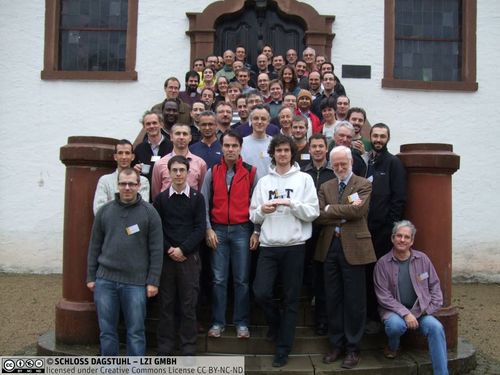
(Click in the middle of the image to enlarge)
Permalink
Please use the following short url to reference this page:
https://www.dagstuhl.de/09481
Organizers
- Albert Benveniste (INRIA Rennes - Bretagne Atlantique, FR)
- Stephen A. Edwards (Columbia University - New York, US)
- Edward A. Lee (University of California - Berkeley, US)
- Klaus Schneider (TU Kaiserslautern, DE)
- Reinhard von Hanxleden (Universität Kiel, DE)
Contact
- Annette Beyer (for administrative matters)
Sponsors
The Dagstuhl Foundation gratefully acknowledges the donation from

Synchronous languages have been designed to allow the unambiguous description of reactive, embedded real-time systems. The common foundation for these languages is the synchrony hypothesis, which treats computations as being logically instantaneous. This abstraction enables functionality and real-time characteristics to be treated separately, facilitating the design of complex embedded systems. Digital hardware has long been designed using the synchronous paradigm; our synchronous languages were devised largely independently and have placed the technique on a much firmer mathematical foundation.
Feedback from the user base and the continuously growing complexity of applications still pose new challenges, such as the sound integration of synchronous and asynchronous, event- and time-triggered, or discrete and continuous systems. This seminar aims to address these challenges, building on a strong and active community and expanding its scope into relevant related fields. This year’s workshop includes researchers in model-based design, embedded real-time systems, mixed system modeling, models of computation, and distributed systems.
The seminar was successful in bringing together researchers and practitioners of synchronous programming, and furthermore in reaching out to relevant related areas. With a record participation in this year’s SYNCHRON workshop of more than 50 participants and a broad range of topics discussed, the aims seem to have been well-met. The program of the seminar was composed of around 36 presentations, all of which included extensive technical discussions. The fields covered included synchronous semantics, modeling languages, verification, heterogeneous and distributed systems, hardware/software integration, reactive processing, timing analyses, application experience reports, and industrial requirements. The discussion identified and collected specific needs for future topics, in particular the integration of different models of computation.
The SYNCHRON workshop constitutes the only yearly meeting place for the researchers in this exciting field. The workshops on Synchronous Languages started in 1993 at Schloss Dagstuhl. Since then, the workshop has evolved significantly in its sixteen years of existence. One obvious change is the citizenship of its attendees, which has shifted from being largely French to being truly world-wide. But the biggest change is in its scope, which has grown to expand many languages and techniques that are not classically synchronous but have been substantially influenced by the synchronous languages’ attention to timing, mathematical rigor, and parallelism. Also, while many of the most senior synchronous language researchers are still active, many younger researchers have also entered the fray and taken the field in new directions. We look forward to seeing where they take us next.
- Joaquin Aguado (Universität Bamberg, DE) [dblp]
- Cédric Auger (University of Paris South XI, FR) [dblp]
- Fernando Barros (University of Coimbra, PT) [dblp]
- Albert Benveniste (INRIA Rennes - Bretagne Atlantique, FR) [dblp]
- Egon Börger (University of Pisa, IT) [dblp]
- Julien Boucaron (INRIA Sophia Antipolis - Méditerranée, FR)
- Timothy Bourke (INRIA Rennes - Bretagne Atlantique, FR) [dblp]
- Jens Brandt (TU Kaiserslautern, DE)
- Benoit Caillaud (INRIA Rennes - Bretagne Atlantique, FR) [dblp]
- Paul Caspi (VERIMAG - Grenoble, FR)
- Albert Cohen (University of Paris South XI, FR) [dblp]
- Christian Colombo (University of Malta, MT) [dblp]
- Willem-Paul de Roever (Universität Kiel, DE) [dblp]
- Robert de Simone (INRIA Sophia Antipolis - Méditerranée, FR) [dblp]
- Gwenaël Delaval (INRIA - Grenoble, FR) [dblp]
- Patricia Derler (Universität Salzburg, AT) [dblp]
- Philippe Dumont (University of Paris South XI, FR)
- Stephen A. Edwards (Columbia University - New York, US) [dblp]
- Giovanni Funchal (VERIMAG - Grenoble, FR)
- Abdoulaye Gamatié (INRIA - University of Lille 1, FR)
- Mike Gemünde (TU Kaiserslautern, DE) [dblp]
- Léonard Gérard (University of Paris South XI, FR)
- Manuel Gesell (TU Kaiserslautern, DE) [dblp]
- Dan R. Ghica (University of Birmingham, GB) [dblp]
- Alain Girault (INRIA - Grenoble, FR) [dblp]
- Ursula Goltz (TU Braunschweig, DE)
- Nicolas Halbwachs (VERIMAG - Grenoble, FR) [dblp]
- David Harel (Weizmann Institute - Rehovot, IL) [dblp]
- Peter Hintenaus (Universität Salzburg, AT)
- Edward A. Lee (University of California - Berkeley, US) [dblp]
- Gerald Lüttgen (Universität Bamberg, DE) [dblp]
- Louis Mandel (University of Paris South XI, FR) [dblp]
- Florence Maraninchi (VERIMAG - Grenoble, FR) [dblp]
- Slobodan Matic (University of California - Berkeley, US)
- Mohamed Nabih Menaa (University of Birmingham, GB)
- Michael Mendler (Universität Bamberg, DE) [dblp]
- Lionel Morel (INSA - Lyon, FR)
- Matthieu Moy (VERIMAG - Grenoble, FR)
- Gordon Pace (University of Malta, MT) [dblp]
- John Plaice (UNSW - Sydney, AU) [dblp]
- Florence Plateau (University of Paris South XI, FR)
- Dumitru Potop-Butucaru (INRIA - Le Chesnay, FR) [dblp]
- Marc Pouzet (University of Paris South XI, FR) [dblp]
- Pascal Raymond (VERIMAG - Grenoble, FR) [dblp]
- Eric Rutten (INRIA - Grenoble, FR) [dblp]
- Stephan Scheele (Universität Bamberg, DE) [dblp]
- Klaus Schneider (TU Kaiserslautern, DE) [dblp]
- Peter Schrammel (INRIA - Grenoble, FR) [dblp]
- Sandeep K. Shukla (Virginia Polytechnic Institute - Blacksburg, US)
- Satnam Singh (Microsoft Research UK - Cambridge, GB) [dblp]
- Martin Strecker (Paul Sabatier University - Toulouse, FR)
- Jean-Pierre Talpin (INRIA Rennes - Bretagne Atlantique, FR)
- Stavros Tripakis (University of California - Berkeley, US) [dblp]
- Reinhard von Hanxleden (Universität Kiel, DE) [dblp]
- Reinhard Wilhelm (Universität des Saarlandes, DE) [dblp]
Related Seminars
- Dagstuhl Seminar 9448: Synchronous Languages (1994-11-28 - 1994-12-02) (Details)
- Dagstuhl Seminar 9650: Synchronous Languages (1996-12-09 - 1996-12-13) (Details)
- Dagstuhl Seminar 01491: Synchronous Languages (2001-12-02 - 2001-12-07) (Details)
- Dagstuhl Seminar 04491: Synchronous Programming - SYNCHRON'04 (2004-11-28 - 2004-12-03) (Details)
- Dagstuhl Seminar 13471: Synchronous Programming (2013-11-17 - 2013-11-22) (Details)
Classification
- Modelling / simulation
- Programming languages / compiler
- Semantics / formal methods
- Verification / logic
Keywords
- Synchronous languages
- Safety-critical real-time systems
- Model-based design
- Discrete and hybrid systems
- Combining synchronous and asynchronous models
- Formally consistent subsetting of UML
- High-level hardware modeling and synthesis
- Compilation and code synthesis for embedded systems
- Visualisation of complex systems
- Simulation
- verification and testing tools
- Execution time analysis for synchronous programs
- Industrial experience reports