
Dagstuhl Seminar 09351
Information processing, rational belief change and social interaction
( Aug 23 – Aug 27, 2009 )
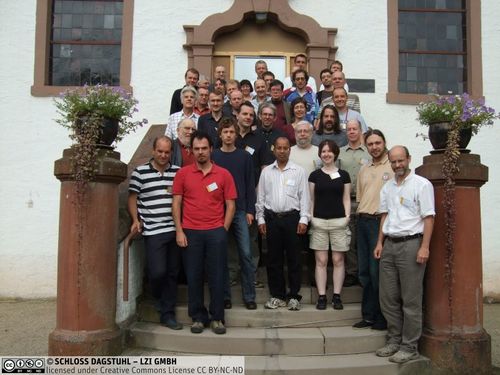
(Click in the middle of the image to enlarge)
Permalink
Please use the following short url to reference this page:
https://www.dagstuhl.de/09351
Organizers
- Giacomo Bonanno (University of California - Davis, US)
- James P. Delgrande (Simon Fraser University - Burnaby, CA)
- Hans Rott (Universität Regensburg, DE)
Contact
- Annette Beyer (for administrative matters)
The study of the formal aspects of information processing, belief formation and rational belief change is of central importance in a number of different fields. A new field of research, called Social Software, maintains that mathematical models developed to reason about the knowledge and beliefs of a group of agents can be used to deepen our understanding of social interaction and aid in the design of successful social institutions. Social Software is the formal study of social procedures focusing on three aspects: (1) the logical and algorithmic structure of social procedures (the main contributors to this area are computer scientists), (2) knowledge and information (the main contributors to this area are logicians and philosophers), and (3) incentives (the main contributors are game theorists and economists). Similarly, the most important question in Game Theory is how to rationally form a belief about other players’ behavior and how to rationally revise those beliefs in light of observed actions. Traditionally Game Theory has relied mostly on probabilistic models of beliefs, although recent research has focused on qualitative aspects of belief change. A new branch of logic, called Dynamic Epistemic Logic, has emerged that investigates the epistemic foundations of game theory from the point of view of formal logic. There are various newly emerging links between the research areas mentioned above.
The purpose of the Workshop was to bring together researches from all these different areas and to promote an exchange of ideas and cross-fertilization between different fields. These researchers normally do not meet together.
Two very successful workshops with similar objectives took place at Schloss Dagstuhl in August 2005 and August 2007 (Seminars 05321 and 07351). Researchers from different fields (logicians, computer scientists, philosophers and economists) participated in these workshops and the anonymous surveys collected at the end gave enthusiastic evaluations of the events.
We saw the Dagstuhl Workshop as providing a forum where researchers in three broad areas (philosophy and logic, artificial intelligence and computer science, and economics and game theory) could address highly related (in some cases, the same) problems, in which work in one area could benefit research in another.
We found the Workshop successful, especially on the following two achievements: first, the seminar made participants aware of a commonality of interests across different disciplines; second, it suggested new directions for research that will probably be taken up by researchers in the next couple of years.
- Guillaume Aucher (University of Luxembourg, LU) [dblp]
- Meghyn Bienvenu (Universität Bremen, DE) [dblp]
- Alexander Bochman (Holon Institute of Technology, IL) [dblp]
- Giacomo Bonanno (University of California - Davis, US)
- Gerhard Brewka (Universität Leipzig, DE) [dblp]
- Jan M. Broersen (Utrecht University, NL) [dblp]
- John Cantwell (KTH Royal Institute of Technology, SE)
- Mathijs de Boer (University of Luxembourg, LU)
- Dick De Jongh (University of Amsterdam, NL) [dblp]
- James P. Delgrande (Simon Fraser University - Burnaby, CA) [dblp]
- Didier Dubois (Paul Sabatier University - Toulouse, FR) [dblp]
- Daniel Eckert (Universität Graz, AT)
- Eduardo Fermé (University of Madeira - Funchal, PT) [dblp]
- Andreas Herzig (Paul Sabatier University - Toulouse, FR) [dblp]
- Aaron M. Hunter (Simon Fraser University - Burnaby, CA)
- Gabriele Kern-Isberner (TU Dortmund, DE) [dblp]
- Sebastien Konieczny (CNRS - Lens, FR) [dblp]
- Jérôme Lang (CNRS - Paris, FR) [dblp]
- Isaac Levi (Columbia University - New York, US)
- Emiliano Lorini (Paul Sabatier University - Toulouse, FR) [dblp]
- Thomas Meyer (Meraka Institute - Pretoria, ZA) [dblp]
- Abhaya Nayak (Macquarie University - Sydney, AU) [dblp]
- Andres Perea (Maastricht University, NL)
- Ramon Pino-Pérez (Univ. de Los Andes - Merida, VE) [dblp]
- Henri Prade (Paul Sabatier University - Toulouse, FR) [dblp]
- Mauricio Reis (University of Madeira - Funchal, PT) [dblp]
- Hans Rott (Universität Regensburg, DE) [dblp]
- Burkhard C. Schipper (University of California - Davis, US) [dblp]
- Steven Schockaert (Ghent University, BE) [dblp]
- Guillermo R. Simari (National University of the South - Bahía Blanca, AR) [dblp]
- Michael Thielscher (TU Dresden, DE) [dblp]
- Leon van der Torre (University of Luxembourg, LU) [dblp]
- Hans Van Ditmarsch (University of Sevilla, ES) [dblp]
- Renata Wassermann (University of Sao Paulo, BR) [dblp]
- Emil Weydert (University of Luxembourg, LU) [dblp]
- Stefan Woltran (TU Wien, AT) [dblp]
Related Seminars
Classification
- Artificial Intelligence
- Interdisciplinary (Computer Science / Economics/ Game Theory / Philosophy)
- Formal methods
- Logic
Keywords
- information processing
- belief formation
- social interaction