
Dagstuhl Perspectives Workshop 09271
Semantic Web Reflections and Future Directions
( Jun 28 – Jul 03, 2009 )
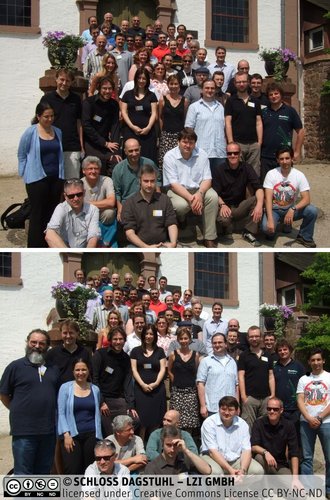
(Click in the middle of the image to enlarge)
Permalink
Please use the following short url to reference this page:
https://www.dagstuhl.de/09271
Organizers
- John Domingue (The Open University - Milton Keynes, GB)
- Dieter Fensel (Universität Innsbruck, AT)
- James A. Hendler (Rensselaer Polytechnic Institute - Troy, US)
- Rudi Studer (KIT - Karlsruher Institut für Technologie, DE)
Contact
Impacts
- Dagstuhl Manifesto : Dagstuhl Perspectives Semantic Web Reflections and Future Directions : pp. 521 - 523 : article - Harth, Andreas; Studer, Rudi - Berlin : Springer, 2010 - (Informatik Spektrum : 33. 2010, 5 : pp. 521-523).
- Handbook of Semantic Web Technologies : Vol. 1: Foundations and Technologies ; Vol. 2: Semantic Web Applications - Domingue, John, Fensel, Dieter, Hendler, James A. - Berlin : Springer, 2011 - (Springer References). ISBN: 978-3-540-92912-3.
Schedule
With an ever increasing amount of data being stored and processed on computers, and the ubiquitous use of the Web for communication and dissemination of content, the world contains a vast amount of digital data that is growing ever faster. The available data is increasingly used to gain insights for science and research, to create commercial value, and to hold governments accountable. Semantic Web technologies for supporting machine-readable content aim at facilitating the processing and integration of data from the open Web environment where large portions of the publicly available data is being published. Since the first Dagstuhl seminar “Semantics for the Web” in 2000 the amount of machine-readable data on the Web has exploded, and Semantic Web technologies have matured and made their way from research labs and universities into commercial applications.
In this Perspectives Workshop participants from academia, industry, and government presented and discussed further directions for Semantic Web research. In general, the field of Semantic Web research has matured in the last decade. One indication for that, among others, is the discussion of advanced issues such as scalablity. More data is becoming available and vocabulary managment is being operationalised, and research on provenance tracking and technologies and methods addressing privacy concerns has commenced. How users can appropriately interact with the flood of data and leverage the data to satisfy information needs or gain insight is still an open question. Some prominent areas for applications of Semantic Web technologies discussed at the workshop are e-Science and mobile and sensor networks.
- Hans Akkermans (Free University of Amsterdam, NL) [dblp]
- Lora Aroyo (VU University Amsterdam, NL) [dblp]
- Stefano Bertolo (European Commission Luxembourg, LU)
- Christian Bizer (FU Berlin, DE) [dblp]
- Paolo Bouquet (Università di Trento, IT) [dblp]
- Daniel Brickley (VU University Amsterdam, NL) [dblp]
- Vinay K. Chaudhri (SRI - Menlo Park, US) [dblp]
- Philipp Cimiano (TU Delft, NL) [dblp]
- Fabio Ciravegna (University of Sheffield, GB)
- Oscar Corcho (Univ. Politec. de Madrid, ES) [dblp]
- Stefan Decker (National University of Ireland - Galway, IE) [dblp]
- John Domingue (The Open University - Milton Keynes, GB) [dblp]
- Jérôme Euzenat (INRIA - Grenoble, FR) [dblp]
- Federico Facca (Universität Innsbruck, AT)
- Anna Fensel (FTW Forschungszentrum Telekommunikation Wien GmbH, AT)
- Dieter Fensel (Universität Innsbruck, AT)
- Aldo Gangemi (CNR - Rome, IT) [dblp]
- Yolanda Gil (USC - Marina del Rey, US) [dblp]
- Asuncion Gomez-Perez (Technical University of Madrid, ES) [dblp]
- Günther Görz (Universität Erlangen-Nürnberg, DE) [dblp]
- Marko Grobelnik (Jozef Stefan Institute - Ljubljana, SI) [dblp]
- Peter Haase (fluid Operations AG - Walldorf, DE) [dblp]
- Harry Halpin (University of Edinburgh, GB) [dblp]
- Sung-Kook Han (Wonkwang University - Iksan-Chonbuk, KR)
- Siegfried Handschuh (National University of Ireland - Galway, IE) [dblp]
- Andreas Harth (KIT - Karlsruher Institut für Technologie, DE) [dblp]
- Tom Heath (Talis Systems Ltd. - Birmingham, GB) [dblp]
- Jeff Heflin (Lehigh University - Bethlehem, US) [dblp]
- James A. Hendler (Rensselaer Polytechnic Institute - Troy, US) [dblp]
- Ivan Herman (CWI - Amsterdam, NL) [dblp]
- Ian Horrocks (University of Oxford, GB) [dblp]
- Atanas Kiryakov (Sirma Group Corp. - Sofia, BG) [dblp]
- Markus Krötzsch (KIT - Karlsruher Institut für Technologie, DE) [dblp]
- Reto Krummenacher (Universität Innsbruck, AT)
- Deborah L. McGuinness (Stanford University, US) [dblp]
- Barry Norton (Universität Innsbruck, AT)
- Natasha Noy (Stanford University, US) [dblp]
- Jeff Z. Pan (University of Aberdeen, GB) [dblp]
- Carlos Pedrinaci (The Open University - Milton Keynes, GB)
- Ruzica Piskac (EPFL - Lausanne, CH) [dblp]
- Valentina Presutti (ISTC - CNR, Trento, IT) [dblp]
- Dumitru Roman (Universität Innsbruck, AT)
- Hans-Peter Schnurr (KIT - Karlsruher Institut für Technologie, DE)
- Guus Schreiber (Free University of Amsterdam, NL)
- Elena Simperl (Universität Innsbruck, AT) [dblp]
- Katharina Siorpaes (Universität Innsbruck, AT)
- Steffen Staab (Universität Koblenz-Landau, DE) [dblp]
- Rudi Studer (KIT - Karlsruher Institut für Technologie, DE) [dblp]
- York Sure-Vetter (GESIS - Bonn, DE)
- Frank van Harmelen (VU University Amsterdam, NL) [dblp]
- Denny Vrandecic (KIT - Karlsruher Institut für Technologie, DE) [dblp]
- Alexander Wahler (Semantic Technology Institute International - Wien, AT)
- Hannes Werthner (TU Wien, AT) [dblp]
- Bob Wielinga (University of Amsterdam, NL)
Related Seminars
- Dagstuhl Seminar 00121: Semantics for the Web (2000-03-19 - 2000-03-24) (Details)
Classification
- artificial intelligence / robotics
- web
Keywords
- Semantic Web
- Semantic Web Services
- eBusiness
- SOA
- Web Services
- GRID
- Web 2.0