
Dagstuhl Perspectives Workshop 09082
The Future of Grid Computing
( Feb 15 – Feb 20, 2009 )
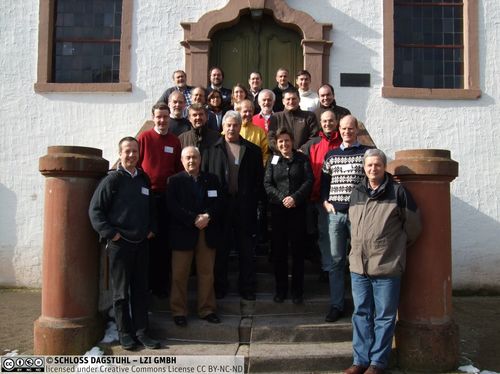
(Click in the middle of the image to enlarge)
Permalink
Please use the following short url to reference this page:
https://www.dagstuhl.de/09082
Organizers
- Dieter Kranzlmüller (LMU München, DE)
- Andreas Reuter (HITS gGmbH - Heidelberg, DE)
- Uwe Schwiegelshohn (TU Dortmund, DE)
Contact
- Annette Beyer (for administrative matters)
Impacts
- Dagstuhl Manifesto : Perspectives in Grid Computing : pp. 220-221 - Schwiegelshohn, Uwe - Berlin : Springer, 2010 - (Informatik Spektrum : 33. 2010, 2 : pp. 220-221).
- Perspectives on grid computing : article : pp. 1104-1115 - Schwiegelshohn, Uwe; Badia, Rosa M.; Bubak, Marian; Danuletto, Marco; Dustdar, Schahram; Gagliardi, Fabrizio; Geiger, Alfred; Hluchy, Ladislav; Kranzlmüller, Dieter; Laure, Erwin; Priol, Thierry; Reinefeld, Alexander; Resch, Michael M.; Reuter, Andreas; Rienhoff, Otto; Rüter, Thomas; Sloot, Peter M. A.; Talia, Domenico; Ullmann, Klaus; Yahyapour, Ramin; Voigt, Gabriele von - Amsterdam : Elsevier, 2010 - (Future generation computer systems : 26. 2010, 8 : pp. 1104-1115).
In February 2009, the participants of a Dagstuhl Perspectives Workshop addressed the future of grid computing. The detailed results are published in the journal Future Generation Computing Systems. In general, it can be observed that grid computing has been promoted for more than 10 years as the global computing infrastructure of the future. Some scientists like Jeremy Rifkin considered it as one of sources of the impact of scientific and technological changes on the economy and society. This claim is based on the observation that the usage of large data volumes becomes important to many disciplines, from natural sciences via engineering even to the humanities. To amortize the substantial costs of generating and maintaining these data volumes, they are typically shared by many scientists of different institutions leading to so called virtual research environments (VRE). We consider the support of these VREs to be the key property of computing grids. Further, the exploitation of these large data volumes usually leads to large simulation tasks that require large IT systems. However, this affects also some disciplines whose members have traditionally little experience in administrating and managing these systems. These users can neither afford to manage suitable IT systems by their own nor to establish a sufficiently large local compute. Therefore, the concept of a computing infrastructure similar to the electrical power infrastructure is particularly appealing to them. However, despite significant investments in the grid concept, the number of users is not increasing. Possibly also for this reason, grid computing recently receives less attention although the basic observations still hold. Instead, new concepts, like cloud computing, seem to replace the grid computing approach.
Unfortunately, the simple electrical power grid analogy does not only provide a simple motivation for efforts to install computational grids but it also has raised hopes for a fast realization. But here this analogy really falls short as it ignores significant differences between electrical and computation power, like, for instance, the heterogeneity of resources and complexity of services.
In general, computer users will move to a new paradigm if the expected benefits dwarf the transition costs. Therefore, we need to address both sides of the coin. While already many publications present approaches to enhance the eventual benefits of Grid computing shall we also increase our efforts to reduce transition costs for the user? Can we identify user groups that are very eager to use Grid computing and may help us to quickly reach system maturity thus reducing transition costs? However, this approach may automatically focus on core services and may create obstacles for building a general Grid with many higher level services. But do most users actually need such a Grid with many high level services or is the cloud computing concept sufficient for the majority of applications?
We believe that these questions can only be answered by examining the foundations of Grid computing. As Grid computing touches many areas of computer science there is an increasing number of computer scientists who pick their favourite research topics to produce some more or less Grid related results. This uncoordinated type of research is likely to produce good results in the long run as most niches are eventually covered by experts in the corresponding fields. However, it may take a long time to achieve a solution for a complex system like an efficiently working production Grid with many interacting services. Can we accelerate this process by identifying the key problems of Grid computing and by convince our colleagues to address them in a systematic and coordinated manner incorporating existing research in related areas of computer science?
Other experts claim grid computing to be the next evolutionary step in internet development thereby implicitly suggesting an analogy between internet/web development and grid evolution. Certainly, IT networks are a precondition for any remote computing paradigm including grid computing. Moreover, some web services already show traits of grid computing. The relationship was discussed in detail during the workshop. We believe that the internet significantly benefits from its huge user communities while there is no indication of a rapid adoption of grids to the mass market at the moment. Instead, grid users have more complex requirements, for instance, in the areas of security and reliability, leading to a slow and more evolutionary proliferation.
Further, the original reasons for grid computing still hold or even gain more importance: the number of applications exploiting large scale data resources will continue to increase as, for instance, the trend towards a virtual representation of the real world is still unbroken. Further, the smart combination of online data from sensor networks and arbitrary archives on the one hand and computing facilities on the other hand will provide novel services that do not only benefit scientific fields, like particle physics or climate research, but also reach into industrial and societal domains.
We also realized that the success of the internet is based to a large extend on the definition of a simple common protocol that allows seamless interoperation between the various networks. But so far, a general need for interoperable grids has not been demonstrated. Nevertheless, at least due to the high dynamicity in IT infrastructure, more specific forms of interoperability are of interests and can be achieved on application and middleware levels. The realization of these forms of interoperability requires a mature and reliable middleware. Unfortunately, current grid middleware implementations do not only fail to interoperate seamlessly but they are also too complex to allow quick appropriate modifications. For the sake of reducing this complexity, it can be expected that some of the necessary grid functionality can be moved to different layers. Security and data integration are key requirements which could be moved from the middleware to the operating system. Other functions, like meta-scheduling and brokering, can be moved up to the community or even to the application levels. In our view, it is necessary that grid researchers and software engineers to establish large scale grid production systems.
In the past, improvements in efficiency, simplicity of use and reduction of cost have always been published reasons for grid computing. In the meantime, commercial players have removed the VRE paradigm of grid computing and provided a new distributed computing on demand concept termed Cloud computing. Due to its simple business model and its less complex technical requirements, Cloud computing has become commercially successful and partially replaced grid computing in public attention. We believe that future grid systems may incorporate Cloud computing on the resource level. But even if a suitable technology is available, still many legal and administrative hurdles must be overcome to achieve these goals.
- Rosa Maria Badia (Barcelona Supercomputing Center, ES) [dblp]
- Marian Bubak (ACK Cyfronet AGH, PL) [dblp]
- Marco Danelutto (University of Pisa, IT)
- Schahram Dustdar (TU Wien, AT) [dblp]
- Fabrizio Gagliardi (Microsoft Switzerland - Geneve, CH)
- Alfred Geiger (T-Systems - Stuttgart, DE)
- Ladislav Hluchy (Slovak Academy of Sciences - Bratislava, SK)
- Dieter Kranzlmüller (LMU München, DE) [dblp]
- Erwin Laure (KTH Royal Institute of Technology, SE) [dblp]
- Thierry Priol (INRIA Rennes - Bretagne Atlantique, FR) [dblp]
- Alexander Reinefeld (Konrad-Zuse-Zentrum - Berlin, DE) [dblp]
- Michael M. Resch (Universität Stuttgart, DE) [dblp]
- Andreas Reuter (HITS gGmbH - Heidelberg, DE) [dblp]
- Otto Rienhoff (Universität Göttingen, DE)
- Thomas Rüter (IBM - Stuttgart, DE)
- Uwe Schwiegelshohn (TU Dortmund, DE) [dblp]
- Peter Sloot (VU University Amsterdam, NL)
- Domenico Talia (University of Calabria, IT) [dblp]
- Klaus Ullmann (DFN-Verein - Berlin, DE)
- Gabriele von Voigt (Leibniz Universität Hannover, DE)
- Ramin Yahyapour (TU Dortmund, DE) [dblp]
Classification
- Web
- security
- cryptography
- networks
- programming languages
- compiler
- sw-engineering
Keywords
- Sustainability of Grid systems
- relationship of Grid computing to classic areas of computer science