
Dagstuhl Seminar 08372
Computer Science in Sport – Mission and Methods
( Sep 07 – Sep 10, 2008 )
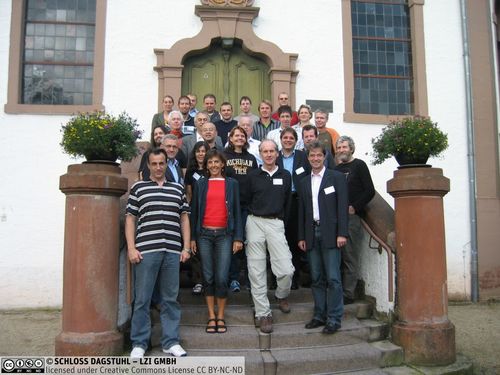
(Click in the middle of the image to enlarge)
Permalink
Please use the following short url to reference this page:
https://www.dagstuhl.de/08372
Organizers
- Arnold Baca (Universität Wien, AT)
- Martin Lames (Universität Augsburg, DE)
- Keith Lyons (Australian Institute of Sport, AU)
- Bernhard Nebel (Universität Freiburg, DE)
- Josef Wiemeyer (TU Darmstadt, DE)
Contact
Sponsors
The Dagstuhl Foundation gratefully acknowledges the donation from

Press/News
-
Simulation soll Doping-Sünder entlarven
Bericht und Interview von Gerd Martin mit Prof. Dr. Jürgen Perl,
Computer Zeitung Online, 7.11.2008 -
Von Nanjing nach Schloss Dagstuhl: Sportinformatik erobert die Welt
Pressemitteilung von Petra Giegerich, Johannes Gutenberg-Universität Mainz, 10.10.2008 -
Wie Hightech den Leistungssport beflügelt
Interview Wolfgang Back vom Computerclub Zwei mit Prof. Dr. Jürgen Perl, Uni Mainz, Folge 129, 6.10.2008 -
Was macht der Computer im Sport?
Interview Wolfgang Back vom Computerclub Zwei mit Prof. Dr. Otto Spaniol, RWTH Aachen, Folge 128, 1.10.2008 -
Informatik: Nutzen für den Sport
Saarländischer Rundfunk, Aktueller Bericht, 9.09.2008. Beitrag von Jürgen Rinner. -
Wie Hightech den Leistungssport beflügelt
Press Release 20.08.2008 (German only)
From September 7 to 10, 2008 about 30 experts from computer science and sport science (see Appendix B) met at the Leibniz-Zentrum für Informatik in Dagstuhl to discuss interdisciplinary issues in the area of computer science in sport. Five topics were selected for discussion (see Appendix A): doping, modeling and simulation, pervasive computing, robotics and sport technology. A total of 17 presentations dealt with selected projects and issues in the above‐mentioned fields.
- Doping – an individual decision or a social phenomenon?
- Modeling and simulation – between reduction and abundance
- Robotics – two directions of transfer: from humans to robots and back
- Pervasive computing – technology meets human needs
- Sport technology – the view of practice
- Mission statement
The seminar proved that both sides (computer science and sport science) can profit from informal exchange. The participants emphasized that this was the salient outcome of the seminar. On the other hand, many issues have been addressed only shortly without having time to go into depth.terdisciplinary field of study of computer science in sport.
The evaluation of the seminar showed that the seminar
- inspired new ideas for further work (research, development or teaching),
- inspired joint projects, joint development, or joint publications,
- led to insights from neighboring fields or communities and
- identified new research directions.
The most important strengths of the seminar were open discussions, breadth of topics and participants, and quality of presentations. The seminar can be improved by reserving even more time for discussions and a more stringent organization of presentations and schedule.
Finally, there was a clear consensus of the participants to continue this kind of exchange.
- Elisabeth André (Universität Augsburg, DE) [dblp]
- Arnold Baca (Universität Wien, AT) [dblp]
- Natalie Balagué Serre (INEFC - Barcelona, ES)
- Roger Bartlett (University of Otago, NZ)
- Sven Behnke (Universität Bonn, DE) [dblp]
- Harald Böhm (TU München, DE)
- Peter Dabnichki (Queen Mary University of London, GB)
- Thorsten Dahmen (Universität Konstanz, DE)
- Jürgen Edelmann-Nusser (Universität Magdeburg, DE)
- Eike Emrich (Universität des Saarlandes, DE)
- Margrit Gelautz (TU Wien, AT)
- Andreas Grunz (Universität Mainz, DE)
- Stephen Hailes (University College London, GB)
- Mario Heller (Universität Wien, AT)
- Robert Hristovski (University of Skopje, MK)
- Eva Maria Karall (Universität Wien, AT)
- Martin Lames (Universität Augsburg, DE) [dblp]
- Daniel Link (TU Darmstadt, DE) [dblp]
- Tim McGarry (University of New Brunswick, CA) [dblp]
- Bernhard Nebel (Universität Freiburg, DE) [dblp]
- Jürgen Perl (Universität Mainz, DE) [dblp]
- Janez Pers (University of Ljubljana, SI)
- Martin Riedmiller (Universität Freiburg, DE) [dblp]
- Karen Roemer (Michigan Technological University, US) [dblp]
- Dietmar Saupe (Universität Konstanz, DE) [dblp]
- Otto Spaniol (RWTH Aachen, DE) [dblp]
- Josef Wiemeyer (TU Darmstadt, DE) [dblp]
- Dapeng Zhang (Universität Freiburg, DE)
Related Seminars
- Dagstuhl Seminar 06381: Computer Science in Sport (2006-09-17 - 2006-09-20) (Details)
- Dagstuhl Seminar 11271: Computer Science in Sport - Special emphasis: Football (2011-07-03 - 2011-07-06) (Details)
- Dagstuhl Seminar 13272: Computer Science in High Performance Sport - Applications and Implications for Professional Coaching (2013-06-30 - 2013-07-03) (Details)
- Dagstuhl Seminar 15382: Modeling and Simulation of Sport Games, Sport Movements, and Adaptations to Training (2015-09-13 - 2015-09-16) (Details)
- Dagstuhl Seminar 21411: Machine Learning in Sports (2021-10-10 - 2021-10-15) (Details)
- Dagstuhl Seminar 24081: Computational Approaches to Strategy and Tactics in Sports (2024-02-18 - 2024-02-23) (Details)
- Dagstuhl Seminar 28051: Computational Modeling of Skeletal Data in Sports (2028-01-30 - 2028-02-04) (Details)
Classification
- Interdisciplinary:Sport
- Interdisciplinarity / research programs / integration
Keywords
- Mission of computer science in sport
- ubiquitous computing
- computerized game and performance analysis in sport
- sport events
- computer-supported training