
Dagstuhl Seminar 06381
Computer Science in Sport
( Sep 17 – Sep 20, 2006 )
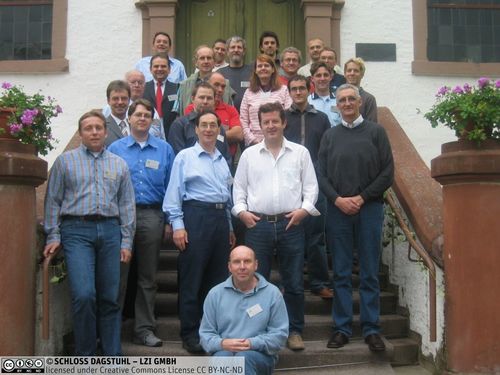
(Click in the middle of the image to enlarge)
Permalink
Please use the following short url to reference this page:
https://www.dagstuhl.de/06381
Organizers
- Arnold Baca (Universität Wien, AT)
- Larry Katz (University of Calgary, CA)
- Jürgen Perl (Universität Mainz, DE)
- Otto Spaniol (RWTH Aachen, DE)
Contact
Sponsors
The Dagstuhl Foundation gratefully acknowledges the donation from

Press/News
Press Review
- Auf Sieg programmiert. Saarbrücker Zeitung, 18.10.06. German only
- Sportinformatik - Hohe Leistung und präzise Kontrolle mit Chip & Co. Deutschlandfunk, 23.09.06. German only
- Was bedeutet „Herandopen“ ?. Saarbrücker Zeitung, 22.09.06. German only
Press Release
- Sportinformatik hilft Doping aufzudecken. 14.07.06. German only
The seminar dealt with a dynamically developing interdisciplinary area, where qualitative and non-deterministic paradigms from Sport like behavioural processes and modelling meet technological and structural paradigms from Computer Science. New demands, new concepts and technologies, and future trends in both disciplines were discussed.
The event brought together working areas of common interest without being focused on a single area such as pure practice, sport theories, or sport technologies. In particular, future-oriented working areas like process modelling and information processing were discussed.
Process modelling, for example, can have quite different understandings in sport science and computer science, respectively. While computer scientists mostly have their focus on deterministic and clearly defined structural processes like in industrial production, sport scientists think of non-deterministic and fuzzy-defined processes like those from games, motion, or training and rehabilitation. The seminar provided a platform for an exchange of experiences in order to establish new ideas and new solutions.
The fields of RoboCup (i.e. soccer playing robots) and, more generally, robotics, as another example, build a thrilling up-to-date working area, where computer scientists and sport scientists can collaborate effectively and successfully, dealing with motor phenomena as well as with tactical aspects of behaviour. In particular, artificial neural networks play an important role here, stretching from pattern and situation recognition over analysing and optimising learning processes to behaviour control. Internationally well known researchers as well as researchers from the younger generation have been invited to participate in this seminar. From 17.9.2006 to 20.9.2006 28 researchers from 7 countries discussed their recent work and actual tendencies in Computer Science in Sport.
There were 24 oral presentations and a discussion session on Doping and Computer Science, which was introduced by lectures given by Matthias Blatt (NADA – Bonn) and Martin Lames (Universität Augsburg). The presentations were thematically grouped into the following areas.
- General aspects
- Modelling
- Biomechanics
- RoboCup/Motion Tracking
- Multimedia/eLearning
- Data acquisition/IT
- Arnold Baca (Universität Wien, AT) [dblp]
- Sven Behnke (Universität Bonn, DE) [dblp]
- Matthias Blatt (NADA - Bonn, DE)
- Peter Dabnichki (Queen Mary University of London, GB)
- Christian Eder (Universität Wien, AT)
- Alexander Ferrein (RWTH Aachen, DE) [dblp]
- Mario Heller (Universität Wien, AT)
- Thomas Hillebrand (Universität Mainz, DE)
- Larry Katz (University of Calgary, CA) [dblp]
- Philipp Kornfeind (Universität Wien, AT) [dblp]
- Martin Lames (Universität Augsburg, DE) [dblp]
- Keith Lyons (Australian Institute of Sport, AU) [dblp]
- Thomas Mauthner (TU Graz, AT)
- Tim McGarry (University of New Brunswick, CA) [dblp]
- Leo Pavicic (University of Zagreb, HR)
- Jürgen Perl (Universität Mainz, DE) [dblp]
- Daniel Ranz (INEFC - Barcelona, ES)
- Karen Roemer (Michigan Technological University, US) [dblp]
- Bodo Rosenhahn (Leibniz Universität Hannover, DE) [dblp]
- Dietmar Saupe (Universität Konstanz, DE) [dblp]
- Wolfgang Schöllhorn (Universität Münster, DE) [dblp]
- Hans-Jürgen Schröder (Universität Mainz, DE)
- Florian Seifriz (Deutsche Sporthochschule Köln, DE)
- André Seyfarth (Universität Jena, DE)
- Otto Spaniol (RWTH Aachen, DE) [dblp]
- Oliver Strubreither (Universität Wien, AT)
- Guido Töpfer (Universität Mainz, DE)
- Josef Wiemeyer (TU Darmstadt, DE) [dblp]
Related Seminars
- Dagstuhl Seminar 08372: Computer Science in Sport - Mission and Methods (2008-09-07 - 2008-09-10) (Details)
- Dagstuhl Seminar 11271: Computer Science in Sport - Special emphasis: Football (2011-07-03 - 2011-07-06) (Details)
- Dagstuhl Seminar 13272: Computer Science in High Performance Sport - Applications and Implications for Professional Coaching (2013-06-30 - 2013-07-03) (Details)
- Dagstuhl Seminar 15382: Modeling and Simulation of Sport Games, Sport Movements, and Adaptations to Training (2015-09-13 - 2015-09-16) (Details)
- Dagstuhl Seminar 21411: Machine Learning in Sports (2021-10-10 - 2021-10-15) (Details)
- Dagstuhl Seminar 24081: Computational Approaches to Strategy and Tactics in Sports (2024-02-18 - 2024-02-23) (Details)
Classification
- Interdisciplinary: sport
Keywords
- Modelling and Simulation
- Multimedia
- Sports management
- Soft computing / computational intelligence
- E-learning
- Distributed games. Interdisciplinary collaboration
- Behavioral process analysis
- Net-based pattern analysis
- Information and communication technology. Game analysis / notational analysis
- Training and competition analysis
- Training and competition data management
- Performance analysis
- Biomechanics
- Assisted mobility