
Dagstuhl Seminar 06061
Theory of Evolutionary Algorithms
( Feb 05 – Feb 10, 2006 )
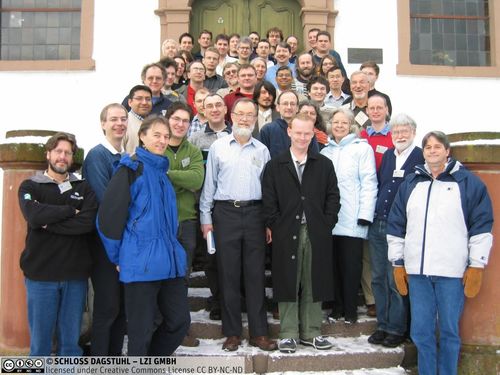
(Click in the middle of the image to enlarge)
Permalink
Please use the following short url to reference this page:
https://www.dagstuhl.de/06061
Organizers
- Dirk Arnold (Dalhousie University, CA)
- Thomas Jansen (TU Dortmund, DE)
- Jonathan Rowe (University of Birmingham, GB)
- Michael D. Vose (University of Tennessee, US)
Contact
Impacts
- Emergent Behaviour, Population-based Search and Low-pass Filtering : article : pp. 88-95 : IEEE Congress on Evolutionary Computation, 2006, CEC 2006 - Poli, Riccardo; Wright, Alden H.; MacPhee, Nicholas F.; Langdon, William B. - Los Alamitos : IEEE, 2006. - pp. 88-95.
- Ignoble trails : where crossover is provable harmful : article S. 92 - 101 - J. Neal Richter ; Alden H. Wright ; John Paxton - Berlin : Springer, 2008 - (Lecture notes in computer science : 5199 ; S. 92-101). DOI: 10.1007/978-3-540-87700-4_10.
- Mapping non-conventional extensions of genetic programmingn : article pp. 21-43 - Langdon, William B.; Poli, Riccardo - Berlin : Springer, 2008 - (Natural Computing : 7. 2008, 1 : pp. 21-43).
- On complexity of optimal recombination for binary representations of solutions : article : S. 127-147 - Eremeev, Anton V. - Cambridge : MIT Press, 2008 - (Evolutionary computation : 16. 2008, 1 : S. 127-147).
The 2006 Dagstuhl Seminar "Theory of Evolutionary Algorithms'' carried forward a series of Dagstuhl seminars that started in 2000 and has become an established event in the community. In the week from from 05.02.2006 to 10.02.2006, 56 researchers from 12 countries discussed their recent work and recent trends in evolutionary computation.
Evolutionary algorithms (EAs) are randomized search heuristics. Introduced in the 60s and havinf come to great popularity in the 80s, they have been applied successfully in many different areas. Borrowing ideas from natural evolution, these algorithms operate on a population (multiset) of candidate solutions to a task. Promising candidates are selected from the population based on their fitness (objective function value) to become parents. Offspring are generated as variants of parents by means of stochastic crossover and mutation operators. The population for the next generation is chosen from parents and offspring, and the process then repeats until some stopping criterion is met. A wealth of different EAs have been developed which vary and embellish this basic theme, including the use of stochastic operators adapted to the search space and task, sophisticated methods for adapting parameters during a run, co-evolutionary paradigms, and explicit estimation of distributions.
Evolutionary algorithm theory is three decades old, but only recently has theory migrated to provably correct foundations. In addition, the vast majority of practitioners are collectively generating EA variants at a rate which far outpaces the speed with which the comparatively few theoreticians can analyze them. Making the situation worse, what most practitioners say they want - an inexpensive answer for how best to optimize - is in general impossible to achieve. All of this has contributed to a chasm between proven theoretical results and evolutionary algorithms as applied in practice.
Evolutionary algorithm theory is comprised of diverse approaches from various perspectives having differing objectives. Facet-wise analyses concentrating on one-step behavior of EAs (schema theory being the best known approach of this kind), analyses based on Markov chains, infinite population models, heuristic analysis borrowing ideas from statistical mechanics, run time analysis in the spirit of the analysis of randomized algorithms, and other approaches, have been developed separately and almost independently.
- Dirk Arnold (Dalhousie University, CA) [dblp]
- Anne Auger (ETH Zürich, CH) [dblp]
- Jürgen Branke (KIT - Karlsruher Institut für Technologie, DE) [dblp]
- Heinrich Braun (SAP SE - Walldorf, DE) [dblp]
- Anthony Bucci (Brandeis University - Waltham, US)
- Edwin D. de Jong (Utrecht University, NL)
- Kenneth A. De Jong (George Mason University - Fairfax, US) [dblp]
- Kalyanmoy Deb (Indian Inst. of Technology - Kanpur, IN) [dblp]
- Stefan Droste (TU Dortmund, DE)
- Anton V. Eremeev (Sobolev Institute of Mathematics - Omsk, RU) [dblp]
- James A. Foster (University of Idaho, US)
- Marcus Gallagher (The University of Queensland - Brisbane, AU) [dblp]
- Ivan Garibay (University of Central Florida - Orlando, US)
- Oliver Giel (TU Dortmund, DE)
- Nikolaus Hansen (ETH Zürich, CH) [dblp]
- Ralph Hartley (Naval Research - Washington, US)
- Christina Hayes (Montana State University - Bozeman, US)
- Jun He (University of Birmingham, GB) [dblp]
- Jeff Horn (Northern Michigan University - Marquette, US)
- Christian Igel (Ruhr-Universität Bochum, DE) [dblp]
- Jens Jägersküpper (TU Dortmund, DE)
- Thomas Jansen (TU Dortmund, DE) [dblp]
- William B. Langdon (University of Essex, GB) [dblp]
- Anthony Liekens (TU Eindhoven, NL)
- Evelyne Lutton (INRIA - Le Chesnay, FR)
- Nicholas Freitag McPhee (University of Minnesota - Morris, US)
- Peter Merz (TU Kaiserslautern, DE)
- Silja Meyer-Nieberg (Universität der Bundeswehr - München, DE) [dblp]
- Martin Middendorf (Universität Leipzig, DE)
- Boris S. Mitavskiy (University of Birmingham, GB)
- Heinz Mühlenbein (Fraunhofer IAIS - St. Augustin, DE)
- Riccardo Poli (University of Essex, GB) [dblp]
- Adam Prugel-Bennett (University of Southampton, GB) [dblp]
- Colin Reeves (University of Warwick, GB)
- J. Neal Richter (Montana State University - Bozeman, US)
- Franz Rothlauf (Universität Mannheim, DE) [dblp]
- Jonathan Rowe (University of Birmingham, GB) [dblp]
- Günter Rudolph (Universität Dortmund, DE) [dblp]
- J. David Schaffer (Philips Research North America, US)
- Lothar M. Schmitt (The University of Aizu, JP)
- Marc Schoenauer (University of Paris South XI, FR) [dblp]
- Hans-Paul Schwefel (Universität Dortmund, DE) [dblp]
- Jonathan L. Shapiro (University of Manchester, GB) [dblp]
- Peter F. Stadler (Universität Leipzig, DE) [dblp]
- Christopher Stephens (Universidad Nacional Autonoma - Mexico, MX)
- Olivier Teytaud (Université Paris Sud, FR) [dblp]
- Lothar Thiele (ETH Zürich, CH) [dblp]
- Dirk Thierens (Utrecht University, NL) [dblp]
- Marc Toussaint (University of Edinburgh, GB) [dblp]
- Paul M. B. Vitanyi (CWI - Amsterdam, NL)
- Michael D. Vose (University of Tennessee, US) [dblp]
- Richard A. Watson (University of Southampton, GB) [dblp]
- Ingo Wegener (TU Dortmund, DE)
- R. Paul Wiegand (Naval Research - Washington, US)
- Carsten Witt (TU Dortmund, DE) [dblp]
- Alden Wright (University of Montana - Missoula, US)
- Xin Yao (University of Birmingham, GB) [dblp]
Related Seminars
- Dagstuhl Seminar 00071: Theory of Evolutionary Algorithms (2000-02-13 - 2000-02-18) (Details)
- Dagstuhl Seminar 02031: Theory of Evolutionary Algorithms (2002-01-13 - 2002-01-18) (Details)
- Dagstuhl Seminar 04081: Theory of Evolutionary Algorithms (2004-02-15 - 2004-02-20) (Details)
- Dagstuhl Seminar 08051: Theory of Evolutionary Algorithms (2008-01-27 - 2008-02-01) (Details)
- Dagstuhl Seminar 10361: Theory of Evolutionary Algorithms (2010-09-05 - 2010-09-10) (Details)
- Dagstuhl Seminar 13271: Theory of Evolutionary Algorithms (2013-06-30 - 2013-07-05) (Details)
- Dagstuhl Seminar 15211: Theory of Evolutionary Algorithms (2015-05-17 - 2015-05-22) (Details)
- Dagstuhl Seminar 17191: Theory of Randomized Optimization Heuristics (2017-05-07 - 2017-05-12) (Details)
- Dagstuhl Seminar 19431: Theory of Randomized Optimization Heuristics (2019-10-20 - 2019-10-25) (Details)
- Dagstuhl Seminar 22081: Theory of Randomized Optimization Heuristics (2022-02-20 - 2022-02-25) (Details)
- Dagstuhl Seminar 24271: Theory of Randomized Optimization Heuristics (2024-06-30 - 2024-07-05) (Details)
Classification
- artificial intelligence / robotics data structures / algorithms / complexity optimization / scheduling interdisciplinary (e.g. bioinformatics)
Keywords
- evolutionary algorithms
- theoretical analysis
- optimization time
- co-evolution