
Dagstuhl Seminar 05381
Form and Content in Sensor Networks
( Sep 18 – Sep 23, 2005 )
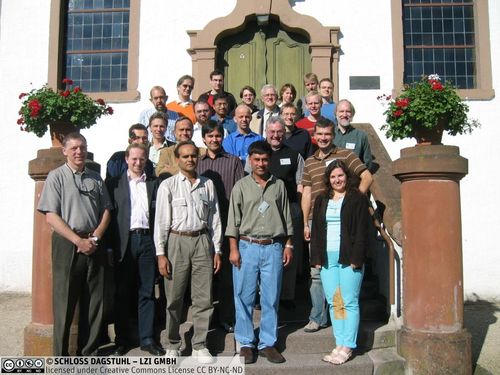
(Click in the middle of the image to enlarge)
Permalink
Please use the following short url to reference this page:
https://www.dagstuhl.de/05381
Organizers
- Leonidas J. Guibas (Stanford University, US)
- Uwe D. Hanebeck (KIT - Karlsruher Institut für Technologie, DE)
- Thomas C. Henderson (University of Utah - Salt Lake City, US)
Contact
Press/News
Press Release
Wie Sensoren kommunizieren (Pressemitteilung vom 16.09.2005)
Advances in computing hardware and wireless networking technologies have enabled low-cost, low-power miniature sensor devices. By combing these tiny sensor nodes, which comprise sensing, data processing, and communication components, a sensor network for distributed sensing is obtained. For example, thousands of these nodes could be spread across a large geographical area in order to perform weather monitoring. Since every node suffers from limited sensing, computing, networking, and energy resources, collaboration between nodes is required, which stimulated the development of new types of communication and information processing algorithms.
Sensor networks have received increasing attention over the last few years. For example, DARPA's SensIT program envisioned the development of dense fields of simple, inexpensive, micro-sensor-processors to exhibit emergent behavior which should be collectively brilliant, operationally effective, long-lived, and robust to failure. Researchers have begun to explore the rich design space of low-power processors, communication devices, and sensors and the requires the development of algorithms for these distributed wireless sensing systems
Some examples of issues addressed by these various projects include self-configuration, data handling, systems issues, power minimization, and fault tolerance. In general, higher-level exploitation of sensor networks requires the application of distributed algorithms to the data. Corresponding applications include distributed source localization, calibration, and habitat monitoring. Areas of particular interest include: (1) Algorithms for sensor tasking and control, including distributed techniques for the formation of sensor collaboration groups, tracking large-area phenomena, information storage and in-network aggregation, identity management, and relational tracking and reasoning, (2) the application of optimal estimation techniques to multisensor data analysis, nonlinear filtering, position estimation and tracking, and the application to mobile robotics, cellular mobile phones, and virtual reality, and (3) the creation of an information layer on top of the sensor nodes, including distributed algorithms for leadership protocols, coordinate frame, and gradient calculation, and distributed signal, feature and structural analysis methods.
The aim of this seminar was to summarize the current state of the art in the field of algorithms for sensor networks and how content and structure impact information processing in the network, and to identify open problems in the following areas
- Low-level Processing (e.g. distributed signal processing, compression, estimation, detection, error handling)
- High-Level Processing (e.g. network structure, dynamic self-organization, tracking, monitoring, system behavior evaluation)
The seminar brought together workers from these areas to establish a stronger dialog with the goal of achieving a coherent view of the communication and information processing aspects which are typically treated separately today.
- Natalie Bender (KIT - Karlsruher Institut für Technologie, DE)
- Frederik Beutler (KIT - Karlsruher Institut für Technologie, DE)
- Bir Bhanu (University of California - Riverside, US)
- Uwe Brinkschulte (KIT - Karlsruhe, DE)
- Dietrich Brunn (KIT - Karlsruher Institut für Technologie, DE)
- Peter Corke (CSIRO - Pullenvale, AU) [dblp]
- Sándor Fekete (TU Braunschweig, DE) [dblp]
- Stefan Funke (MPI für Informatik - Saarbrücken, DE) [dblp]
- Edward Grant (North Carolina State University, US)
- Frans Groen (VU University Amsterdam, NL)
- Leonidas J. Guibas (Stanford University, US) [dblp]
- Uwe D. Hanebeck (KIT - Karlsruher Institut für Technologie, DE) [dblp]
- Thomas C. Henderson (University of Utah - Salt Lake City, US)
- John E. Hershberger (Mentor Graphics - Wilsonville, US)
- Seth Hutchinson (University of Illinois - Urbana Champaign, US)
- Wolfgang Karl (KIT - Karlsruher Institut für Technologie, DE) [dblp]
- Alexei Makarenko (University of Sydney, AU)
- Pedro Jose Marrón (Universität Stuttgart, DE)
- Gregor Pavlin (VU University Amsterdam, NL)
- Nageswara Rao (Oak Ridge National Laboratory, US)
- Daniela Rus (MIT - Cambridge, US) [dblp]
- Peter Sanders (KIT - Karlsruher Institut für Technologie, DE) [dblp]
- Sergio Servetto (Cornell University, US)
- Subhash Suri (University of California - Santa Barbara, US) [dblp]
- Christian von der Weth (KIT - Karlsruher Institut für Technologie, DE)
- Peter Wieland (Universität Stuttgart, DE)