
Dagstuhl Seminar 05081
Foundations of Global Computing
( Feb 20 – Feb 25, 2005 )
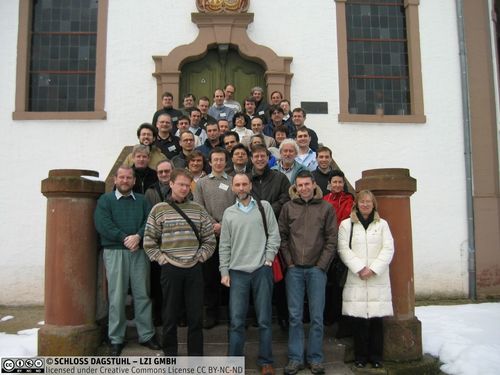
(Click in the middle of the image to enlarge)
Permalink
Please use the following short url to reference this page:
https://www.dagstuhl.de/05081
Organizers
- José Luiz Fiadeiro (University of Leicester, GB)
- Ugo Montanari (University of Pisa, IT)
- Martin Wirsing (LMU München, DE)
Contact
Today software undergoes a fast technological progress where not only the complexity of software systems is considerably increasing but also the computing infrastructure is dramatically changing. The internet serves as platform for globally distributed applications; objects we work with are more and more equipped with processors and embedded software; in the Grid approach computing power is shared among many distributed processors; physical devices are mobile, data can migrate, and applications come and go in a dynamically changing ad-hoc way. Thus computation becomes global in the sense that it is distributed over the net and highly dynamic, with the network often changing dynamically.
These developments lead to enormous engineering challenges for
- constructing global computing systems with predictable and desirable behaviour and
- ensuring reliability, safety, security, and availability of global computing systems.
Current engineering techniques such as object-orientation, modelling languages such as UML, and actual programming languages such as Java and CASE tools can only partly cope with these problems. These approaches support only partly the construction of global computing systems and have to be extended with new appropriate concepts for software architecture, coordination, distribution and mobility. Moreover, these pragmatic approaches lack scientific foundations for analysing and validating global computing systems. On the other hand, formal techniques such as process calculi, type systems and logics for specifying, analysing and validating global computing systems are only partially available and mostly not well connected with systematic development methods.
The aim of this seminar is to study foundational theories, calculi and techniques for global computing systems and to bring them together with methods for systematically developing global computing systems. The topics of the seminar include:
- calculi, models, and semantic theories of concurrent, distributed, mobile global computing systems,
- types and logics for security, safety, resource-control and availability of global computing systems,
- systematic development techniques, modelling and programming languages for global computing.
- Hubert Baumeister (LMU München, DE)
- Gérard Boudol (INRIA Sophia Antipolis - Méditerranée, FR) [dblp]
- Julian Bradfield (University of Edinburgh, GB) [dblp]
- Ed Brinksma (Embedded Systems Institute - Eindhoven, NL)
- Maura Cerioli (University of Genova, IT)
- Andrea Corradini (University of Pisa, IT) [dblp]
- Rocco De Nicola (University of Florence, IT) [dblp]
- Schahram Dustdar (TU Wien, AT) [dblp]
- José Luiz Fiadeiro (University of Leicester, GB)
- Stefania Gnesi (CNR - Pisa, IT) [dblp]
- Daniele Gorla (Sapienza University of Rome, IT)
- Jens Gustedt (INRIA Lorraine - Nancy, FR)
- Matthew Hennessy (University of Sussex - Brighton, GB)
- Dan Hirsch (University of Pisa, IT)
- Piotr Kosiuczenko (University of Leicester, GB)
- Thomas A. Kuhn (TU München, DE)
- Ivan Lanese (University of Pisa, IT) [dblp]
- Antonia Lopes (University of Lisboa, PT) [dblp]
- Michele Loreti (University of Florence, IT) [dblp]
- Dominique Méry (LORIA - Nancy, FR) [dblp]
- Stephan Merz (LORIA - Nancy, FR) [dblp]
- Eugenio Moggi (University of Genova, IT)
- Uwe Nestmann (EPFL - Lausanne, CH) [dblp]
- Cristóvão Oliveira (University of Leicester, GB)
- Catuscia Palamidessi (INRIA Grenoble Rhône-Alpes, FR) [dblp]
- Doron A. Peled (University of Warwick - Coventry, GB) [dblp]
- Stephan Reiff-Marganiec (University of Leicester, GB)
- Mark D. Ryan (University of Birmingham, GB) [dblp]
- Vladimiro Sassone (University of Sussex - Brighton, GB)
- Jean-Bernard Stéfani (INRIA - Grenoble, FR) [dblp]
- Mark-Oliver Stehr (University of Illinois - Urbana-Champaign, US)
- Perdita Stevens (University of Edinburgh, GB) [dblp]
- Carolyn L. Talcott (SRI - Menlo Park, US) [dblp]
- Andrzej Tarlecki (University of Warsaw, PL)
- Vasco T. Vasconcelos (University of Lisboa, PT) [dblp]
- Björn Victor (Uppsala University, SE) [dblp]
- Martin Wirsing (LMU München, DE) [dblp]
- Lucian Wischik (Microsoft Corporation - Redmond, US)
- Pawel T. Wojciechowski (EPFL - Lausanne, CH) [dblp]
- Alan Wood (University of York, GB)
- Artur Zawlocki (University of Warsaw, PL)