
Dagstuhl Seminar 04241
Graph Transformations and Process Algebras for Modeling Distributed and Mobile Systems
( Jun 06 – Jun 11, 2004 )
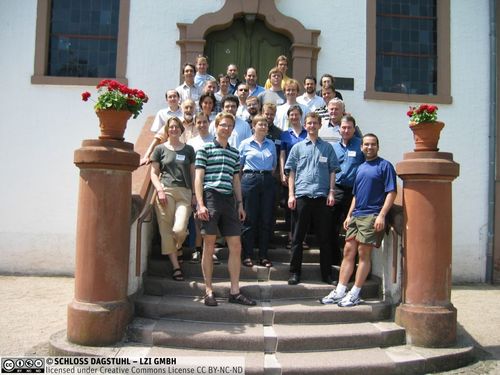
(Click in the middle of the image to enlarge)
Permalink
Please use the following short url to reference this page:
https://www.dagstuhl.de/04241
Organizers
- Philippa Gardner (Imperial College London, GB)
- Barbara König (Universität Stuttgart, DE)
- Ugo Montanari (University of Pisa, IT)
Contact
Recently there has been a lot of research, combining concepts of process algebra with those of the theory of graph grammars and graph transformation systems. Both can be viewed as general frameworks in which one can specify and reason about concurrent and distributed systems. There are many areas where both theories overlap and this reaches much further than just using graphs to give a graphic representation to processes.
Processes in a communication network can be seen in two different ways: as terms in an algebraic theory, emphasizing their behaviour and their interaction with the environment, and as nodes (or edges) in a graph, emphasizing their topology and their connectedness. Especially topology, mobility and dynamic reconfigurations at runtime can be modelled in a very intuitive way using graph transformation. On the other hand the definition and proof of behavioural equivalences is often easier in the process algebra setting.
Also standard techniques of algebraic semantics for universal constructions, refinement and compositionality can take better advantage of the process algebra representation. An important example where the combined theory is more convenient than both alternatives is for defining the concurrent (noninterleaving), abstract semantics of distributed systems. Here graph transformations lack abstraction and process algebras lack expressiveness.
Another important example is the work on bigraphical reactive systems with the aim of deriving a labelled transitions system from an unlabelled reactive system such that the resulting bisimilarity is a congruence. Here, graphs seem to be a convenient framework, in which this theory can be stated and developed.
So, although it is the central aim of both frameworks to model and reason about concurrent systems, the semantics of processes can have a very different flavour in these theories. Research in this area aims at combining the advantages of both frameworks and translating concepts of one theory into the other. This workshop was aimed at bringing together researchers of the two communities in order to share their ideas and develop new concepts. These proceedings do not only contain abstracts of the talks given at the workshop, but also summaries of topics of central interest.
We would like to thank all participants of the workshop for coming and sharing their ideas and everybody who has contributed to the proceedings.
- Paolo Baldan (University of Venezia, IT) [dblp]
- Roberto Bruni (University of Pisa, IT) [dblp]
- Maria Grazia Buscemi (University of Pisa, IT)
- Andrea Corradini (University of Pisa, IT) [dblp]
- Frank Drewes (University of Umeå, SE) [dblp]
- Oswald Drobnik (Universität Frankfurt, DE)
- Hartmut Ehrig (TU Berlin, DE)
- Fabio Gadducci (University of Pisa, IT) [dblp]
- Philippa Gardner (Imperial College London, GB) [dblp]
- Arne John Glenstrup (IT University of Copenhagen, DK)
- Stefan Haar (CAPS entreprise - Rennes, FR)
- Annegret Habel (Universität Oldenburg, DE) [dblp]
- Reiko Heckel (University of Leicester, GB) [dblp]
- Tobias Heindel (Universität Stuttgart, DE)
- Thomas T. Hildebrandt (IT University of Copenhagen, DK) [dblp]
- Dan Hirsch (University of Pisa, IT)
- Ole Hogh Jensen (Aalborg University, DK)
- Lionel Khalil (University of Paris North, FR)
- Barbara König (Universität Stuttgart, DE) [dblp]
- Ivan Lanese (University of Pisa, IT) [dblp]
- Robin Milner (University of Cambridge, GB)
- Detlef Plump (University of York, GB) [dblp]
- Guilherme Rangel (TU Berlin, DE)
- Arend Rensink (University of Twente, NL) [dblp]
- Vladimiro Sassone (University of Sussex - Brighton, GB)
- Pawel Sobocinski (Aarhus University, DK) [dblp]
- Alin Stefanescu (Universität Stuttgart, DE)
- Gheorghe Stefanescu (National University of Singapore, SG)
- Emilio Tuosto (University of Pisa, IT) [dblp]
- Björn Victor (Uppsala University, SE) [dblp]
- Lucian Wischik (Microsoft Corporation - Redmond, US)