
Dagstuhl Seminar 04131
Geometric Properties from Incomplete Data
( Mar 21 – Mar 26, 2004 )
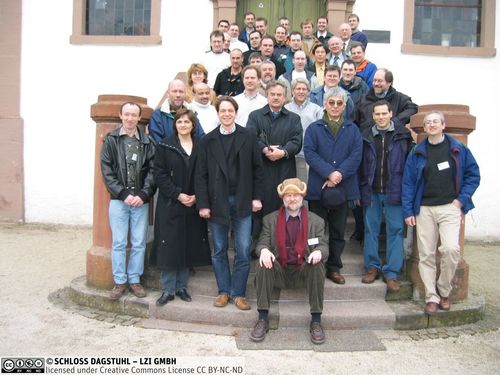
(Click in the middle of the image to enlarge)
Permalink
Please use the following short url to reference this page:
https://www.dagstuhl.de/04131
Organizers
- Reinhard Klette (University of Auckland, NZ)
- Ryszard Kozera (The Univ. of Western Australia - Nedlands, AU)
- Lyle Noakes (The Univ. of Western Australia - Nedlands, AU)
- Joachim Weickert (Universität des Saarlandes, DE)
Contact
External Homepage
Computer vision and image analysis requires interdisciplinary collaboration between mathematics and engineering, especially in the area of high-accuracy measurements of length, area, curvature, motion parameters and other geometrical quantities from acquired image data. The seminar will bring together researchers in computer vision, engineering and mathematics who are working in this area.
Recent proceedings of international conferences on computer vision emphasize mathematical methods for measurement problems, drawing on classical and differential geometry, mathematical analysis, optimization, topology, statistics, stochastic equations, differential equations and numerical analysis.
The seminar will focus on interdisciplinary work on estimation of curves, surfaces and motion from image data that is mathematically incomplete, either through digitization, contamination by noise, or some other indirectness in the measurement process. Problems include
- estimation of lengths of curves and areas of surfaces from digitized images (geometric feature analysis)
- estimation of curves and surfaces from samples of unparameterized data (shape recovery)
- estimation of objects from incomplete volume data such as X-ray, MRI, CT scans (model-based shape extraction)
- estimation of landmarks on solid objects from multiple camera images (structure from motion)
- estimation of rigid body motion, particularly in connection with computer vision.
Participants will be invited to discuss these tasks and relationships with mathematics, especially approximation theory, numerical analysis and differential geometry. Contributions in digital topology, computational geometry and complexity, geometric modelling, optimization and differential equations are also in the scope.
As a specific example, recent work of Katoulokis on space-carving has attracted a lot of interest, including attempts to speed up the process. One of the steps, to quickly estimate the photo-hull, can be viewed as a nonstandard problem in approximation theory, where unparameterized direction data is available from unknown points on a curve or surface.
All seminar participants will be expected to contribute short (15-20 minutes) or long talks (30-45 minutes). Refereed seminar papers will be published in a research monograph volume in Springer Lecture Notes in Computer Science, with submission following the seminar. The seminar schedule will be characterised by flexibility, working groups, and sufficient time for focused discussions.
Working groups will be formed on day one of the seminar for smaller and more focuses meetings during the week.
- Alfred M. Bruckstein (Technion - Haifa, IL) [dblp]
- Andrés Bruhn (Universität des Saarlandes, DE) [dblp]
- Thomas Bülow (Philips - Hamburg, DE)
- Simon Collings (The Univ. of Western Australia - Nedlands, AU)
- Alain Daurat (University of Strasbourg, FR)
- Isabelle Debled-Rennesson (CNRS - Nancy, FR)
- Helene Dörksen (Universität Hamburg, DE)
- Leo Dorst (University of Amsterdam, NL)
- Ulrich Eckhardt (Universität Hamburg, DE)
- Rida T. Farouki (University of California - Davis, US) [dblp]
- Michael Felsberg (Linköping University, SE) [dblp]
- Vojtech Franc (Czech Technical University, CZ)
- Peter Gritzmann (TU München, DE) [dblp]
- Michael Hofer (TU Wien, AT)
- Atsushi Imiya (Chiba University, JP) [dblp]
- Kenichi Kanatani (Okayama University, JP)
- Ron Kimmel (Technion - Haifa, IL) [dblp]
- Nahum Kiryati (Tel Aviv University, IL)
- Reinhard Klette (University of Auckland, NZ) [dblp]
- Ryszard Kozera (The Univ. of Western Australia - Nedlands, AU) [dblp]
- Norbert Krüger (University of Southern Denmark - Odense, DK) [dblp]
- Wayne M. Lawton (National University of Singapore, SG)
- Harry McLaughlin (Rensselaer Polytechnic Institute - Troy, US)
- Hrushikesh N. Mhaskar (California State Univ. - Los Angeles, US) [dblp]
- Knut M. Morken (University of Oslo, NO)
- Pavel Mrazek (Universität des Saarlandes, DE)
- Matthias Mühlich (Goethe-Universität - Frankfurt a. M., DE)
- Lyle Noakes (The Univ. of Western Australia - Nedlands, AU)
- Christian Perwass (Universität Kiel, DE)
- Massimiliano Pontil (University College London, GB) [dblp]
- Antonio Robles-Kelly (University of York, GB) [dblp]
- Otmar Scherzer (Universität Innsbruck, AT) [dblp]
- Christoph Schnörr (Universität Heidelberg, DE)
- Wladislaw Skarbek (Warsaw Univ. of Technology, PL)
- Nir Sochen (Tel Aviv University, IL) [dblp]
- Gerald Sommer (Universität Kiel, DE)
- Gabriele Steidl (Universität Mannheim, DE) [dblp]
- Mohamed Tajine (University of Strasbourg, FR)
- Joachim Weickert (Universität des Saarlandes, DE) [dblp]
- Jovisa Zunic (University of Exeter, GB) [dblp]