
Dagstuhl Seminar 04101
Language Engineering for Model-Driven Software Development
( Feb 29 – Mar 05, 2004 )
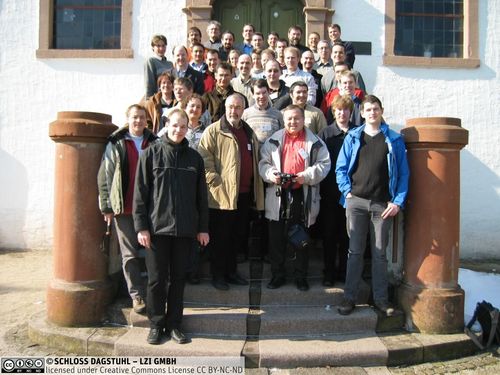
(Click in the middle of the image to enlarge)
Permalink
Please use the following short url to reference this page:
https://www.dagstuhl.de/04101
Organizers
- Jean Bezivin (University of Nantes, FR)
- Reiko Heckel (University of Leicester, GB)
Contact
External Homepage
Impacts
- A taxonomy of model transformation : article : S. 125-142 - Mens, Tom; Gorp, Pieter van - Amsterdam : Elsevier, 2006 - (Electronic notes in theoretical computer science : 152. 2006, S. 125-142). DOI: 10.1016/j.entcs.2005.10.021.
- Clarifying matters of (meta-)modeling : an author's reply : article S. 395-401 - Kühne, Thomas - Berlin : Springer, 2006 - (Software and systems modeling : 5. 2006, 4 : S. 395-401). DOI: 10.1007/s10270-006-0034-8.
- Matters of (meta)-modeling : article : S. 369-385 - Kühne, Thomas - Berlin : Springer, 2006 - (Software and systems modeling : 5. 2006, 4 : S. 369-385). DOI: 10.1007/s10270-006-0017-9.
- On the unification power of models : article : S. 171-188 - Bezivin, Jean - Berlin : Springe, 2005 - (Software and systems modeling : 4. 2005, 2, S. 171-188). DOI: 10.1007/s10270-005-0079-0.
- Special issue on language engineering for model-driven software development : S. 231 - 341 - Bezivin, Jean; Heckel, Reiko - Berlin : Springer, 2006 - (Software and systems modeling : 5. 2006, 3 : S. 231 - 341).
Model-driven approaches to software development require precise definitions and tool support for modeling languages, their syntax and semantics, their notions of consistency and refinement, as well as their mappings to the implementation level. In order to support model-driven development in a variety of contexts, we must find efficient ways of designing languages, accepting that definitions are evolving and that tools need to be delivered in a timely fashion.
In this respect, language definitions are not unlike software. Thus, a discipline of language engineering is required to support the design, implementation, and validation of modeling languages with the goal to deliver languages at low cost and with high quality.
An important contribution of any engineering science, besides the actual technology provided, is the meta knowledge about what are the relevant concerns to be addressed, what are the possible solutions, and what concern is best addressed in a given context by which kind of technology.
It is understood that different concerns of language engineering, like the defi- nition of abstract syntax and well-formedness rules, operational and denotational semantics, consistency and refinement relations, and model transformations, will, in general, require technologies from different domains.
A framework for classifying, choosing, and relating different solutions domains is provided by the concept of technological spaces [KBA03]. A technological space is a working context with a set of associated concepts, body of knowledge, tools, acquired skills and possibilities, often associated to a given community. Well-known examples include XML, UML meta modeling, graph transformation, algebra and logic, programming languages, etc.
It has been the goal of the seminar to investigate relevant concerns and promising solution domains for language engineering, learn from specific solutions presented by the participants, and attempt a provisional classification and mapping. To illustrate problems and available solutions, a sample language engineering problem was proposed and elaborated.
After a more detailed discussion of the architectural aspect of language engineering, this summary presents this case study, discusses concerns and open issues raised by the corresponding language definition problem, and gives a more general motivation of technological spaces as solution domains for model-driven development.
- Mehmet Aksit (University of Twente, NL)
- Colin Atkinson (Universität Mannheim, DE) [dblp]
- Jean Bezivin (University of Nantes, FR) [dblp]
- Alexey Cherchago (Universität Paderborn, DE)
- Krzysztof Czarnecki (University of Waterloo, CA) [dblp]
- Keith Duddy (DSTC - Brisbane, AU)
- Gregor Engels (Universität Paderborn, DE) [dblp]
- Jean-Marie Favre (LSR - IMAG, FR) [dblp]
- Tracy Gardner (IBM United Kingdom Ltd. - Winchester, GB)
- Sébastien Gérard (CEA - Gif sur Yvette, FR) [dblp]
- Tudor Girba (Universität Bern, CH) [dblp]
- Martin Gogolla (Universität Bremen, DE) [dblp]
- Ursula Goltz (TU Braunschweig, DE)
- Luuk P.J. Groenewegen (Leiden University, NL)
- Martin Große-Rhode (FhG - ISST Berlin, DE)
- Alan Hartman (IBM - Haifa, IL) [dblp]
- Jan Hendrik Hausmann (Universität Paderborn, DE)
- Reiko Heckel (University of Leicester, GB) [dblp]
- Jean-Marc Jézéquel (INRIA - Rennes, FR) [dblp]
- Frédéric Jouault (University of Nantes, FR)
- Alexander Königs (TU Darmstadt, DE)
- Thomas Kühne (TU Darmstadt, DE) [dblp]
- Jochen M. Küster (Universität Paderborn, DE)
- Ralf Lämmel (Microsoft Research - Redmond, US) [dblp]
- Tom Mens (University of Mons, BE) [dblp]
- Daniel Moldt (Universität Hamburg, DE) [dblp]
- Peter D. Mosses (Swansea University, GB) [dblp]
- Pierre-Alain Muller (ESSAIM - Mulhouse, FR) [dblp]
- Wolfgang Reisig (HU Berlin, DE) [dblp]
- Arend Rensink (University of Twente, NL) [dblp]
- Bernhard Rumpe (TU Braunschweig, DE) [dblp]
- James Skene (University College London, GB)
- Sebastian Thöne (Universität Paderborn, DE)
- Laurence Tratt (King's College London, GB) [dblp]
- Pieter Van Gorp (University of Antwerp, BE) [dblp]
- Dániel Varró (Budapest University of Technology & Economics, HU) [dblp]
- Jos Warmer (De Nederlandsche Bank - Amsterdam, NL)
- Heike Wehrheim (Universität Oldenburg, DE) [dblp]
- Michel Wermelinger (The Open University - Milton Keynes, GB) [dblp]
- Albert Zündorf (Universität Kassel, DE) [dblp]