
Dagstuhl Seminar 03091
Program Analysis for Object-Oriented Evolution
( Feb 23 – Feb 28, 2003 )
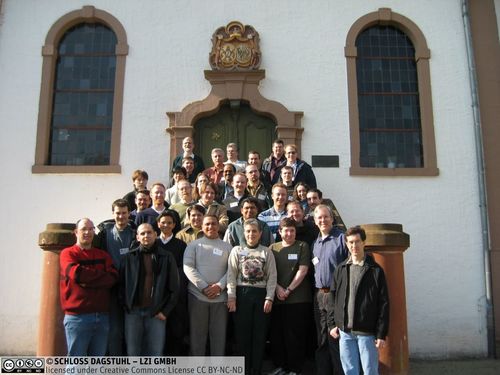
(Click in the middle of the image to enlarge)
Permalink
Please use the following short url to reference this page:
https://www.dagstuhl.de/03091
Organizers
- Ralph Johnson (University of Illinois - Urbana-Champaign, US)
- Gregor Snelting (Universität Passau, DE)
- Frank Tip (IBM TJ Watson Research Center - Hawthorne, US)
Contact
Sponsors
The Dagstuhl Foundation gratefully acknowledges the donation from
Maintenance and restructuring are activities that have traditionally been associated with "legacy" languages such as Cobol and PL/I. However, with the increasing use of object oriented languages for largescale industrial projects, the same activities are now often re quired in the objectoriented domain as well. But due to the complexity of advanced object oriented software development, existing techniques for maintenance and restructuring pro cedural programs are not adequate.
In order to tackle the challenges of objectoriented maintenance, the Dagstuhl seminar "Program Analysis for ObjectOriented Evolution'' brought together two groups of scientists: the program analysis community and the refactoring community. Program analysis has a long tradition and has recently been used extensively to support maintenance activities. Refactoring is a new approach to improve objectoriented designs by applying a sequence of semanticspreserving transformations.
The workshop featured a series of presentations about stateoftheart program analysis and refactoring technology, as well as extensive discussions about mutual benefit. As an overall result,
- Program analysis researchers now do understand current problems in evolution and restructuring of objectoriented programs. They do understand that the principle of conservative approximation, which is essential in traditional program analysis, can be softened in a refactoring context.
- Researchers in evolution and refactoring now do understand the possibilities provided by the stateoftheart in program analysis. They do understand that program analysis can provide the semantic guarantees needed for successful refactorings.
As a consequence, we expect many new research projects utilizing these insights. Some such projects have already been started. These projects open the door for safer and more powerful refactorings, providing more reliable and efficient evolution of objectoriented sys tems.
The workshop featured 30 presentations. There were 4 outstanding keynote presentations on program analysis and refactoring. The other talks presented ongoing research. Two discussion sessions culminated in a collection of open research topics. Half of the talks were given by young scientists (graduate students or postdocs). These young researchers had excellent opportunity to discuss their work with the more senior participants, thus obtaining many valuable insights. About half of the participants (and more than half of the young researchers) were from Europe.
- Uwe Aßmann (TU Dresden, DE) [dblp]
- Rastislav Bodik (University of California - Berkeley, US) [dblp]
- Paulo Borba (Federal University of Pernambuco - Recife, BR) [dblp]
- Robert Bowdidge (Apple Computer Inc. - Cupertino, US) [dblp]
- Marcio Cornelio (Federal University of Pernambuco - Recife, BR) [dblp]
- Serge Demeyer (University of Antwerp, BE) [dblp]
- Julian Dolby (IBM TJ Watson Research Center, US) [dblp]
- Stéphane Ducasse (Universität Bern, CH) [dblp]
- Robert Fuhrer (IBM TJ Watson Research Center - Hawthorne, US)
- Alejandra Garrido (University of Illinois - Urbana-Champaign, US) [dblp]
- Jan Hannemann (University of British Columbia - Vancouver, CA)
- Laurie J. Hendren (McGill University - Montreal, CA) [dblp]
- Ralph Johnson (University of Illinois - Urbana-Champaign, US)
- Adam Kiezun (MIT - Cambridge, US)
- Günter Kniesel (Universität Bonn, DE)
- Jochen Kreimer (Universität Paderborn, DE)
- Shriram Krishnamurthi (Brown University - Providence, US) [dblp]
- Michele Lanza (University of Lugano, CH) [dblp]
- Yanhong Annie Liu (SUNY - Stony Brook, US)
- David Melski (GrammaTech Inc. - Ithaca, US) [dblp]
- Erhard Plödereder (Universität Stuttgart, DE) [dblp]
- Christian W. Probst (Technical University of Denmark - Lyngby, DK) [dblp]
- Ganesan Ramalingam (IBM TJ Watson Research Center, US) [dblp]
- Derek Rayside (MIT - Cambridge, US)
- Atanas Rountev (Ohio State University - Columbus, US)
- Barbara G. Ryder (Rutgers University - Piscataway, US) [dblp]
- Peter H. Schmitt (KIT - Karlsruher Institut für Technologie, DE) [dblp]
- Gregor Snelting (Universität Passau, DE) [dblp]
- Sergio Soares (Federal University of Pernambuco - Recife, BR)
- Max Störzer (Universität Passau, DE)
- Mirko Streckenbach (Universität Passau, DE)
- Tim Teitelbaum (Cornell University, US) [dblp]
- Frank Tip (IBM TJ Watson Research Center - Hawthorne, US) [dblp]
- Chris Verhoef (VU University Amsterdam, NL)
- Alexander Wißpeintner (TU München, DE)
- Andreas Zeller (Universität des Saarlandes, DE) [dblp]
- Wolf Zimmermann (Martin-Luther-Universität Halle-Wittenberg, DE)
Keywords
- Refactoring
- program analysis
- objectoriented programming
- software evolution