
Dagstuhl Seminar 02081
Algorithmic Combinatorial Game Theory
( Feb 17 – Feb 22, 2002 )
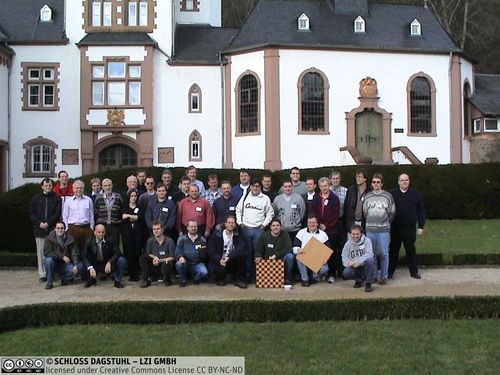
(Click in the middle of the image to enlarge)
Permalink
Please use the following short url to reference this page:
https://www.dagstuhl.de/02081
Organizers
- Erik D. Demaine (MIT - Cambridge, US)
- Rudolf Fleischer (Fudan University - Shanghai, CN)
- Aviezri S. Fraenkel (Weizmann Institute - Rehovot, IL)
- Richard J. Nowakowski (Dalhousie University - Halifax, CA)
Contact
Impacts
- Algorithmic combinatorial game theory : special issue - Fleischer, Rudolf H.; Nowakowski, Richard J - Amsterdam : Elsevier, 2004 - (Theoretical computer science : 313. 2004, 3, S. 313-546).
- Error propagation in game trees : article : S. 79-93 - Doerr, Benjamin; Lorenz, Ulf - Berlin : Springer, 2006 - (Mathematical methods of operations research ; 64. 2006, 1, S. 79-93).
- It is tough to be a plumber : article : S. 473-484 - Kral, Daniel; Majerech, Vladan; Tichy, Tomas; Woeginger, Gerhard J. - Amsterdam : Elsevier, 2004 - (Theoretical computer science : 313. 2004, 3 : S. 473-484). DOI: 10.1016/j.tcs.2002.12.002.
- Open problems at the 2002 Dagstuhl seminar on algorithmic combinatorial game theory : appendix B : article : S. 539 - 543 - Demaine, Erik D.; Fleischer, Rudolf H.; Fraenkel, Aviezri S.; Nowakowski, Richard J. - Amsterdam : Elsevier, 2004 - (Theoretical computer science : 313. 2004, 3 : S. 539-543).
- The liar game over an arbitrary channel : article : S. 537-559 - Dumitriu, Ioana; Spencer, Joel H. - Berlin : Springer, 2005 - (Combinatorica : 25. 2005, 5 : S. 537 - 559). DOI: 10.1007/s00493-005-0033-3.
Games are as old as humanity. The combinatorial game theory community has studied games extensively, resulting in powerful tools for their analysis, like the notion of game-theoretic value. This theory provides a high-level understanding of how to play combinatorial games, but to completely solve specific games requires algorithmic techniques. So far, algorithmic results are rare and mainly negative, e.g., the proofs that Chess and Go are EXPTIME-complete. There are also some positive results on endgames of Go and on various classes of impartial games. But most games lie in "Wonderland4, i.e., we are wondering about their complexity/efficiency. (We are not normally interested in exhaustive approaches like the recent world-class computer players for Checkers and Chess.)
The two large communities of combinatorial game theory and algorithmics rarely interact. This is unfortunate. Game theory could benefit from applying algorithmic techniques to games with known outcomes but no known efficient strategies, e.g., Hex and poset games such as Chomp. On the other hand, better knowledge of the game-theoretic tools could help researchers in algorithmics to develop more efficient or more general algorithms for games whose complexity is barely known, e.g., Hex and Chomp and epidemiography games such as Nimania. Maybe the game-theoretic framework can even be extended to non combinatorial games, like geometric games.
There has been a recent surge of interest in algorithmic combinatorial game theory from both communities. The goal of this seminar is to bring these two communities together, to advance the area of algorithmic combinatorial game theory from infancy to maturity. We will invite a few keynote speakers from both communities; so far, Elwyn Berlekamp has confirmed his participation.
- Helmut Alt (FU Berlin, DE) [dblp]
- Ingo Althöfer (Universität Jena, DE)
- Cyril Banderier (MPI für Informatik - Saarbrücken, DE)
- Malgorzata Bednarska (University of Poznan, PL)
- Elwyn Berlekamp (University of California - Berkeley, US)
- Erik D. Demaine (MIT - Cambridge, US) [dblp]
- Martin Demaine (MIT - Cambridge, US)
- Benjamin Doerr (Christian-Albrechts-Universität zu Kiel, DE) [dblp]
- Ioana Dumitriu (MIT - Cambridge, US)
- Kimmo Eriksson (Mälardalen University - Vasterås, SE)
- Ulrich Faigle (Universität Köln, DE)
- Sándor Fekete (TU Braunschweig, DE) [dblp]
- Rainer Feldmann (Universität Paderborn, DE)
- Rudolf Fleischer (Fudan University - Shanghai, CN) [dblp]
- Aviezri S. Fraenkel (Weizmann Institute - Rehovot, IL)
- J.P. Grossman (Halifax NS, CA)
- Robert A. Hearn (MIT - Cambridge, US)
- Michael Hoffmann (ETH Zürich, CH) [dblp]
- Thomas Hofmeister (TU Dortmund, DE)
- Markus Holzer (TU München, DE) [dblp]
- Walter Kern (University of Twente, NL)
- Daniel Král' (Charles University - Prague, CZ) [dblp]
- Howard A. Landman (Fort Collins, US)
- Alejandro Lopez-Ortiz (University of Waterloo, CA) [dblp]
- Ulf Lorenz (Universität Paderborn, DE)
- Tomasz Luczak (Adam Mickiewicz University - Poznan, PL) [dblp]
- Wolfgang Merkle (Universität Heidelberg, DE) [dblp]
- Burkhard Monien (Universität Paderborn, DE)
- Martin Müller (University of Alberta - Edmonton, CA) [dblp]
- Ian Munro (University of Waterloo, CA) [dblp]
- Jürg Nievergelt (ETH Zürich, CH)
- Richard J. Nowakowski (Dalhousie University - Halifax, CA)
- Stefan Pickl (Universität Köln, DE) [dblp]
- Jörg Sameith (Universität Jena, DE)
- Stefan Schwarz (Universität Jena, DE)
- Jiri Sgall (Czech Academy of Sciences - Prague, CZ) [dblp]
- Wolfgang Slany (TU Wien, AT)
- Raymond Georg Snatzke (Universität Jena, DE)
- Joel Spencer (New York University, US) [dblp]
- Theodore Tegos (University of Alberta - Edmonton, CA)
- Tomas Tichy (Czech Academy of Sciences - Prague, CZ)
- John Tromp (CWI - Amsterdam, NL)
- Jos Uiterwijk (Maastricht University, NL)
- Gerhard J. Woeginger (TU Eindhoven, NL) [dblp]
- David Wolfe (Gustavus Adolphus College - St. Peter, US)
- Uri Zwick (Tel Aviv University, IL) [dblp]