
Dagstuhl-Perspektiven-Workshop 09402
Democracy in a Network Society
( 27. Sep – 02. Oct, 2009 )
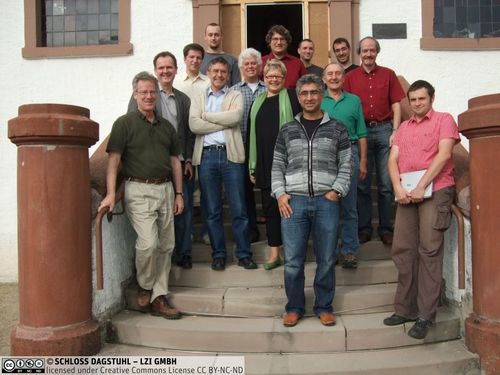
(zum Vergrößern in der Bildmitte klicken)
Permalink
Bitte benutzen Sie folgende Kurz-Url zum Verlinken dieser Seite:
https://www.dagstuhl.de/09402
Organisatoren
- David Chaum (Sherman Oaks, BE)
- William H. Dutton (University of Oxford, GB)
- Miroslaw Kutylowski (Wroclaw University of Technology, PL)
- Tracy Westen (Center for Governmental Studies - Los Angeles, US)
Kontakt
Presse/News
Impacts
- Dagstuhl Manifesto : Democracy in a Network Society : pp. 326-329 - Kutylowski, Miroslaw - Berlin : Springer, 2011 - (Informatik Spektrum : 34. 2011, 3 : pp. 326-329).
- Machiavelli Confronts 21st Century Digital Technology : Democracy in a Network Society - Baer, Walter S.; Borisov, Nikita; Danezis, George; Dutton, William H.; Gürses, Seda F.; Klonowski, Marek; Kutylowski, Miroslaw; Maier-Rabler, Ursula; Moran, Tal; Pfitzmann, Andreas; Preneel, Bart; Sadeghi, Ahmad-Reza; Vedel, Thierry; Westen, Tracy; Zagors - Oxford : Oxford Internet Institute, 2009.
- Elektronische Demokratie - Wie das Internet die Politik beeinflusst
Von Thomas Reintjes, Interviews mit Seminarteilnehmern, Deutschlandfunk, 3.10.2009 - Bundestag ohne Papier? - Grenzen für den Technikeinsatz in Parlament und Verwaltung
Wissenschaftsjournalist Thomas Reintjes im Gespräch mit Manfred Kloiber, Deutschlandfunk, 3.10.2009 - Elektronische Demokratie - Wie das Internet die Politik beeinflusst
Podcast der Beiträge im Deutschlandfunk am 3.10.2009; von Thomas Reintjes - Die Grenzen der elektronischen Demokratie
Press Release 15.09.2009 (German only)
The workshop was a meeting forum for experts in the area of computer security and social sciences. The main idea of the seminar was to discuss new challenges for democracy during the transition from traditional society into a society where network communication influences so much social and political life.
The workshop participants discussed the key issues behind success or failure of electronic systems in e-democracy. While advances of technology play a central role in evolution of e-democracy, the main threats and failures are due to insufficient collaboration and lack of understanding among technologists, social scientists, public officials and other stakeholders.due to insufficient In the past, major failures can be attributed to a narrow view of the systems supporting e-democracy. For this reason many fundamental mistakes have been made.
Some major problems arise when technical sciences and social sciences meet. On the one hand, computer specialists are often unaware of real requirements for the emerging systems, on the other hand the specialists from social sciences might be unaware of technical limitations due to hermetic language of computer security professionals. Nevertheless, the workshop participants succeeded immediately in building up a working group focused on identifying the most crucial issues for development of future e-democracy systems.
The result of the workshop is a set of recommendations for decision-makers regarding e-democracy systems. The list does not consider all problems that may arise, but brings focus to those that in our opinion have the biggest impact.
- Encourage Interdisciplinary Collaboration. Severe design errors may result from making decisions based on partial expertise, or from separate groups working in isolation. As design processes for technologies used in democratic systems should include a wide range of competencies, it is vital that lawyers, public officials and social scientists are engaged as well as computer scientists and engineers. Unfortunately, the workshop participants observe that this is not a common practice today and many fundamental errors in the past resulted from partial expertise.
- Ensure Effective Take-up of E-democracy Solutions. At present, government-driven processes (like elections, disclosure of information) are often so conservative that they fail to take full advantage of new technologies and approaches, despite that they have proved effective elsewhere. The reason for this phenomenon is a discrepancy between available solutions that are ready to use and specific requirements of e-democracy. Substantial amount of research is necessary to adapt emerging technologies to meet the diverse requirements of e-democracy.
- Deploy Appropriate Design Models. The lesson we have learnt during the last decades is that the really successful systems are in practice the flexible ones that were not designed by a single organization but have instead developed through collaborative efforts of many participants driven by their interests and needs. Therefore we feel that new technical systems supporting e-democracy should be small, flexible, modular and based on proven off-the-shelf technical components, rather than be large, centralized special-purpose systems.
- Promote Best Practice. There are examples of excellent solutions which are implemented and used in practice. However, dissemination of such best practices is limited. A survey should be conducted of best practices. This is particularly important for making government information accessible online inexpensively, efficiently and in forms that are easy to use by the public. Today, inefficient access to information is one of the major weaknesses of democracies, despite many efforts. Pilot projects should then be funded to implement these best practices in a number of different jurisdictions. Information on best practices and pilot projects should be made available to the public in easily accessible formats.
- Support Open-Audit Systems. Research on electronic voting systems has shown that our approach to security assurance should be redefined. Traditional certification by trusted bodies should be continued, however in order to provide undeniable evidence open-audit concepts should be developed. In particular, current field trials of open-audit voting systems should be carefully assessed and documented. When they are successful, larger-scale trials should be encouraged.
- Learn from Web 2.0 Innovations. Public officials and system designers should draw on the experience of Web-based social networks. There are substantial technical and social challenges related to Web 2.0, but there are opportunities as well. This should be taken into account when planning online systems for democratic decision making.
- Address Conflicting Requirements. Quite often, requirements for e-democracy systems are in conflict. A prominent example are e-voting systems, which have to provide strong privacy of vote casting and voters' identification at the same time. Since according to the present state-of-the-art the answers for many fundamental questions are still missing, more research should be directed towards new technologies that have the potential to reconcile between such conflicting requirements. This concerns in particular privacy enhancing technologies, identity management and cryptographic protocols.
- Gain Public Acceptance. One of preconditions for introducing technical systems supporting democratic processes is gaining understanding, acceptance and confidence by the lay, non-scientific public. A failure to do so would immediately undermine the citizens' will to engage in the process. Therefore technical solutions for e-democracy that support democratic processes should be made simple enough, or must be so widely endorsed by the scientific community and other trusted societal leaders. Democratic technologies should be designed with widespread public acceptance as a key design parameter.
- Fund Civic Engagement Experiments. Since in the field of e-democracy we are entering unknown grounds, a lot can be learned from examples. For this reason, governments should be encouraged to fund experimentations with technologies that support greater online civic engagement in democratic processes (voting, information acquisition, collaborative participation in government decisions). On the one hand, such government funding will encourage technological research as well as provide computer scientists with the priorities they require. On the other hand, these experimentations will allow the citizens to influence design evolution so that it goes in the right direction.
- Share Knowledge Between Disciplines. Lack of interaction and sometimes even barriers for interdisciplinary work is one of the main risk factors for development of e-systems supporting democracy. Therefore, various contributions made by different disciplines to e-democracy development can be strengthened through forums that encourage (not only verbally) dialogue between multidisciplinary groups of computer and social scientists, legal scholars, practitioners and policy experts.
For more about results of the seminar see the article in Social Sciences Research Network Machiavelli Confronts 21st Century Digital Technology: Democracy in a Network Society published by the workshop participants.
- Walter Baer (USC Annenberg - Los Angeles, US)
- Nikita Borisov (University of Illinois - Urbana Champaign, US) [dblp]
- George Danezis (Microsoft Research UK - Cambridge, GB) [dblp]
- William H. Dutton (University of Oxford, GB)
- Seda F. Gürses (KU Leuven, BE) [dblp]
- Marek Klonowski (Wroclaw University of Technology, PL)
- Miroslaw Kutylowski (Wroclaw University of Technology, PL)
- Ursula Maier-Rabler (Universität Salzburg, AT)
- Tal Moran (Harvard University - Cambridge, US)
- Andreas Pfitzmann (TU Dresden, DE)
- Bart Preneel (KU Leuven, BE) [dblp]
- Ahmad-Reza Sadeghi (TU Darmstadt, DE) [dblp]
- Thierry Vedel (CEVIPOF SciencesPo - Paris, FR)
- Tracy Westen (Center for Governmental Studies - Los Angeles, US)
- Filip Zagórski (Wroclaw University of Technology, PL)
Klassifikation
- security
- cryptography
- society
- HCI
- Interdisciplinary with non-informatics-topic: legal and social problems
- political sciences
Schlagworte
- e-democracy
- legal models
- political models
- privacy enhancing technologies
- privacy threats
- authentication
- digital identity
- malware
- malicious cryptography
- usability
- social effects